Last updated: August 30, 2026
Texas has one of the largest and most fragmented hospital markets in the country. If you sell into health systems, recruit clinical staff, or manage vendor relationships with hospitals, finding a working phone number or email for the right decision maker is often harder than it should be. Staff turnover, decentralized org charts, and inconsistent public directories all get in the way.
This guide covers what a hospital decision-maker contact list actually includes, who tends to use one, the practical limits of any third-party data source, and how Heartbeat.ai approaches sourcing and verifying this kind of data for Texas.
What’s on this page:
Get a Hospital Decision-Makers List for Texas from Heartbeat
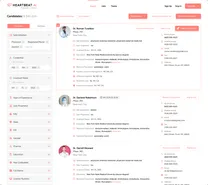
Heartbeat.ai’s platform lets you search and filter licensed healthcare professionals and hospital leadership across the United States, including Texas. You can narrow results by role, specialty, location, and other filters, then pull verified contact details for outreach.
Titles that typically show up in a hospital decision-makers dataset include:
- Hospital CEOs and other executive leadership
- Department head nurses, who often influence supply and equipment selection
- Pharmacy directors, involved in pharmaceutical purchasing and vendor agreements
- Administrative directors overseeing day-to-day operations
- IT department heads responsible for technology infrastructure decisions
- Procurement officers who manage equipment and service purchasing
- Radiology directors involved in imaging equipment and service decisions
Not every hospital labels these roles the same way, and smaller facilities may combine several of them into one position. That variation is one reason a curated list, rather than a generic directory scrape, tends to save more time than it costs.
Texas Healthcare Market Overview
Texas has over 650 hospitals, making it one of the largest hospital markets in the U.S., with a population that exceeds 30 million. Hospital counts vary depending on how a source defines “active hospital” — some counts include specialty and rehab facilities, others focus only on general acute care — so treat any single figure as an approximation rather than a fixed number.
Major academic and specialty centers such as MD Anderson Cancer Center, UT Southwestern Medical Center, and Baylor University Medical Center anchor much of the state’s specialized care and research activity, alongside large regional systems like Texas Health Resources and Memorial Hermann. These systems tend to have more layered decision-making structures than independent community hospitals, which matters when you’re deciding who to target first.
Why Accurate Contact Information Matters
Bad contact data isn’t just an inconvenience — it compounds. A few concrete costs:
- Recruitment: A stale email for a department head means a recruiter’s outreach never reaches the person who can actually approve a hire, delaying fills for open clinical roles.
- Vendor and sales outreach: Sending a pitch to a generic hospital info@ address instead of the procurement officer usually means it gets filtered before anyone relevant sees it.
- Networking: Professional relationships in healthcare often depend on timely follow-up. A wrong number or bounced email can quietly end an opportunity before it starts.
Why This Data Is Hard to Find and Keep Current
A few structural issues make hospital decision-maker lists in Texas harder to compile than they look:
- Turnover: Leadership and department-head roles change hands more often than public directories get updated.
- Fragmented sources: Contact information is scattered across hospital websites, licensing boards, conference bios, and professional networks, with no single authoritative source.
- Scale: With hundreds of hospitals across the state, manually verifying contacts one by one isn’t realistic for most teams.
- Data privacy rules: Healthcare organizations operate under strict handling requirements, which limits what gets published openly in the first place.
Technology helps close some of this gap. CRM systems keep a working record of who you’ve reached and when. Data platforms that pull from multiple public and licensed sources, then apply verification and matching logic, can catch role changes faster than manual research. None of this makes a list permanently accurate — healthcare staffing changes too often for that — but it reduces how quickly a list goes stale.
What a Heartbeat Hospital Decision-Makers List Includes
Heartbeat.ai’s database is built specifically for healthcare outreach and can be filtered down to a single state, region, or facility type. A typical record includes:
- Name
- Location
- Contact numbers (work, cell, mobile)
- Email address
- Specialization
- Years of experience
- Sole proprietor status
- Licensed states
- License number
- Fax
- Address
Available Hospital Decision-Makers Lists by State
Browse hospital decision-maker contact data for other states below.
| Hospital decision makers lists by states |
|---|
| Hospital decision makers lists in Alabama |
| Hospital decision makers lists in Alaska |
| Hospital decision makers lists in Arizona |
| Hospital decision makers lists in Arkansas |
| Hospital decision makers lists in California |
| Hospital decision makers lists in Colorado |
| Hospital decision makers lists in Connecticut |
| Hospital decision makers lists in Delaware |
| Hospital decision makers lists in Florida |
| Hospital decision makers lists in Georgia |
| Hospital decision makers lists in Hawaii |
| Hospital decision makers lists in Idaho |
| Hospital decision makers lists in Illinois |
| Hospital decision makers lists in Indiana |
| Hospital decision makers lists in Iowa |
| Hospital decision makers lists in Kansas |
| Hospital decision makers lists in Kentucky |
| Hospital decision makers lists in Louisiana |
| Hospital decision makers lists in Maine |
| Hospital decision makers lists in Maryland |
| Hospital decision makers lists in Massachusetts |
| Hospital decision makers lists in Michigan |
| Hospital decision makers lists in Minnesota |
| Hospital decision makers lists in Mississippi |
| Hospital decision makers lists in Missouri |
| Hospital decision makers lists in Montana |
| Hospital decision makers lists in Nebraska |
| Hospital decision makers lists in Nevada |
| Hospital decision makers lists in New hampshire |
| Hospital decision makers lists in New jersey |
| Hospital decision makers lists in New mexico |
| Hospital decision makers lists in New york |
| Hospital decision makers lists in North carolina |
| Hospital decision makers lists in North dakota |
| Hospital decision makers lists in Ohio |
| Hospital decision makers lists in Oklahoma |
| Hospital decision makers lists in Oregon |
| Hospital decision makers lists in Pennsylvania |
| Hospital decision makers lists in Rhode island |
| Hospital decision makers lists in South carolina |
| Hospital decision makers lists in South dakota |
| Hospital decision makers lists in Tennessee |
| Hospital decision makers lists in Texas |
| Hospital decision makers lists in Utah |
| Hospital decision makers lists in Vermont |
| Hospital decision makers lists in Virginia |
| Hospital decision makers lists in Washington |
| Hospital decision makers lists in West virginia |
| Hospital decision makers lists in Wisconsin |
| Hospital decision makers lists in Wyoming |
How This Data Gets Compiled
Heartbeat.ai pulls from a wide range of official, public, and licensed sources to build and maintain healthcare professional records, then applies matching and verification logic to keep entries current as people change roles or facilities. No contact database — Heartbeat’s included — can guarantee 100% accuracy at any given moment, since hospital staff turnover happens continuously. What a well-maintained platform can do is shorten the gap between a role change and when that change shows up in your data, and flag records that need re-verification.
Who Uses a Hospital Decision-Makers Contact List
This kind of list gets used by a fairly broad set of people: business development teams selling equipment or services into hospitals, recruiters filling clinical and administrative roles, medical device and pharma reps building relationships with purchasing decision makers, researchers gathering industry data, and nonprofit or association staff doing outreach to hospital leadership. Regardless of use case, outreach should stay within applicable data privacy and communication regulations — this list is a sourcing tool, not a substitute for compliance review.
Using the List Effectively
A few practical guidelines for outreach to hospital decision makers:
- Segment by role before you write copy — a message to a CEO and a message to a procurement officer shouldn’t read the same.
- Keep initial outreach short. Decision makers in hospital settings are managing full schedules and clinical responsibilities.
- Reference something specific to the facility or department when possible; generic mass outreach gets ignored faster in this sector than in most others.
- Respect HIPAA and other applicable privacy rules in how you store and use contact data — this applies to the outreach content itself, not just patient information.
- Re-verify contacts periodically rather than assuming a list stays accurate indefinitely.
Bottom Line
Texas’s hospital market is large, decentralized, and constantly shifting at the leadership level. A curated, regularly maintained contact list won’t be perfect, but it narrows the gap between “who should I talk to” and “how do I reach them” far more efficiently than manual research across hundreds of individual hospital websites.
Frequently Asked Questions
What are hospital decision makers?
Hospital decision makers are individuals within a hospital or health system responsible for choices around policy, budgeting, staffing, purchasing, and operations — ranging from executive leadership to department-level directors.
How many hospitals are in Texas?
Estimates vary by source and methodology, but Texas is consistently ranked as the state with the most hospitals in the country, generally cited in the range of 650 to 750-plus facilities depending on how “active hospital” is defined.
Why does accurate contact data matter for hospital outreach?
Reaching the wrong person, or a disconnected number or bounced email, wastes outreach cycles and can cost recruiters and vendors real opportunities, since hospital purchasing and hiring decisions are typically made by specific named roles rather than general departments.
What information is typically included in a hospital decision-makers list?
Typical fields include name, job title, facility, location, phone numbers, email address, and sometimes licensing or specialty details, depending on the data provider.