Last updated: August 31, 2026
Tennessee has a large, geographically uneven healthcare workforce, and nurse practitioners fill a lot of the gaps — especially in rural counties where physician coverage is thin. For anyone recruiting, marketing to, or coordinating with NPs in the state, the practical challenge isn’t finding that NPs exist. It’s finding current, working contact details for the right ones.
This page covers what makes Tennessee’s NP landscape distinct, why contact data goes stale faster than people expect, and how a data provider like Heartbeat fits into a recruiting or outreach workflow.
What’s on this page:
Nurse practitioners in Tennessee’s healthcare system
Tennessee is home to major academic and referral centers — Vanderbilt University Medical Center, Baptist Memorial Hospital, and the University of Tennessee Medical Center among them — alongside a dense network of rural clinics, critical access hospitals, and community health centers. NPs work across all of these settings, in roles ranging from primary care to acute and specialty care.
One detail matters more in Tennessee than in many other states: Tennessee requires nurse practitioners to work under a collaborative practice agreement with a licensed physician in order to practice and prescribe. Nurse Practitioners (NPs) in Tennessee are required to establish a Collaborative Practice Agreement (CPA) with a licensed physician to practice and obtain prescriptive authority, as mandated by the Tennessee Board of Nursing. This isn’t a formality — the supervising physician must visit the supervisee’s site of practice every 30 days and review 20% of the supervisee’s charts.
For recruiters and outreach teams, this has a practical implication: an NP’s professional situation in Tennessee is often tied to a specific collaborating physician and practice site, and that relationship can shift when either party changes jobs. That’s one reason contact records for Tennessee NPs can go out of date faster than in full-practice-authority states, where NPs operate more independently of a fixed physician relationship.
Why accurate contact data matters here specifically
Three groups depend on accurate NP contact information for different reasons:
- Recruiters and staffing teams need current direct numbers and emails to fill roles quickly, particularly in understaffed rural areas where delays compound existing coverage gaps.
- Vendors and healthcare marketers need verified contacts so outreach doesn’t get wasted on bounced emails or disconnected lines.
- Peer networks and referral partners rely on working contact info for care coordination and professional collaboration.
A wrong number or a defunct email address isn’t just an inconvenience — it delays hiring timelines, wastes outreach budget, and in a state with real provider shortages in certain counties, it slows down efforts to actually address those gaps.
What makes finding Tennessee NPs harder than it should be
A few structural factors make this data harder to keep current:
- Uneven distribution. Nashville, Memphis, and Knoxville have concentrated provider density; many rural counties do not, which means recruiting outreach often needs to reach smaller, harder-to-find practices.
- Collaborative agreement turnover. Because Tennessee NPs must maintain an active collaborating physician relationship, changes in that relationship can also mean a change in practice site, employer, or contact channel.
- Growing demand. An aging population and rising rates of chronic disease increase the need for primary and specialty NP capacity, which keeps hiring pipelines active and contact lists in flux.
Telehealth has helped stretch NP capacity across distance, letting one practitioner support patients in multiple locations remotely. That’s useful for care delivery, but it doesn’t simplify the data problem — if anything, it adds more potential points of contact (a home office, a clinic line, a telehealth platform) that need to be tracked and verified.
How Heartbeat’s Tennessee NP contact data can help
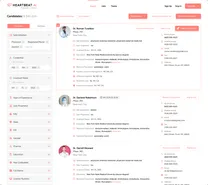
Whether you’re looking for family, pediatric, psychiatric-mental health, women’s health, or oncology nurse practitioners, Heartbeat.ai’s database lets you filter by specialty, location, and license status to build a targeted contact list for Tennessee providers.
Records in the database typically include:
- Nurse practitioner name
- Location
- Contact numbers (work, cell, mobile)
- Email address
- Specialization
- Years of experience
- Sole proprietor status
- Licensed states
- License number
- Fax
- Address
A simple workflow for using this data
- Define the specialty and geography. Are you hiring for a rural clinic in East Tennessee, or filling a specialty role in Nashville? Narrowing this first cuts down wasted outreach.
- Filter by license and experience level. Verify the license is active in Tennessee before reaching out — this avoids contacting someone who’s moved states or let a certification lapse.
- Cross-check contact freshness. Given how often collaborative agreements and practice sites change, treat any contact record older than a few months with some caution and verify before a formal outreach push.
- Personalize the outreach. Generic mass emails get ignored. Reference the specialty, setting, or specific need relevant to that NP.
- Track response and update records. Feed back what you learn — bounced emails, disconnected numbers, job changes — so future outreach doesn’t repeat the same mistakes.
Nurse practitioners by state
Browse contact list availability for nurse practitioners in other states:
| Nurse practitioners by states |
|---|
| Nurse practitioners in Alabama |
| Nurse practitioners in Alaska |
| Nurse practitioners in Arizona |
| Nurse practitioners in Arkansas |
| Nurse practitioners in California |
| Nurse practitioners in Colorado |
| Nurse practitioners in Connecticut |
| Nurse practitioners in Delaware |
| Nurse practitioners in Florida |
| Nurse practitioners in Georgia |
| Nurse practitioners in Hawaii |
| Nurse practitioners in Idaho |
| Nurse practitioners in Illinois |
| Nurse practitioners in Indiana |
| Nurse practitioners in Iowa |
| Nurse practitioners in Kansas |
| Nurse practitioners in Kentucky |
| Nurse practitioners in Louisiana |
| Nurse practitioners in Maine |
| Nurse practitioners in Maryland |
| Nurse practitioners in Massachusetts |
| Nurse practitioners in Michigan |
| Nurse practitioners in Minnesota |
| Nurse practitioners in Mississippi |
| Nurse practitioners in Missouri |
| Nurse practitioners in Montana |
| Nurse practitioners in Nebraska |
| Nurse practitioners in Nevada |
| Nurse practitioners in New hampshire |
| Nurse practitioners in New jersey |
| Nurse practitioners in New mexico |
| Nurse practitioners in New york |
| Nurse practitioners in North carolina |
| Nurse practitioners in North dakota |
| Nurse practitioners in Ohio |
| Nurse practitioners in Oklahoma |
| Nurse practitioners in Oregon |
| Nurse practitioners in Pennsylvania |
| Nurse practitioners in Rhode island |
| Nurse practitioners in South carolina |
| Nurse practitioners in South dakota |
| Nurse practitioners in Tennessee |
| Nurse practitioners in Texas |
| Nurse practitioners in Utah |
| Nurse practitioners in Vermont |
| Nurse practitioners in Virginia |
| Nurse practitioners in Washington |
| Nurse practitioners in West virginia |
| Nurse practitioners in Wisconsin |
| Nurse practitioners in Wyoming |
Who typically uses this kind of contact list
NP contact lists get used across a range of legitimate business needs: healthcare staffing and recruiting, medical device and pharma sales outreach, professional association communication, and B2B service marketing aimed at practices and clinics. Whatever the use case, responsible use means respecting opt-out requests and applicable privacy and communication regulations — treating the list as a tool for relevant, professional outreach rather than mass unsolicited contact.
Practical tips for outreach that actually lands
- Lead with something specific to the recipient’s specialty or setting — generic pitches get filtered out fast.
- Keep messages short; NPs in active clinical roles have limited time to read cold outreach.
- Use the channel that fits the purpose — a direct cell number for time-sensitive recruiting, email for informational or promotional content.
- Always give an easy way to opt out, and honor it immediately.
Bottom line
Tennessee’s NP workforce is large and varied, but its collaborative-practice structure and uneven geographic distribution mean contact information changes more often than a static directory can keep up with. Whether you’re recruiting for a rural clinic or building a specialty-focused outreach list, working from a data source that’s actively maintained — and verifying before a big push — will save more time than any single list feature.
Frequently Asked Questions
What is the role of nurse practitioners in Tennessee?
Nurse practitioners in Tennessee provide primary and specialty healthcare services, including diagnosing conditions, prescribing medications, and educating patients, typically operating under a collaborative practice agreement with a physician.
What are the requirements to become a nurse practitioner in Tennessee?
Candidates generally complete a Bachelor of Science in Nursing (BSN), obtain an RN license, complete a Master of Science in Nursing (MSN) or equivalent graduate degree with an NP specialization, pass a national certification exam, and obtain a Tennessee nurse practitioner certificate of fitness from the Board of Nursing.
Where can I find nurse practitioners in Tennessee?
Tennessee NPs work in hospitals, clinics, private practices, community health centers, and increasingly through telehealth platforms serving rural or underserved areas.
What is the scope of practice for nurse practitioners in Tennessee?
A nurse practitioner must file a notice with the board naming the collaborating physician who has control and responsibility for prescriptive services rendered by the nurse practitioner. Within that framework, NPs diagnose and treat common illnesses, order and interpret diagnostic tests, and prescribe medications, but Tennessee is a reduced/restricted practice state rather than a full-practice-authority one.