Last updated: August 30, 2026
Massachusetts recruiters and healthcare marketers trying to reach nurse practitioners run into a familiar problem: job boards and LinkedIn searches turn up outdated titles, old employers, and generic office lines that never reach the actual clinician. A working list of direct emails and mobile numbers solves a lot of that friction, but only if the data is current and verified against how NPs actually practice in this state.
This page covers what the Massachusetts NP landscape looks like, why contact accuracy matters more here than in some other states, and how a contact database like Heartbeat’s fits into a realistic outreach or recruiting workflow.
What’s on this page:
Nurse Practitioner Scope of Practice in Massachusetts
Massachusetts permanently empowers nurse practitioners to practice independently and to the full extent of their education and training after two years of supervised practice with a physician. This became law when Governor Charlie Baker signed An Act Promoting a Resilient Health Care System That Puts Patients First, making Massachusetts the 23rd state in the nation to pass full practice authority legislation for nurse practitioners.
That’s a meaningful detail for anyone building outreach campaigns or recruiting pitches: full practice authority means many Massachusetts NPs can run their own practice, sign their own leases, and make independent hiring and purchasing decisions without a physician co-signing every step. A vendor pitch or recruiting message written for a heavily supervised NP workforce will misread the audience here.
Worth noting for anyone doing deeper research: a 2024 qualitative study in Nursing Outlook examined how full practice authority has actually played out on the ground in Massachusetts, since payer policies must align with state law to fully implement full practice authority. In practice, some NPs report that billing and credentialing systems haven’t fully caught up with the legal change. That gap matters if your outreach involves anything tied to reimbursement, credentialing services, or EHR tools.
Why Accurate Contact Data Matters More for This Specialty
Three practical reasons accurate NP contact data pays off:
- Recruitment speed. Positions in primary care, gerontology, psychiatric-mental health, and pediatric NP roles often sit open longer when recruiters rely on stale directories. A wrong email or disconnected number means a lost week, sometimes longer, before a recruiter even realizes the message never landed.
- Independent practice owners are harder to find through traditional channels. Because Massachusetts NPs can practice independently after their supervised period, some run solo clinics or small group practices that don’t show up in hospital directories at all. A database built from licensing and public records tends to catch these providers more reliably than a scrape of hospital staff pages.
- Specialty targeting reduces wasted outreach. Family NPs, psychiatric-mental health NPs, and women’s health NPs have different day-to-day priorities. Segmenting a list by specialty, rather than blasting one generic message to every NP in the state, tends to get better response rates.
Common Roadblocks in Massachusetts NP Recruiting
Recruiters and marketers working this market typically run into a few recurring issues:
- Hospital directory listings that lag behind actual staffing by months.
- NPs who’ve moved from supervised to independent practice and changed their business email or phone in the process.
- Rural and Western Massachusetts facilities that have smaller digital footprints than the major Boston-area hospital systems, making them harder to research manually.
- Generic contact forms on practice websites that route messages to office staff rather than the clinician.
None of these are unique to Massachusetts, but the state’s independent-practice environment adds a wrinkle: independent NPs are more likely to be reachable by direct email or cell than by a hospital switchboard, which changes how outreach should be structured from the start.
What a Nurse Practitioner Contact List Typically Includes
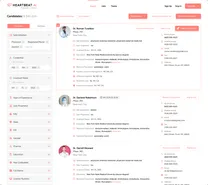
A usable NP contact list for Massachusetts should give you more than a name and a guess at an email address. Look for records that include:
- Nurse practitioner name
- Location and practice address
- Contact numbers (work, cell, mobile)
- Email address
- Specialization (family, pediatric, gerontology, psychiatric-mental health, women’s health, and others)
- Years of experience
- Sole proprietor status
- Licensed states
- License number
- Fax
How Heartbeat Builds Its Nurse Practitioner Contact Data
Heartbeat compiles healthcare provider contact records from more than 200 official, private, and public sources, then applies predictive modeling to fill in and verify direct contact details where public records are incomplete. The platform reports coverage across more than 11 million U.S. healthcare professionals, including direct cell numbers and personal emails, with predictive-modeling accuracy rates that Heartbeat states at roughly 84% for cell phone numbers and 92% for personal emails.
Those figures come from Heartbeat’s own reporting on its database and should be treated as vendor-stated performance rather than independently audited benchmarks — worth confirming directly with Heartbeat if accuracy rates are a deciding factor for your use case.
Who Actually Uses These Lists
In practice, Massachusetts NP contact data gets used by a narrower group than the generic “anyone doing outreach” framing suggests:
- Healthcare staffing agencies filling permanent or locum NP roles
- Medical device and pharmaceutical sales teams targeting specific specialties
- Continuing education providers promoting certification or CE courses
- Professional associations recruiting members or conference attendees
- Researchers distributing surveys to a defined NP population
Whatever the purpose, outreach to healthcare professionals should respect applicable spam and privacy regulations, including opt-out mechanisms for email and any relevant telemarketing rules for phone outreach. This is B2B contact data for professional purposes, not a channel for anything resembling patient solicitation or medical advice.
A Quick Workflow for Using a Massachusetts NP List
- Define the specialty and role you actually need — a generic “NP list” wastes time compared to filtering by specialization and independent-practice status up front.
- Segment by practice setting: hospital-employed NPs generally respond better to different messaging than independent-practice owners.
- Start outreach with a short, specific message tied to a real need (an open role, a relevant CE credit, a product update) rather than a broad introduction.
- Track response and bounce rates by segment so you can tell whether a list source needs refreshing.
- Re-verify contact data periodically — license renewals, practice moves, and job changes make static lists degrade over time.
Nurse Practitioners by State
Explore contact list availability for nurse practitioners across other states:
| Nurse practitioners by states |
|---|
| Nurse practitioners in Alabama |
| Nurse practitioners in Alaska |
| Nurse practitioners in Arizona |
| Nurse practitioners in Arkansas |
| Nurse practitioners in California |
| Nurse practitioners in Colorado |
| Nurse practitioners in Connecticut |
| Nurse practitioners in Delaware |
| Nurse practitioners in Florida |
| Nurse practitioners in Georgia |
| Nurse practitioners in Hawaii |
| Nurse practitioners in Idaho |
| Nurse practitioners in Illinois |
| Nurse practitioners in Indiana |
| Nurse practitioners in Iowa |
| Nurse practitioners in Kansas |
| Nurse practitioners in Kentucky |
| Nurse practitioners in Louisiana |
| Nurse practitioners in Maine |
| Nurse practitioners in Maryland |
| Nurse practitioners in Massachusetts |
| Nurse practitioners in Michigan |
| Nurse practitioners in Minnesota |
| Nurse practitioners in Mississippi |
| Nurse practitioners in Missouri |
| Nurse practitioners in Montana |
| Nurse practitioners in Nebraska |
| Nurse practitioners in Nevada |
| Nurse practitioners in New hampshire |
| Nurse practitioners in New jersey |
| Nurse practitioners in New mexico |
| Nurse practitioners in New york |
| Nurse practitioners in North carolina |
| Nurse practitioners in North dakota |
| Nurse practitioners in Ohio |
| Nurse practitioners in Oklahoma |
| Nurse practitioners in Oregon |
| Nurse practitioners in Pennsylvania |
| Nurse practitioners in Rhode island |
| Nurse practitioners in South carolina |
| Nurse practitioners in South dakota |
| Nurse practitioners in Tennessee |
| Nurse practitioners in Texas |
| Nurse practitioners in Utah |
| Nurse practitioners in Vermont |
| Nurse practitioners in Virginia |
| Nurse practitioners in Washington |
| Nurse practitioners in West virginia |
| Nurse practitioners in Wisconsin |
| Nurse practitioners in Wyoming |
Frequently Asked Questions
What is a nurse practitioner?
A nurse practitioner is a healthcare professional with advanced education and clinical training who can diagnose and treat illnesses, prescribe medications, and manage patient care.
Do nurse practitioners in Massachusetts need physician supervision?
Not after an initial supervised period. Massachusetts empowers nurse practitioners to practice independently and to the full extent of their education and training after two years of supervised practice with a physician. Some administrative and billing systems are still catching up to that legal change, so it’s worth confirming current arrangements with any individual practice.
How do I become a nurse practitioner in Massachusetts?
The typical path includes earning a Bachelor of Science in Nursing, passing the NCLEX-RN, gaining registered nurse experience, and completing a Master of Science in Nursing or Doctor of Nursing Practice program with a specialization in advanced practice nursing, followed by state licensure requirements.