Last updated: August 30, 2026
A therapist mailing list is only as useful as its accuracy. Outreach to mental health professionals — for referrals, recruiting, continuing education promotion, or vendor marketing — depends on having current, verified contact details rather than a scraped directory that goes stale within months.
This guide covers what a therapist email list typically contains, how providers like Heartbeat AI compile and maintain that data, the compliance issues you need to think through before sending, and practical ways to structure outreach so it doesn’t land as spam.

What’s on this page:
What’s Included in Heartbeat AI’s Therapist Email Lists
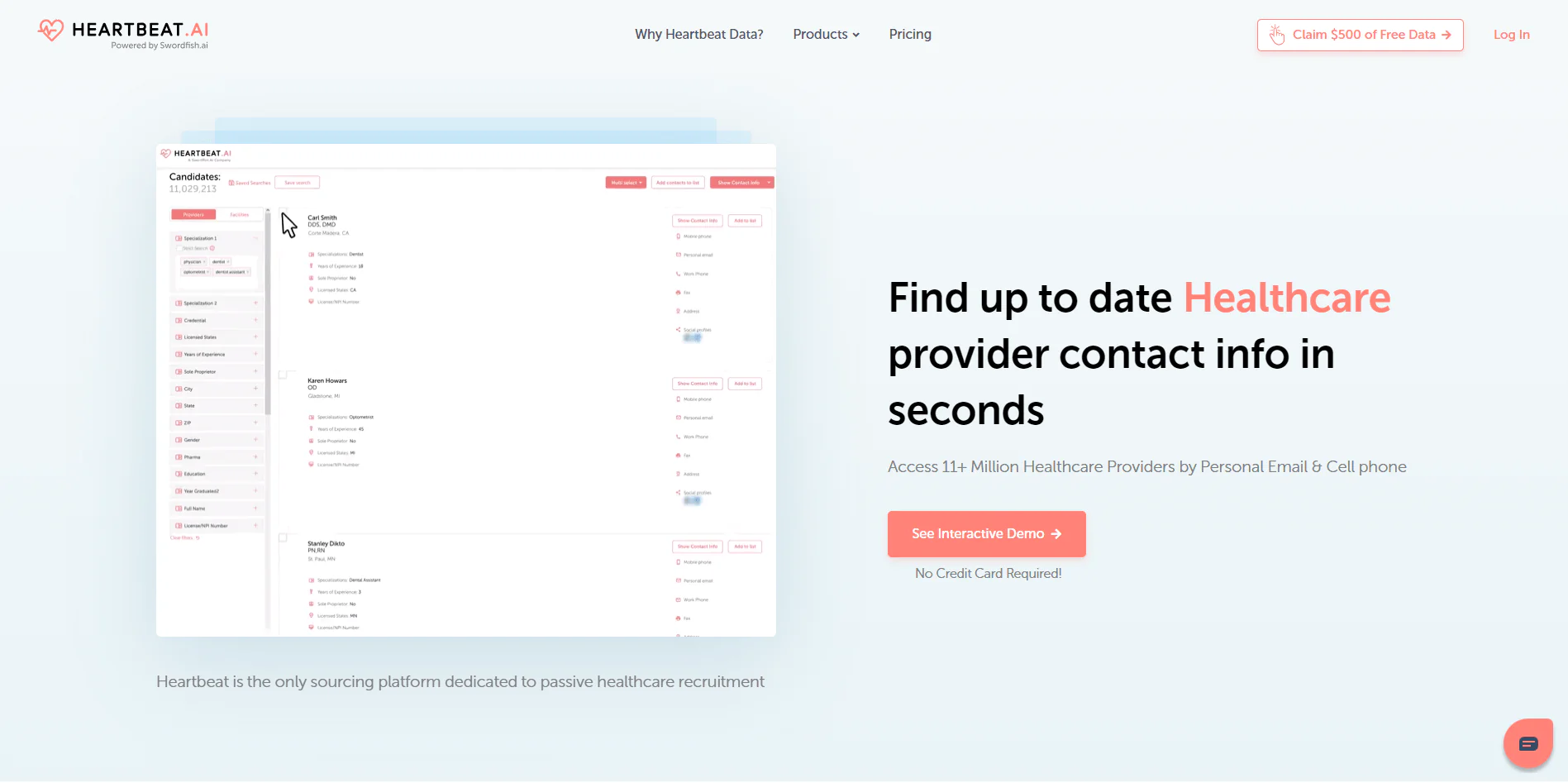
Heartbeat AI’s therapist contact data is built for targeted communication within the mental health services sector, whether you’re focused on a single state or the whole country.
- Email address inclusion: therapist contact records center on verified email addresses as the primary data point.
- Chrome extension: a Chrome extension lets you pull contact information directly from social profiles while sourcing candidates or contacts.
- Data enhancement: existing therapist databases can be enriched with missing contact fields to fill gaps in older or incomplete lists.
- Social profile integration: the platform connects with social profiles so you can access contact details without leaving your workflow.
- Privacy compliance: data handling is built around applicable privacy standards such as CCPA.
Typical Data Fields in a Therapist Email List
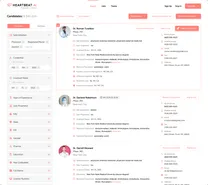
- Therapist name
- Location
- Contact numbers (work, cell, mobile)
- Email address
- Specialization
- Years of experience
- Sole proprietor status
- Licensed states
- License number
- Fax
- Address
 Accuracy & coverage of personal contact info were unrivaled by other platforms… this gives any healthcare recruiter a competitive advantage when engaging hard-to-reach healthcare providers.
Senior Growth Strategist






Why Data Accuracy Matters for Therapist Outreach
An accurate list changes what’s possible with your outreach — not just how many emails you send, but how relevant they are.
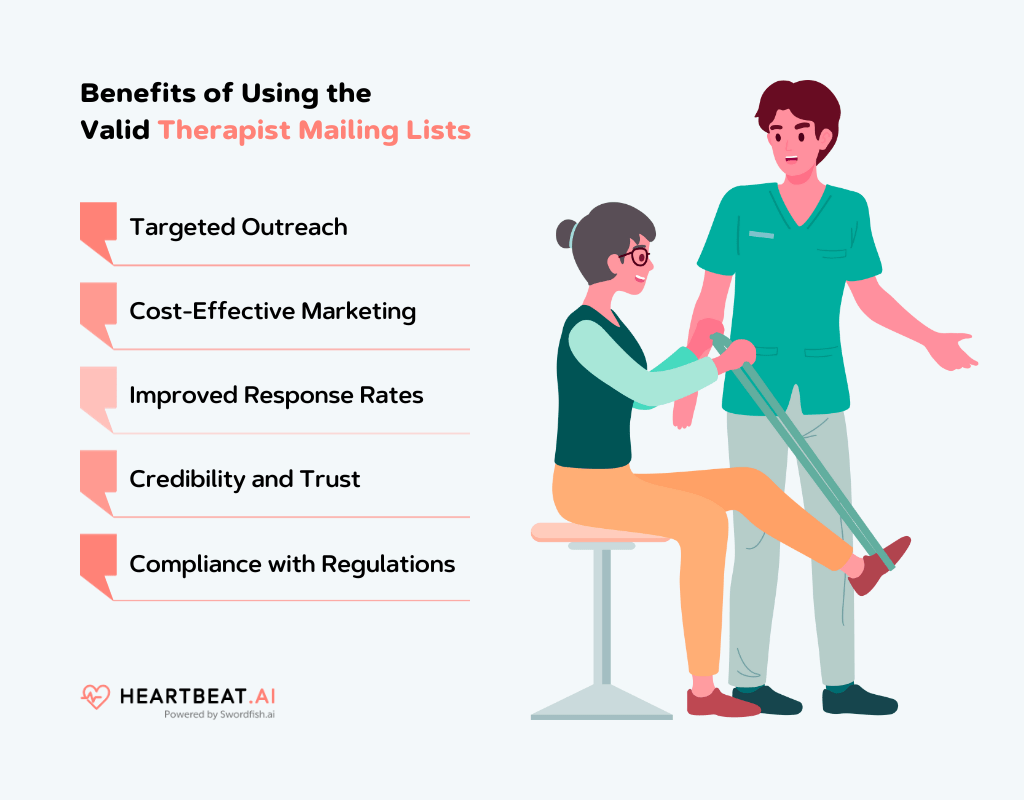
Targeted outreach
Filtering by location, specialty, or licensure means your message reaches therapists who actually fit your criteria, instead of a generic broadcast list.
Cost efficiency
Focusing budget on a precise, current list generally beats spreading the same budget across a broad, unfiltered one — fewer wasted sends, less time cleaning bounces.
Better response rates
Messages relevant to a therapist’s practice area or region tend to get more engagement than generic pitches sent to an entire database.
Credibility
A clean, well-maintained list signals professionalism. Sloppy, outdated data — wrong titles, bounced addresses, duplicate records — undermines trust before a conversation even starts.
Regulatory awareness
Working from a list of licensed professionals, sourced and used appropriately, reduces the risk of contacting the wrong person or violating email marketing rules.
Therapist Categories in the Database
The database spans a range of specialties within mental health professions.
Therapist Contacts Available by State
Coverage extends across every U.S. state.
How Heartbeat Compiles Therapist Contact Data
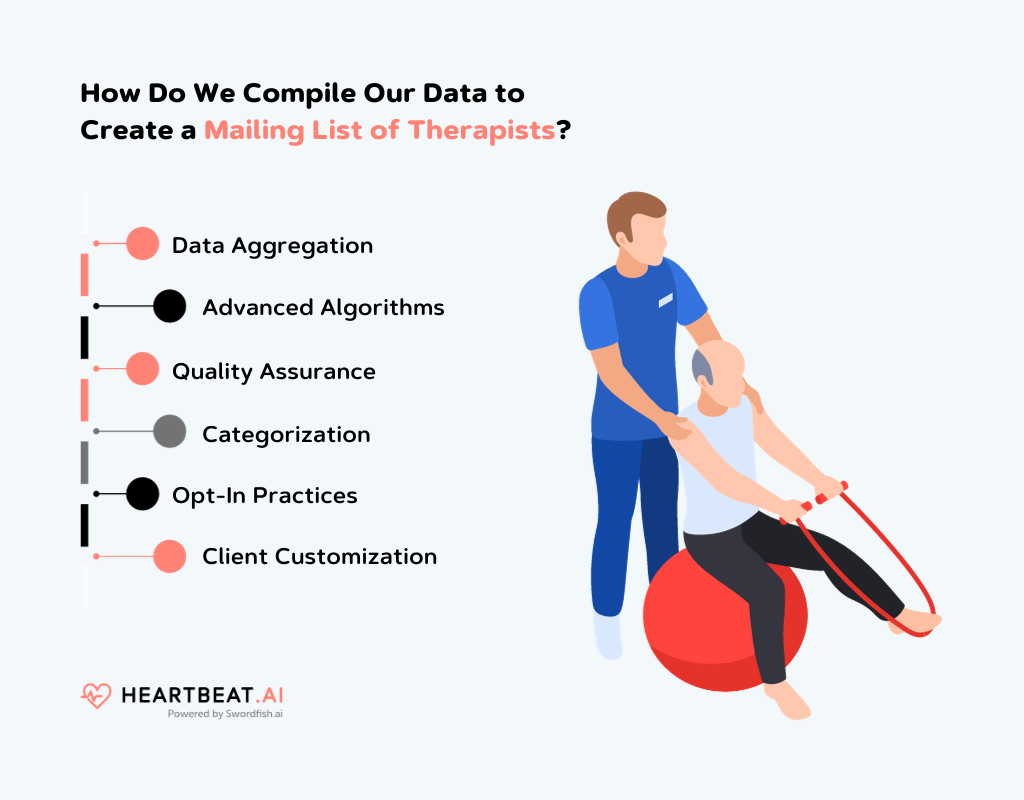
Data aggregation
Records draw from data partners, including online directories, professional associations, and public records — covering names, contact details, specialties, and practice locations.
Algorithmic matching
AI-driven processes scan and extract therapist-related information from websites, social profiles, and other public sources to keep the database current.
Quality checks
Records go through review to remove duplicates, correct errors, and confirm active status before they’re included in a list.
Categorization
Therapists are tagged by specialty, qualification, and geography so lists can be filtered to a specific outreach need rather than delivered as one flat file.
Sourcing practices
Priority goes to therapists who have made their information public through directories or professional listings, rather than through unauthorized scraping.
Customization
Lists can be shaped around a client’s specific criteria — specialty, state, experience level — instead of a one-size-fits-all export.
What to Check Before You Buy a Therapist Email List
Not every list vendor operates the same way, and a cheap list that bounces half its emails costs more in deliverability damage than it saves in price. Run through this before committing:
- Data accuracy and recency: ask how often records are refreshed and what verification process is used before a list ships.
- Audience specificity: confirm you can filter by specialty, state, or licensure rather than buying an undifferentiated national list.
- Legal compliance: check how the provider sources contact information and whether it aligns with applicable rules such as GDPR or the CAN-SPAM Act.
- Source reputation: a provider with a track record and transparent sourcing methodology carries less risk than an anonymous data broker.
- Consent and opt-in signals: lists built from professionals who’ve made their information publicly available generally perform better and draw fewer complaints than blind cold lists.
One limitation worth flagging directly: no third-party list, however well maintained, is permanently accurate. Therapists change practices, retire, or update licensure, so even a recently verified list will have some decay within months. Budget for periodic re-verification rather than treating a single purchase as a lifetime asset.
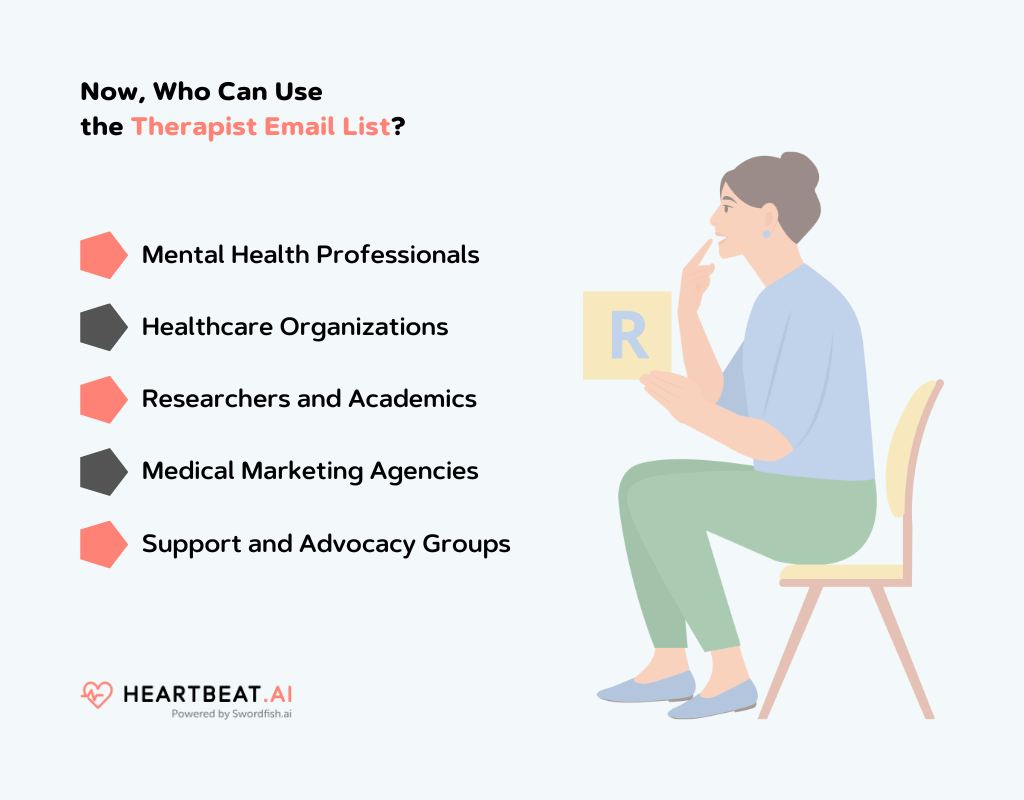
Who Typically Uses a Therapist Email List
Mental health professionals
Licensed therapists, psychologists, and counselors use these lists to connect with referral sources and build professional networks.
Healthcare organizations
Hospitals, clinics, and mental health centers use therapist contact data for recruiting and coordinating care partnerships.
Researchers and academics
Psychology and mental health researchers use therapist contacts to recruit participants for surveys or studies.
Healthcare marketing agencies
Agencies serving the mental health space use these lists to run targeted campaigns for products and services relevant to therapists’ practices.
Support and advocacy organizations
Non-profits use therapist contacts to recruit volunteers or build coalitions around advocacy initiatives.
Getting More Out of a Therapist Email List
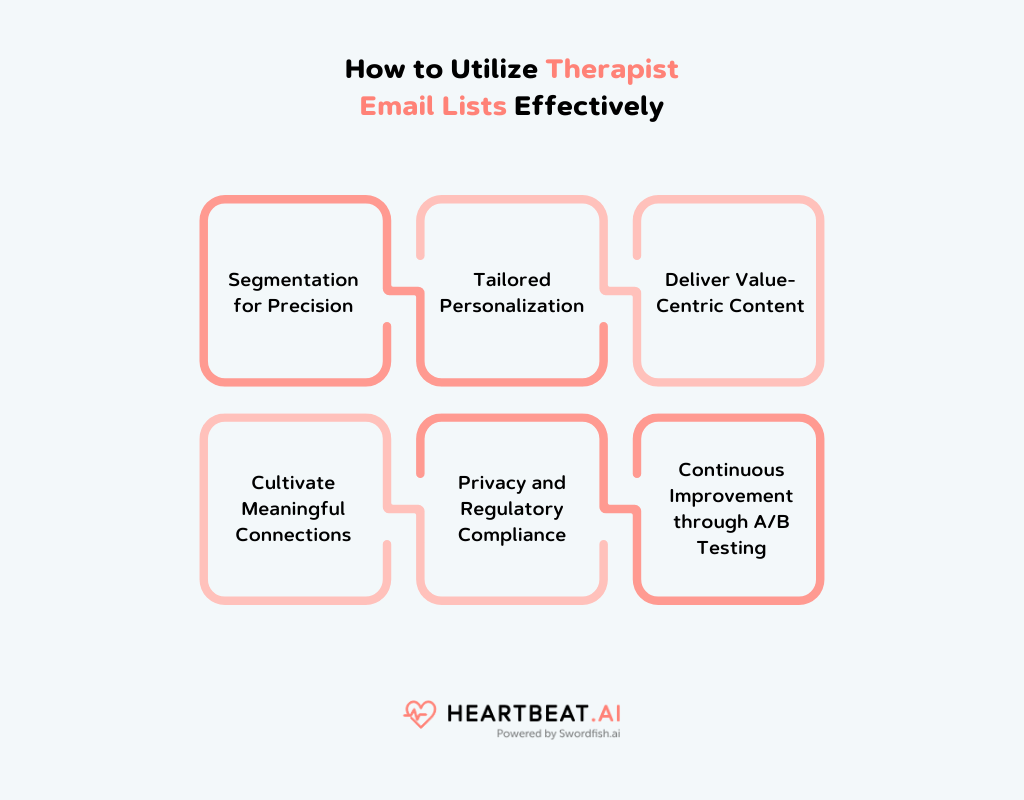
Segment before you send
Break the list into groups by location, specialty, or experience level. A generic blast to the entire file performs worse than three smaller, relevant sends.
Personalize beyond the first name
Reference a therapist’s specialty or region where it’s genuinely relevant. Templates that read as mass mail get ignored or reported.
Lead with something useful
Articles, resources, or invitations tied to therapeutic practice or industry trends give a recipient a reason to open the next email, not just this one.
Build the relationship, not just the send
A single email rarely converts. Following up with something concrete — a webinar invite, a relevant resource, a genuine question — does more than repeated pitches.
Stay inside compliance lines
Commercial email in the U.S. falls under the CAN-SPAM Act, which requires accurate sender information, non-deceptive subject lines, a working opt-out mechanism, and prompt processing of unsubscribe requests. If you’re reaching contacts outside the U.S., stricter consent-based rules like GDPR may also apply.
Test and refine
Track open and reply rates by segment, and adjust subject lines and content based on what actually gets a response from this specific audience — A/B testing works as well here as in any other outreach channel.
Bottom Line
A therapist email list is a tool, not a shortcut — its value comes down to how current the data is, how well it’s segmented, and whether your outreach respects both the recipient’s time and the applicable email rules. Used carelessly, a list burns trust fast; used with reasonable targeting and a bit of personalization, it can meaningfully shorten the path to a referral, a hire, or a partnership.
If you’re evaluating providers, ask specific questions about verification cadence, sourcing methods, and segmentation options before committing to a purchase.
Frequently Asked Questions
Can I segment the email list to target specific types of therapists?
Yes — most providers offer filtering by specialty, geographic location, or other relevant criteria so you’re not working from one undifferentiated file.
What are the legal considerations when using a therapist email list for marketing?
Commercial email to U.S. recipients must comply with the CAN-SPAM Act, which requires accurate header information, honest subject lines, and a working opt-out mechanism that’s honored promptly. If you’re contacting recipients in the EU, GDPR’s consent requirements may also apply.
Is the data in a therapist email list up-to-date and accurate?
Reputable providers verify and refresh contact records on a regular cycle, but no list stays perfectly current indefinitely — periodic re-verification is worth budgeting for.