Last updated: August 28, 2026

The American Hospital Association puts the current U.S. hospital count at roughly 6,100 facilities. That number looks stable on paper, but it says nothing about how often the people inside those buildings change roles, email domains, or phone extensions. Hospitals merge, physicians move between practices, and administrative staff turn over constantly. A list that was accurate last year can be stale today.
Building or buying a healthcare email list means dealing with that churn directly. Heartbeat AI focuses on collecting and refreshing contact data for healthcare organizations and professionals, pairing email addresses with phone numbers, mailing addresses, and license details so outreach teams aren’t stitching together information from five different sources.
What’s on this page:
What’s Included in a Heartbeat Healthcare Email List

Heartbeat AI compiles contact data for healthcare facilities and licensed professionals, giving sales, recruiting, and marketing teams a way to reach the right person without guessing at an email format or dialing a general switchboard.
- Contact accuracy focus: The platform is built around verifying cell phone numbers and personal emails rather than relying solely on general corporate addresses that may go unread.
- Bulk list generation: Lists can be generated at scale for institutions and individual professionals, filtered down to the segment you actually need.
- Flexible pricing: Heartbeat AI offers a range of pricing plans depending on volume and use case.
- More than just email: Records typically include phone numbers, mailing addresses, and license details alongside the email address itself.
Data Fields You’ll Typically See
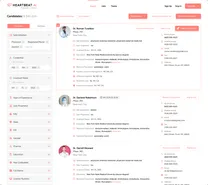
A healthcare contact record in Heartbeat’s database generally includes:
- Name of the healthcare professional or organization
- Location
- Contact numbers (work, cell, mobile)
- Email address
- Specialization
- Years of experience
- Sole proprietor status
- Licensed states
- License number
- Fax
- Mailing address
 Accuracy & coverage of personal contact info were unrivaled by other platforms… this gives any healthcare recruiter a competitive advantage when engaging hard-to-reach healthcare providers.
Senior Growth Strategist





Why a Verified List Matters More Than List Size

A large list full of bounced emails isn’t an asset — it’s a liability that hurts sender reputation and wastes budget. The real value shows up in a few specific areas.
Targeted Outreach
Segmenting by specialty, license state, or facility type means your message reaches people who can actually act on it, instead of a generic inbox that gets ignored.
Response Rates
Reaching a professional’s direct email or mobile number, rather than a front-desk line, tends to produce better response rates than blanket outreach to general contact addresses.
Cost Efficiency
Every bounced email or wrong number costs time and, in paid campaigns, money. Fewer bad records means your budget goes further per qualified contact.
Better Personalization
Accurate specialty and experience data lets you write messages that reference something relevant to the recipient’s actual practice, rather than a generic template.
Market Expansion
A well-organized database makes it easier to identify underserved regions or specialties you haven’t approached yet.
Healthcare Categories in the Database
Heartbeat AI’s healthcare data spans multiple facility and provider types, including:
| Healthcare Institutions by Category |
| Hospitals |
| Clinics |
| Physician Practices |
| Nursing Homes |
| Assisted Living Facilities |
| Ambulatory Surgical Centers (ASCs) |
| Rehabilitation Centers |
| Mental Health Facilities |
| Community Health Centers |
| Urgent Care Centers |
| Pharmacies |
| Diagnostic Centers |
| Research Institutions |
| Public Health Departments |
| Telehealth Providers |
| Primary Care Health Care |
Coverage by State
Heartbeat AI’s database spans all 50 states, letting you narrow outreach to a specific region without buying a national list you won’t fully use.
| Healthcare By States |
| Healthcare in Alabama |
| Healthcare in Alaska |
| Healthcare in Arizona |
| Healthcare in Arkansas |
| Healthcare in California |
| Healthcare in Colorado |
| Healthcare in Connecticut |
| Healthcare in Delaware |
| Healthcare in Florida |
| Healthcare in Georgia |
| Healthcare in Hawaii |
| Healthcare in Idaho |
| Healthcare in Illinois |
| Healthcare in Indiana |
| Healthcare in Iowa |
| Healthcare in Kansas |
| Healthcare in Kentucky |
| Healthcare in Louisiana |
| Healthcare in Maine |
| Healthcare in Maryland |
| Healthcare in Massachusetts |
| Healthcare in Michigan |
| Healthcare in Minnesota |
| Healthcare in Mississippi |
| Healthcare in Missouri |
| Healthcare in Montana |
| Healthcare in Nebraska |
| Healthcare in Nevada |
| Healthcare in New Hampshire |
| Healthcare in New Jersey |
| Healthcare in New Mexico |
| Healthcare in New York |
| Healthcare in North Carolina |
| Healthcare in North Dakota |
| Healthcare in Ohio |
| Healthcare in Oklahoma |
| Healthcare in Oregon |
| Healthcare in Pennsylvania |
| Healthcare in Rhode Island |
| Healthcare in South Carolina |
| Healthcare in South Dakota |
| Healthcare in Tennessee |
| Healthcare in Texas |
| Healthcare in Utah |
| Healthcare in Vermont |
| Healthcare in Virginia |
| Healthcare in Washington |
| Healthcare in West Virginia |
| Healthcare in Wisconsin |
| Healthcare in Wyoming |
How the Data Gets Compiled

Building a usable healthcare contact database isn’t a one-time export job — it’s an ongoing process.
Sourcing
Heartbeat AI pulls from 200+ data partners along with public and private records to assemble baseline contact information.
Technology-Assisted Matching
Matching algorithms cross-reference multiple data points to reduce duplicate or mismatched records before they reach a client list.
Ongoing Maintenance
Because providers change roles and organizations restructure, lists are refreshed on a recurring basis rather than compiled once and left static.
Customization
Filtering by specialty, experience level, city, or license state lets you build a list scoped to an actual campaign rather than working through an entire national file.
Choosing Between List Providers: What Actually Matters

Not every healthcare list vendor operates the same way, and the differences show up fast once a campaign launches. A few criteria worth checking before you buy:
- Verification cadence. Ask how often records are refreshed — quarterly maintenance behaves very differently than a list that was scraped once and never touched again.
- Depth of fields. A record with only a name and email forces you to do extra research later. Fields like license number, specialty, and years of experience save that step.
- Filtering granularity. Can you pull a list by specific specialty and state, or only by broad category?
- Source transparency. Vendors should be able to explain, at least generally, where contact data originates.
Coverage Claims
Heartbeat AI markets access to a large pool of U.S. healthcare professionals, including physicians, nurses, and physical therapists, though exact figures shift as the database is refreshed. Treat any specific headcount as a snapshot rather than a fixed number.
Search and Filtering
Filtering by location, license details, and years of experience narrows a broad database down to the segment relevant to a specific outreach goal, whether that’s recruiting, sales, or research partnerships.
What to Check Before You Buy a Healthcare Database

- Data breadth: Look for records that go beyond a single email field — phone numbers and mailing addresses reduce dependency on one channel.
- Regulatory awareness: Understand how the vendor’s data practices intersect with privacy expectations; HIPAA governs protected health information in clinical settings, and general business contact data used for B2B outreach is a separate category worth understanding clearly before you launch a campaign.
- Sourcing transparency: Data pulled from questionable or unclear sources creates deliverability and compliance risk down the line.
- Update frequency: A directory that isn’t refreshed regularly degrades in value every month it sits unused.
- Security practices: Ask how contact records are stored and who can access them internally at the vendor.
Who Actually Uses a Healthcare Email List

- Medical professionals connecting with colleagues or exploring new opportunities.
- Healthcare administrators coordinating across facilities or vendors.
- Marketers running targeted campaigns for products or services relevant to specific specialties.
- Recruiters sourcing candidates for clinical or administrative roles.
- Researchers looking for collaborators or study participants in academia or clinical trials.
- Suppliers and service providers selling equipment, software, or services into healthcare organizations.
A Practical Workflow for Using the List

A list is only as useful as the process around it. Here’s a straightforward sequence for putting one to work.
- Define the objective first. Recruiting, product marketing, and research outreach call for different messaging and different segments — decide which before you pull a list.
- Segment by criteria that matter to your campaign. Location, specialty, and experience level are common starting points.
- Write for the segment, not the whole list. A message tailored to a specialty performs differently than a generic blast.
- Lead with something useful. Relevant resources or specific, on-topic information tend to get a better reception than a straight pitch.
- Build in compliance from the start. Understand how HIPAA and general email marketing regulations (like CAN-SPAM) apply to your specific use case before sending anything at scale.
- Design for mobile. Most recipients will open on a phone first, so test how the email renders there.
- Honor opt-outs immediately. A visible, working unsubscribe link isn’t optional — it protects deliverability and keeps you compliant.
Limitations Worth Knowing
No contact database, including Heartbeat’s, is perfectly current at every moment. Providers change jobs, retire, or move between states, and any list reflects a point in time. Treat verification rates as directional rather than absolute, and build a habit of checking bounce and response data after each campaign to catch drift early.
The Bottom Line
Assembling accurate healthcare contact data takes ongoing verification, not a single import. Heartbeat AI’s approach — combining email, phone, and license data with regular refreshes — is built to reduce the manual cleanup that comes with outdated directories.
Whether you’re recruiting, marketing, or coordinating research, matching your list to a clear segment and keeping your messaging relevant will do more for response rates than list size alone.
FAQs
What is Heartbeat AI’s healthcare email directory?
It’s a database containing contact information for healthcare professionals and institutions, including hospitals, physicians, and nurses, built for networking, recruiting, and outreach purposes.
Is the healthcare email list customizable?
Yes. You can filter by criteria such as medical specialty, geographic location, and years of professional experience to target outreach more precisely.
Can this list be used for research collaboration?
Yes, it can help connect with healthcare professionals for research partnerships, though any outreach involving patient data still falls under HIPAA and related privacy rules.