


What’s on this page:
Key takeaways
- A physician email list is most useful when its records are accurate, current, and segmented for the outreach.
- Physician records can become outdated as doctors change roles, locations, specialties, or affiliations.
- The article describes filtering physician contacts by attributes such as specialty, title, hospital affiliation, and location.
- The article recommends targeted, relevant messaging, a reasonable send cadence, and a clear opt-out.
- The article identifies clinical research recruitment, event promotion, job postings, product education, and CRM enrichment as possible uses.
Last updated: August 28, 2026

A physician email list is only useful if it connects the right message to the right doctor at the right time. For marketers, recruiters, and hospital teams, that means the value isn’t in the raw count of contacts but in how accurate, current, and well-segmented those contacts are.
Physicians, for their part, rely on relevant professional email to stay current on treatments, research, and industry news. When outreach is targeted and compliant, both sides benefit. When it isn’t, the result is wasted budget, spam complaints, and damaged sender reputation.
Building an accurate physician contact database is difficult. Doctors change hospitals, add specialties, retire, or move states, so records can become outdated without active maintenance. Heartbeat says its physician data is designed to address this challenge.
About Heartbeat Physician Email Lists: What You Will Get
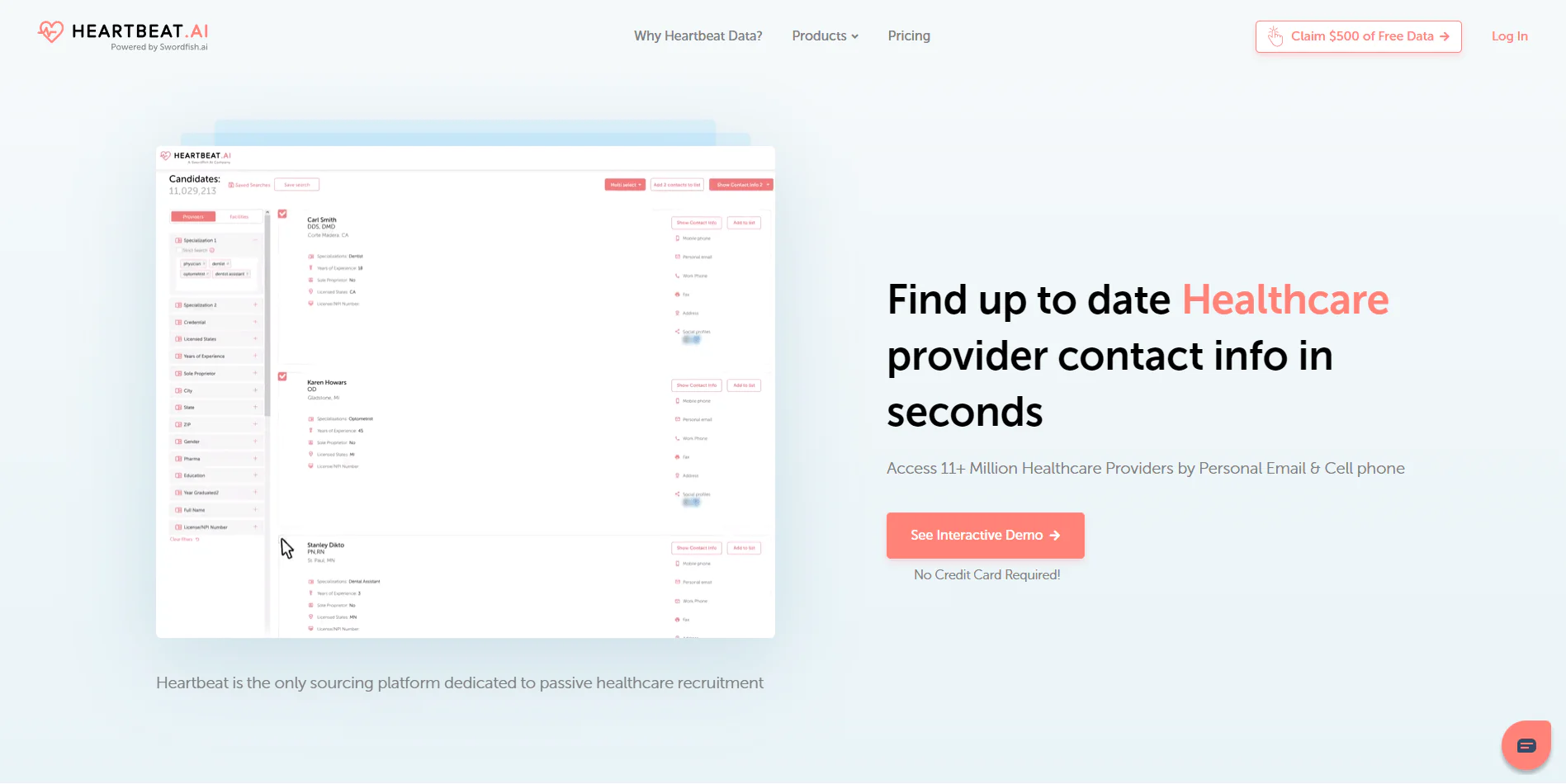
The Heartbeat physician email database draws from a large pool of licensed doctors across specialties and practice settings. The goal is to put your message directly in front of the healthcare decision-makers who matter to your campaign.
A typical B2B physician email list from Heartbeat includes:
- Contact details: names, locations, phone numbers, and email addresses.
- State-level context: useful when regulations, licensing requirements, or regional trends affect how you approach outreach.
- National coverage: for campaigns that need reach across the U.S. rather than a single region.
- Specialization data: cardiology, pediatrics, and other fields are tagged so you can filter by area of practice.
- Regularly refreshed records: physician data changes constantly, so ongoing updates matter more than a one-time snapshot.
Types of Data Included in a Physician Mailing List
- Physician name
- Location
- Contact numbers (work, cell, mobile)
- Email address
- Specialization
- Years of experience
- Sole proprietor status
- Licensed states
- License number
- Fax
- Address

Accuracy & coverage of personal contact info were unrivaled by other platforms… this gives any healthcare recruiter a competitive advantage when engaging hard-to-reach healthcare providers.
Senior Growth Strategist



Claim $500 of Free Data
Trusted by



Benefits of Using Valid Physician Mailing Lists
Tracking physician careers across states and specialties over time is difficult to do manually. Data hygiene and consent tracking therefore matter as much as list size. A well-maintained physician email list can support:
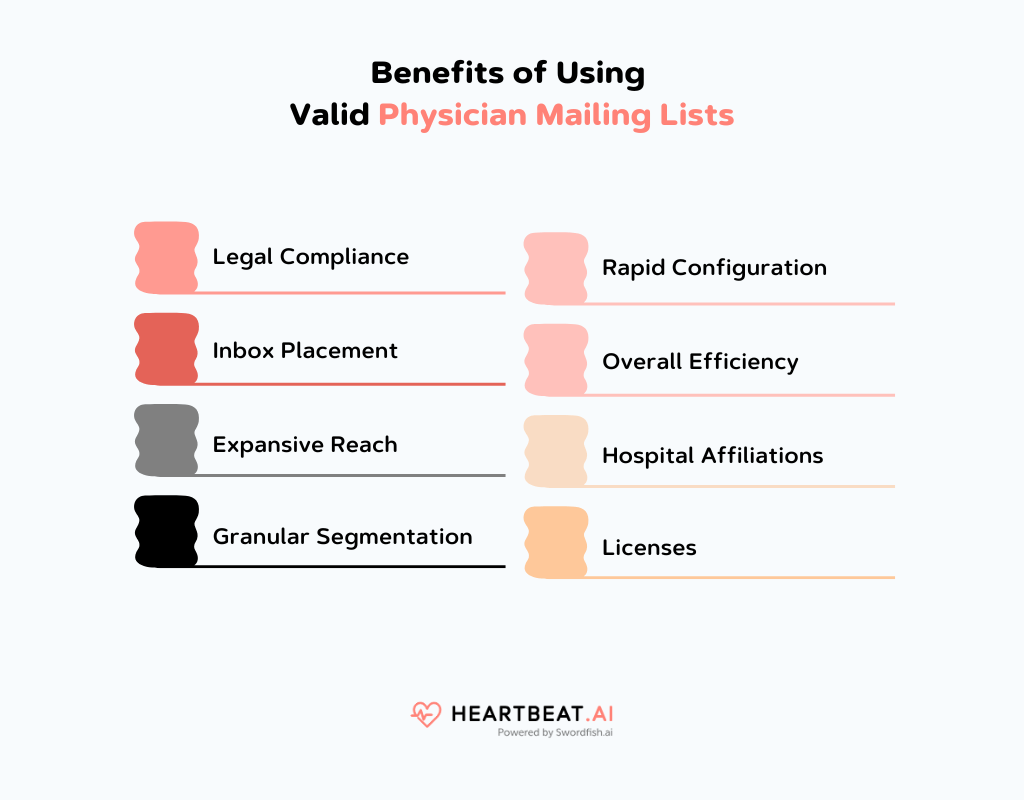
- Legal compliance: validated opt-in status reduces the risk of violations and helps maintain physician trust.
- Inbox placement: verified addresses cut down on bounces and deliverability problems.
- Broader reach: primary care and specialty physicians in one dataset expand campaign options.
- Granular segmentation: filtering by specialty, title, language, or hospital affiliation supports precise targeting.
- Faster setup: CRM and marketing automation integration lets you scale personalized outreach without manual list building.
- Fewer wasted sends: a validated foundation cuts down on misdirected messages and spam-filter flags.
- Hospital affiliations: network membership data tied to major medical systems.
- License data: state and medical board license status.
Consider exploring related datasets, such as the Physician Recruiters Email List and the Medical Geneticist Email List.
Who Are You Likely to See in Our Physician Email List by Category?
| Physician Categories |
| Primary Care Physicians |
| Specialists |
| Surgeons |
| Emergency Medicine Physicians |
| Obstetricians/Gynecologists (OB/GYNs) |
| Pediatricians |
| Psychiatrists |
| Anesthesiologists |
| Radiologists |
| Pathologists |
| Ophthalmologists |
| Otolaryngologists |
| Dermatologists |
| Orthopedic Surgeons |
| Cardiologists |
| Gastroenterologists |
Available Physician in Our Email List by States
The physician email list includes categories organized by state.
| Physician By States |
| Physician in Alabama |
| Physician in Alaska |
| Physician in Arizona |
| Physician in Arkansas |
| Physician in California |
| Physician in Colorado |
| Physician in Connecticut |
| Physician in Delaware |
| Physician in Florida |
| Physician in Georgia |
| Physician in Hawaii |
| Physician in Idaho |
| Physician in Illinois |
| Physician in Indiana |
| Physician in Iowa |
| Physician in Kansas |
| Physician in Kentucky |
| Physician in Louisiana |
| Physician in Maine |
| Physician in Maryland |
| Physician in Massachusetts |
| Physician in Michigan |
| Physician in Minnesota |
| Physician in Mississippi |
| Physician in Missouri |
| Physician in Montana |
| Physician in Nebraska |
| Physician in Nevada |
| Physician in New Hampshire |
| Physician in New Jersey |
| Physician in New Mexico |
| Physician in New York |
| Physician in North Carolina |
| Physician in North Dakota |
| Physician in Ohio |
| Physician in Oklahoma |
| Physician in Oregon |
| Physician in Pennsylvania |
| Physician in Rhode Island |
| Physician in South Carolina |
| Physician in South Dakota |
| Physician in Tennessee |
| Physician in Texas |
| Physician in Utah |
| Physician in Vermont |
| Physician in Virginia |
| Physician in Washington |
| Physician in West Virginia |
| Physician in Wisconsin |
| Physician in Wyoming |
How Do We Compile Our Data to Create a Mailing List of Physicians?
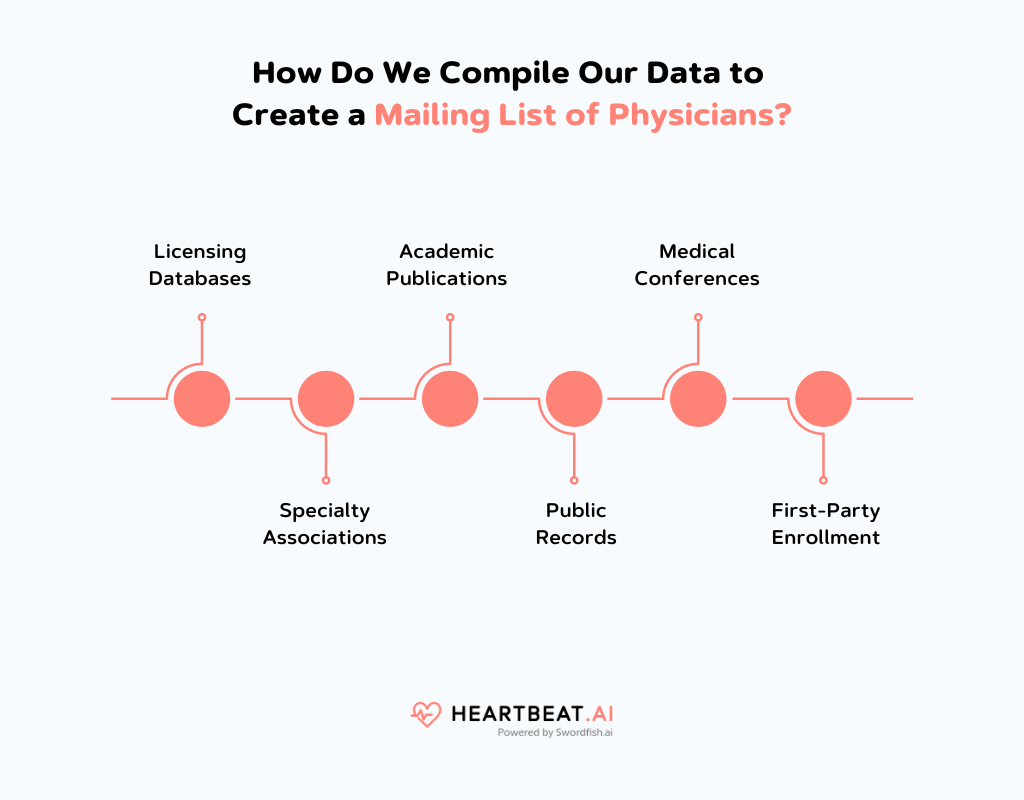
Heartbeat relies on a multi-source verification approach rather than a single static list. We draw on verified data sources to cross-check physician records as careers progress.
- Licensing databases: state medical boards confirm practicing credentials.
- Specialty associations: rosters from groups like the AMA and specialty colleges provide additional validation.
- Academic publications: university faculty directories help verify affiliations.
- Public records: data from CMS, NIH, and other agencies supports accuracy checks.
- Medical conferences: direct physician engagement helps confirm and update profiles.
- First-party enrollment: physician self-service portals let individuals manage and correct their own records.
No single source is complete or fully current on its own — that’s the limitation of any physician database, including this one. Cross-referencing multiple sources reduces error rates but doesn’t eliminate them, which is why ongoing re-verification matters more than a one-time compile.
Why Choose Heartbeat’s Physician Mailing Lists?
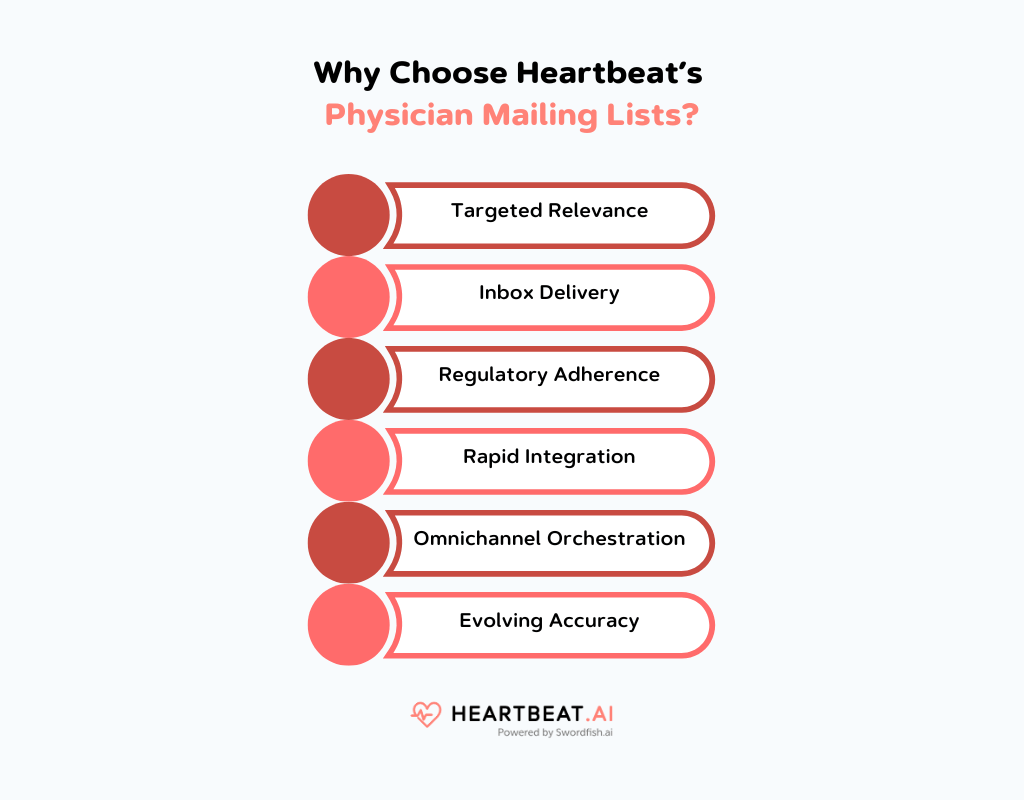
Reaching physicians in a crowded inbox takes more than volume. It takes accuracy, targeting discipline, and respect for consent. Here’s what that looks like in practice:
Targeted relevance
Filtering by specialty, title, hospital affiliation, and similar attributes keeps messages aligned with what each recipient actually cares about, rather than a generic blast.
Inbox delivery
Verified data and ongoing checks help protect sender reputation, which affects whether your messages land in the inbox or the spam folder.
Regulatory awareness
Healthcare-related B2B email marketing in the U.S. generally falls under the CAN-SPAM Act rather than HIPAA, since HIPAA governs protected health information rather than commercial sender-to-provider outreach. B2B marketing and sales communications to healthcare providers fall under CAN-SPAM, while communications containing patient data fall under HIPAA. Under CAN-SPAM, senders must use truthful headers, accurate subject lines, ad disclosure, a valid physical postal address, a clear opt-out mechanism, honor opt-outs within 10 business days, and remain accountable for third parties acting on their behalf.
Rapid integration
Syncing physician data with CRM and marketing automation platforms lets teams launch and scale campaigns without manual list-building delays.
Omnichannel use
Physician profile attributes can support personalized messaging across email, web, social, and offline channels rather than email alone.
Ongoing accuracy checks
Because physicians change roles, locations, and affiliations, list accuracy depends on regular re-verification and updates.
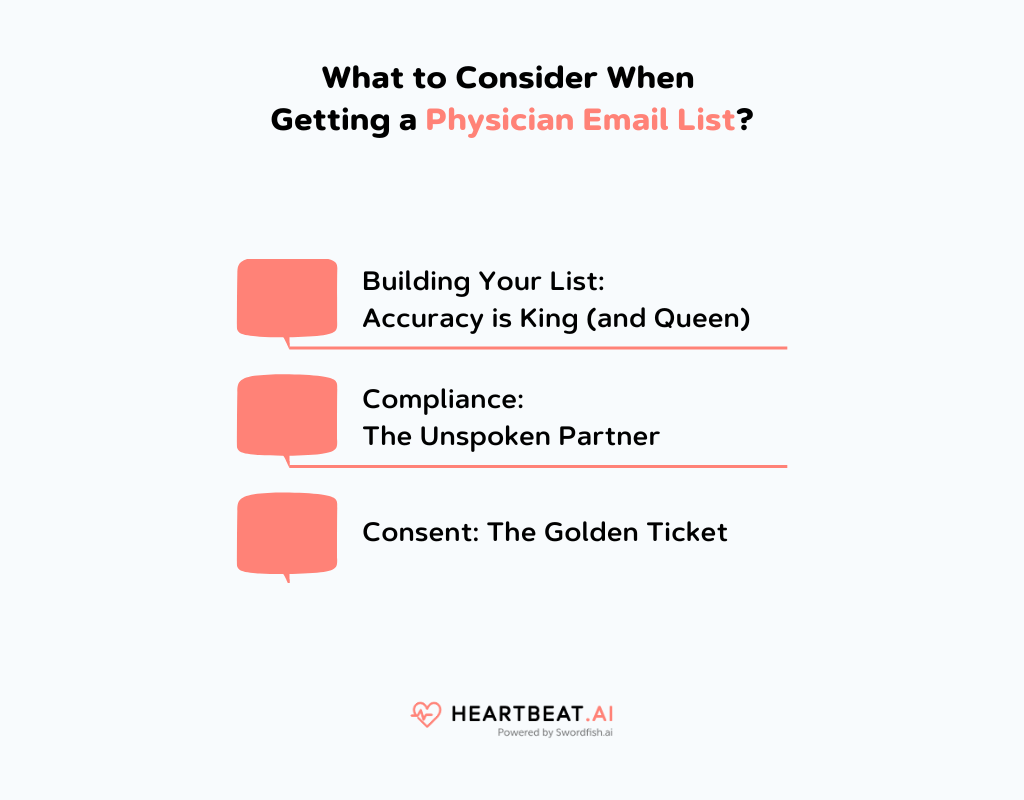
What to Consider When Getting a Physician Email List
Acquiring a physician email list involves balancing reach against ethical and legal boundaries. Here’s what to weigh before you commit to a data source or campaign plan.
Building your list
A poorly targeted list wastes both budget and physician goodwill — sending a pain-management product pitch to a list full of retired dentists helps no one. A few reliable approaches:
- Targeted medical associations: partnering with associations in your field can provide access to verified members and contact details.
- Credible data providers: established vendors maintain physician lists segmented by specialty, location, and practice setting.
- Direct outreach: building your own opt-in list through your website or at conferences takes longer but tends to produce highly qualified contacts.
Compliance checklist
Before you launch a physician email campaign, confirm you can check off each of these:
- CAN-SPAM basics: accurate sender information, no deceptive subject lines, a valid postal address, and a working opt-out link.
- Opt-out handling: unsubscribe requests honored within 10 business days, with no re-adding removed contacts.
- HIPAA boundary awareness: keep any protected health information out of marketing emails; operational communications containing specific patient information, such as a referral, are governed by HIPAA rather than marketing rules.
- State and local laws: some states layer additional requirements on top of the federal baseline, so check before a multi-state campaign.
Consent as a baseline expectation
Even where prior consent isn’t legally required for commercial email under CAN-SPAM, transparent outreach can help build trust with physicians. Make clear who is sending the message and why, and provide an easy way to stop receiving it.
Who Can Use a Physician Email List?
Physician contact data is a powerful tool, but it works best when the outreach is relevant to the recipient’s specialty and role. Organizations that typically use these lists ethically include:
Healthcare companies
Pharmaceutical firms, device manufacturers, and healthcare service providers use targeted lists to share product updates, clinical trial opportunities, or educational webinars.
Medical associations and societies
These groups use lists to distribute practice guidelines, research findings, or event announcements to members.
Patient advocacy groups
For awareness campaigns or fundraising, reaching the right physicians can extend a message’s impact and connect groups with potential allies.
Continuing medical education (CME) providers
Sharing details about upcoming courses, conferences, or online modules benefits both physicians pursuing professional development and the providers offering it.
For more on targeted outreach strategy, see our article on optimizing outreach to psychiatrists through targeted email campaigns.
How to Use Physician Email Lists Effectively
A physician email list opens the door to outreach, but the value comes from how you use it. A few practical applications:
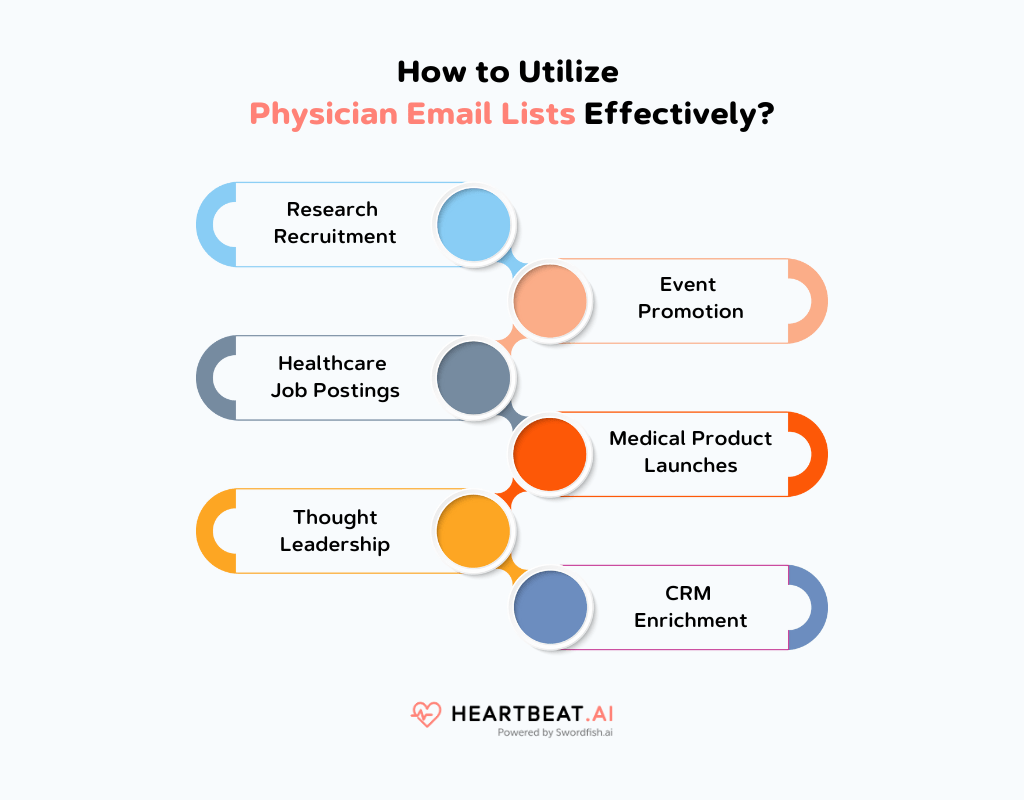
Research recruitment
Share clinical trial opportunities or survey requests with specialized physicians in geographic areas that match study logistics.
Event promotion
Notify physicians about conferences, seminars, and training relevant to their specialty by targeting the right segments.
Healthcare job postings
Staffing agencies can identify passive and active candidates matching specific role criteria.
Medical product launches
Introduce prescribing physicians to new treatments or devices with context on how they may fit into patient care decisions.
Thought leadership
Build credibility by addressing specific challenges physicians face in their specialty rather than generic messaging.
CRM enrichment
Append physician attributes to existing CRM contacts for more relevant follow-up based on background and prior engagement.
Best practices for emailing physicians
- Personalize content: tailor messaging to practice type using CRM data on physician attributes and engagement history.
- Reasonable cadence: space out sends so you’re not overwhelming a physician’s inbox.
- Lead with value: explain clearly how your message benefits patient outcomes or practice efficiency.
- Coordinate channels: pair email with LinkedIn, social, or offline touches rather than relying on email alone.
- Optimize for mobile: keep emails and landing pages concise and easy to act on from a phone.
Conclusion
A well-maintained physician email list supports efficient, targeted outreach — whether that’s clinical trial recruitment, product education, or event promotion. The lists that perform well share a few traits: verified sourcing, regular updates, clear segmentation, and compliance with CAN-SPAM and applicable state rules.
Heartbeat’s physician data is built around those principles, aiming to give marketers, recruiters, and healthcare organizations a dependable foundation for outreach.
FAQs
How often do you update and validate the physician email lists?
Heartbeat refreshes its physician contact database regularly, overlaying authentication signals and prompting physicians to review their profiles. Records with bouncing emails are flagged for ongoing maintenance.
Can I filter physician mailing lists by medical specialty?
Yes. The database supports filtering by specialty, along with attributes like title, hospital network, and location. Contact the team for additional segmentation needs.
What type of consent do you obtain before adding physicians to email lists?
Heartbeat includes healthcare professionals who have opted in for industry communications, following a validation process designed to align with applicable privacy requirements before records reach clients.
How do I purchase access to the physician database lists?
Heartbeat.ai provides healthcare and medical data, including emails and cell phone numbers for physicians, doctors, nurses, and locum tenens professionals. Search millions of healthcare provider records and get personal email and mobile contact details directly.
See pricing here and sign up for the Heartbeat.ai free trial today.

