Last updated: August 30, 2026
Wyoming’s healthcare system relies heavily on critical care nurses to staff intensive care units, emergency departments, and specialty units across a state with a small, spread-out population. For recruiters, staffing agencies, and healthcare marketers, finding and reaching these professionals is harder here than in denser states simply because there are fewer of them and they’re spread across a large geographic area.
This guide covers what critical care nursing looks like in Wyoming, why accurate contact data matters for recruitment and outreach, and how a verified contact database like Heartbeat’s can support that work.
What’s on this page:
Critical Care Nursing in Wyoming: A Quick Overview
Cheyenne Regional Medical Center is the largest hospital in the state of Wyoming, employing over 2,000 people and treating over 350,000 patients from southeastern Wyoming, western Nebraska, and northern Colorado. It provides comprehensive medical services, including emergency care, surgical services, maternity care, and critical care. Wyoming Medical Center in Casper is another major facility with critical care capacity.
Beyond these two hubs, much of Wyoming’s critical care nursing workforce is distributed across smaller community and rural hospitals — places like Rawlins, Jackson, and other county hospital districts — where ICU-trained nurses often cover a wider scope of practice than they might in a large urban medical center. Intensive care unit staff RNs in these settings provide care for patients with life-threatening medical conditions, frequently working across ICU, telemetry, and emergency services roles rather than a single specialty.
This distribution matters for anyone trying to reach these nurses at scale. A recruiter or vendor targeting “Wyoming critical care nurses” isn’t dealing with a concentrated urban labor pool — they’re dealing with a thin, geographically scattered workforce where personal referrals and direct outreach tend to outperform generic job postings.
Why Accurate Contact Information Matters
Outdated or incomplete contact records slow down every part of the recruitment and networking process. A few concrete consequences worth flagging:
- Slower hiring cycles. When a phone number or email bounces, recruiters lose days chasing down a working contact instead of moving a candidate forward.
- Missed networking opportunities. Conference invitations, continuing education announcements, and professional development outreach depend on current email addresses.
- Wasted outreach budget. Sales and marketing teams selling into hospitals or health systems burn time and money on contacts that no longer work at the facility listed.
Given how few critical care nurses work in Wyoming relative to larger states, each accurate contact is proportionally more valuable — there’s less room to make up for bad data with volume.
Why Wyoming Is a Harder Market to Reach
A few structural factors make sourcing critical care nurse contacts in Wyoming more difficult than in higher-population states:
- Low population density. Wyoming has one of the smallest populations of any state, which limits the raw number of critical care nursing roles and makes turnover harder to absorb.
- Geographic spread. Facilities are hours apart in many cases, so building a network the traditional way — through local associations or word of mouth — takes longer.
- Workforce concentration in a few hospitals. Because so much critical care capacity sits within a handful of major facilities, hiring pipelines can dry up quickly if those hospitals aren’t actively recruiting.
Technology helps close some of this gap. Verified contact databases, telehealth-supported staffing models, and workforce analytics all reduce the friction of finding and reaching nurses in a low-density state. None of these fully solve the underlying supply problem, but they shorten the time it takes to connect with the right person.
What’s Included in Heartbeat’s Critical Care Nurse Contact Data
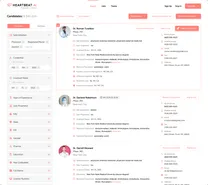
Heartbeat’s contact records for critical care nurses are built to support recruitment, sales, and professional outreach without requiring manual verification of every entry. A typical record includes:
- Nurse name
- Location
- Contact numbers (work, cell, mobile)
- Email address
- Specialization
- Years of experience
- Sole proprietor status
- Licensed states
- License number
- Fax
- Address
Critical Care Nurse Contact Lists by State
The table below links to contact list pages for other states, useful if your recruitment or outreach work spans beyond Wyoming.
| Critical care nurses by states |
|---|
| Critical care nurses in Alabama |
| Critical care nurses in Alaska |
| Critical care nurses in Arizona |
| Critical care nurses in Arkansas |
| Critical care nurses in California |
| Critical care nurses in Colorado |
| Critical care nurses in Connecticut |
| Critical care nurses in Delaware |
| Critical care nurses in Florida |
| Critical care nurses in Georgia |
| Critical care nurses in Hawaii |
| Critical care nurses in Idaho |
| Critical care nurses in Illinois |
| Critical care nurses in Indiana |
| Critical care nurses in Iowa |
| Critical care nurses in Kansas |
| Critical care nurses in Kentucky |
| Critical care nurses in Louisiana |
| Critical care nurses in Maine |
| Critical care nurses in Maryland |
| Critical care nurses in Massachusetts |
| Critical care nurses in Michigan |
| Critical care nurses in Minnesota |
| Critical care nurses in Mississippi |
| Critical care nurses in Missouri |
| Critical care nurses in Montana |
| Critical care nurses in Nebraska |
| Critical care nurses in Nevada |
| Critical care nurses in New hampshire |
| Critical care nurses in New jersey |
| Critical care nurses in New mexico |
| Critical care nurses in New york |
| Critical care nurses in North carolina |
| Critical care nurses in North dakota |
| Critical care nurses in Ohio |
| Critical care nurses in Oklahoma |
| Critical care nurses in Oregon |
| Critical care nurses in Pennsylvania |
| Critical care nurses in Rhode island |
| Critical care nurses in South carolina |
| Critical care nurses in South dakota |
| Critical care nurses in Tennessee |
| Critical care nurses in Texas |
| Critical care nurses in Utah |
| Critical care nurses in Vermont |
| Critical care nurses in Virginia |
| Critical care nurses in Washington |
| Critical care nurses in West virginia |
| Critical care nurses in Wisconsin |
| Critical care nurses in Wyoming |
How Heartbeat Builds and Verifies This Data
Heartbeat aggregates healthcare provider contact information from a mix of official, private, and public sources, then applies matching and verification processes to keep records current. The goal is to reduce the manual research time recruiters and outreach teams typically spend hunting down a working phone number or email before they can even start a conversation.
No contact database is perfect — nurses change jobs, phone carriers, and personal email providers regularly, and Wyoming’s small workforce means any single record error is more noticeable than it would be in a state with a larger talent pool. Treat any purchased list as a starting point that still benefits from spot-checking before a large outreach campaign.
Who Uses Critical Care Nurse Contact Lists
Contact lists like this typically serve a mix of use cases: HR and talent acquisition teams filling open ICU or specialty nursing roles, healthcare sales and marketing teams introducing new products or services, professional associations organizing continuing education or conferences, and researchers conducting workforce studies. Recruiters and staffing agencies working travel or per-diem nursing placements are also frequent users, given how quickly they need to fill short-term gaps in low-density states like Wyoming.
Practical Tips for Outreach
A few things worth keeping in mind when reaching out to critical care nurses using contact data:
- Lead with a clear, specific reason for contact — critical care nurses have demanding schedules and little tolerance for vague pitches.
- Respect time zones and shift patterns; ICU staff often work nights or rotating shifts.
- Keep messaging professional and factual rather than promotional.
- Follow up once or twice, but avoid repeated unsolicited contact.
- Stay within applicable data privacy and communication regulations for healthcare outreach.
Common Questions
What do critical care nurses in Wyoming do day to day?
Critical care nurses monitor and manage patients in serious or unstable condition, administer medications, coordinate with physicians and other clinical staff, and communicate with patients’ families. In Wyoming’s smaller facilities, they often work across multiple specialty areas rather than a single dedicated unit.
What qualifications do critical care nurses in Wyoming typically need?
Critical care nurses generally hold a nursing degree, an active RN license, and clinical experience in an intensive care or similarly acute setting. A current Wyoming Registered Nurse license from the Wyoming State Board of Nursing, or an active enhanced Nurse Licensure Compact license, is commonly required by Wyoming employers.
Are there certifications specific to critical care nursing?
Many critical care nurses pursue the CCRN credential offered by the American Association of Critical-Care Nurses, which recognizes expertise in caring for acutely and critically ill patients. It isn’t universally required, but it’s commonly viewed as a marker of specialized experience.