Last updated: August 29, 2026

By Ben Argeband, Founder & CEO of Heartbeat.ai
Cardiology is one of the harder specialties to recruit against a fast timeline. Clinic runs tight, procedures run long, call schedules shift week to week, and a lot of cardiologists are practice owners with staff whose job is to protect their time. If your outreach isn’t short, specific, and easy to decline, you burn dials, damage email deliverability, and slow down submittals.
This guide treats cardiologist contact data as a workflow, not a spreadsheet: build the list, confirm identity, suppress opt-outs and bounces, sequence outreach by channel, then review metrics weekly.
What “cardiologist contact data” means here: physician identity (name plus current practice or hospital), a cardiology specialty signal (NPI taxonomy), and reachable channels — phone and email — that you can verify, suppress, and measure. Good data is verified, suppressible, and tracked by outcome without creating compliance or reputation risk.
What’s on this page:
Who this is for
This is written for recruiters sourcing cardiologists:
- In-house TA teams filling cardiology service lines (general, interventional, EP, heart failure, imaging).
- Agency recruiters who need faster connect rates without damaging their sending domain.
- Recruiting ops leads who want a repeatable process tied to measurable outcomes across calls and email.
Quick answer
- Core answer
- Use identity plus NPI taxonomy checks, prioritize direct channels, and send short cardiology-specific outreach with a clear opt-out to reach cardiologists without hurting deliverability.
- Key insight
- Cardiology outreach performs best when channel and timing match clinic and procedure windows, and the first sentence includes one concrete role detail — call burden, cath lab coverage, or clinic mix. There are no universal specialty benchmarks here; track your own rates using the definitions below.
- Best for
- Recruiters sourcing cardiologists who need faster connects and cleaner outreach tracking.
Compliance & safety
This method is for legitimate recruiting outreach only. Respect candidate privacy, opt-out requests, and local data laws. Heartbeat does not provide medical or legal advice.
The “specialist respect” pattern
Cardiologists rarely have time for a long intro. This pattern keeps outreach professional and effective:
- Short: two to three sentences in the first touch, one ask.
- Specific: reference a cardiology-relevant detail — call burden, cath lab coverage, clinic/procedure split, program growth, imaging volume.
- Easy out: give a clean decline path and honor it, whether that’s an opt-out reply or a “not a fit” response.
The trade-off: you’ll send fewer broad messages. In exchange, you protect your domain, your reputation, and your own hours.
Use cases
Interventional coverage (STEMI/cath lab)
- Channel order: email first with one coverage detail, then call in a realistic window.
- First-line relevance: reference the specific coverage need — STEMI, cath lab, structural — and whether there’s call rotation or APP support.
- Micro-ask: “Worth a 7-minute call, or should I send details?”
EP lab expansion
- Channel order: call first if you have a high-confidence mobile; otherwise email first.
- First-line relevance: mention the lab expansion and case mix directly.
- Micro-ask: “Is there a better time window for you this week?”
Private practice owner or decision-maker (partner search or call relief)
- Channel order: email first with decision-maker framing, then a short voicemail asking for the right contact.
- First-line relevance: ask directly whether they’re the right person to speak with about adding a partner or call relief.
- Micro-ask: “If not, who should I speak with?”
Step-by-step method
Step 1: Define the cardiology target
Before touching any data, write a one-paragraph target definition. If you can’t describe the role in plain language, your outreach will read generic and get ignored.
- Clinical focus: general cardiology vs. interventional vs. EP vs. advanced heart failure vs. imaging.
- Schedule reality: clinic days, procedure days, call frequency, weekend coverage, outreach clinic travel.
- Setting: employed system vs. private practice ownership vs. academic.
- Non-negotiables: board status, start timeline, geographic constraints.
Step 2: Build a clean identity spine
Two common cardiology sourcing failures: contacting the wrong physician with a common name, and contacting someone who has already moved groups. The fix is an identity spine:
- NPI taxonomy alignment: confirm the physician is actually in cardiology, and ideally the correct subspecialty.
- Practice match: confirm current or recent group/hospital affiliation before personalizing anything.
- Suppression list: remove anyone who opted out, bounced, or asked not to be contacted.
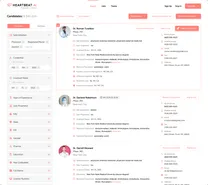
In Heartbeat.ai, this looks like building a cardiology list with specialty filters and applying suppression before outreach. Whatever tool you use, the principle holds: identity first, messaging second.
Identity spine checklist
- Identity: full name, credentials, and a current or recent practice/hospital match.
- Specialty signal: cardiology confirmed via taxonomy, plus subspecialty signal when available.
- Reachability: at least one direct channel you can actually work — mobile and/or role-appropriate email.
- Suppression flags: opt-out status, prior bounces, internal do-not-contact notes applied before outreach.
- Provenance note: where the record came from, so you can audit what’s causing bounces or bad matches.
Minimum data fields to work a cardiology record:
- Physician identifiers: full name, credentials, and an identifier you trust for matching.
- Specialty confirmation: cardiology signal plus subspecialty cue if relevant.
- Current context: practice/hospital affiliation and city/state for accuracy.
- Phone: direct mobile when available; label main lines so you don’t waste dials.
- Email: role-appropriate address rather than a generic front-desk inbox.
- Suppression: opt-out and bounce history applied before any outreach.
Step 3: Choose channel order by call window and gatekeeper reality
Cardiologists are frequently unreachable during clinic and procedures. Channel order should reflect that:
- Call first when you have a high-confidence mobile and a tight message.
- Email first for busy proceduralists, heavy clinic schedules, or roles that need one sentence of context before a call makes sense.
- Text only if your organization allows it and you have a documented, compliant basis — keep it minimal and opt-out friendly.
Gatekeeper handoff script: introduce yourself, state you recruit cardiology physicians, ask one quick question, and offer to email details if that’s easier. If the gatekeeper declines to connect you, thank them and move to the next channel rather than pushing.
One practical differentiator worth checking for in any data tool: mobile numbers ranked by answer probability, so dial time goes toward numbers more likely to connect rather than being spread evenly across a list.
Step 4: Put cardiology relevance in the first sentence
Generic intros get ignored. The first sentence should carry one concrete detail:
- Call structure — rotation, coverage expectations.
- Clinic/procedure split.
- Program growth — structural, EP lab expansion, imaging volume.
- Team model — APP support, hospitalist coverage, cardiothoracic backup.
Follow with a micro-commitment: “Worth a 7-minute call?” or “Should I send details?”
Step 5: Verify before you scale
Cardiology groups are small worlds. Hit the wrong person or a generic inbox repeatedly and you’ll get blocked fast. Before a second touch, check:
- Does the practice website list the physician?
- Does the hospital directory still show them?
- Does the email pattern match the organization?
- Did the first email deliver, and did the call connect?
Step 6: Track metrics that control throughput
Manage the top of funnel like a production line. Standardize these definitions and always state the denominator:
- Connect rate = connected calls / total dials (per 100 dials).
- Answer rate = human answers / connected calls (per 100 connected calls).
- Deliverability rate = delivered emails / sent emails (per 100 sent emails).
- Bounce rate = bounced emails / sent emails (per 100 sent emails).
- Reply rate = replies / delivered emails (per 100 delivered emails).
Use one system of record for outreach outcomes, tag touches as cardiology, and review weekly by segment — procedural vs. clinic-heavy vs. owner — so you can identify the actual bottleneck instead of guessing.
Diagnostic table
| Symptom | Likely cause in cardiology outreach | Fast fix (today) | System fix (this week) |
|---|---|---|---|
| Lots of dials, few real conversations | Calling during clinic/procedure blocks; low-quality numbers; gatekeeper routing | Shift call blocks to realistic windows; leave a 12-second voicemail with a single ask | Prioritize direct mobile-first records; segment by setting (private practice vs employed) and adjust timing |
| Email sends are high, replies are low | Generic subject lines; no cardiology-specific relevance; too long | Rewrite first line to reference call/clinic mix; cut to 2–3 sentences | Build a cardiology template library by subspecialty (general, interventional, EP) |
| Bounces or spam complaints | Stale addresses; missing suppression; repeated follow-ups to wrong inbox | Stop sequence; suppress bounces and opt-outs immediately | Implement verification + suppression workflow; audit sources feeding your list |
| “Not interested” with no engagement | Ask is too big; unclear why you picked them | Switch to micro-commitment: “Should I send details?” | Use NPI taxonomy + practice match to personalize the first sentence |
Weighted checklist
Use this to decide whether a cardiology record is ready for outreach. Score each item 0–2 and total it, max 14. Prioritize the highest scores first.
- (2) Identity confirmed: name plus practice/hospital match at the physician level, not just group level.
- (2) Specialty confirmed via NPI taxonomy aligned to cardiology.
- (2) Mobile number present and plausible for direct reach, not a main line.
- (2) Email is role-appropriate, not a generic front-desk inbox, and hasn’t previously bounced.
- (2) Suppression checked: prior opt-out honored and applied before send/call blocks.
- (2) Message relevance ready: you can reference one cardiology-specific detail in the first sentence.
- (2) Timing plan: you have a call window and a follow-up plan that won’t spam.
Routing rule: 12–14 = call and email same day; 9–11 = email first then call; 8 or below = enrich/verify before outreach.
Outreach templates
These are built for short attention windows and designed to reduce back-and-forth. Use as-is, then swap in your own role details.
Customization variables (pick one per first touch): call model, clinic/procedure split, cath lab/EP coverage, program growth, APP support.
Cardiology subject lines
- Quick question on your call schedule
- 7 minutes re: cath lab coverage
- Cardiology role — clinic/procedure mix
- EP coverage question (short)
- General cardiology — outpatient focus?
Email template 1 (general cardiology, employed setting)
Subject: Quick question on your call schedule
Dr. {{LastName}} — I recruit cardiology physicians and had a question based on your work with {{Org/Practice}}. We’re hiring a {{Role}} with {{one detail: call model OR clinic/procedure split}}.
Worth a 7-minute call this week, or should I send details by email? If you’d rather not get recruiting outreach from me, reply “opt out” and I’ll stop.
Email template 2 (interventional/procedural focus)
Subject: 7 minutes re: cath lab coverage
Dr. {{LastName}} — reaching out because your background in cardiology looks aligned with a role covering {{specific: STEMI/cath lab/structural}} with {{specific: call rotation OR APP support}}.
Is it reasonable to ask for a quick call, or is there a better time window for you? If not a fit, a “no” is totally fine.
Email template 3 (private practice owner/decision-maker angle)
Subject: Cardiology coverage question (short)
Dr. {{LastName}} — I work with cardiology groups on hard-to-fill coverage. Are you the right person to ask about {{specific: adding a partner / call relief / outreach clinic coverage}}?
If not, who should I speak with? If you prefer no outreach, reply “opt out” and I’ll suppress your contact.
Voicemail script 1 (12 seconds, micro-commitment)
Hi Dr. {{LastName}}, this is {{YourName}}. I recruit cardiology physicians. I had a quick question about a {{Role}} with {{one detail: call model OR clinic/procedure mix}}. If it’s easier, text me at {{Number}} with a good time, or just reply “not interested.” Thanks.
Voicemail script 2 (gatekeeper-safe, referral ask)
Hi Dr. {{LastName}}, {{YourName}} here. I’m trying to reach the right cardiology physician about a {{Role}} in {{City}}. If you’re not the right person, could you point me to who handles recruiting conversations in your group? My number is {{Number}}. Thank you.
Referral ask (email or voicemail add-on)
If you’re not open to a move, is there a cardiology colleague you respect who might want {{specific: call relief / outpatient-heavy / procedural growth}}? I’ll keep it discreet.
If you want to validate reachability before you spend a week on the wrong list, start free search & preview data.
Common pitfalls
- Forcing the main line. If you’re repeatedly routed to a front desk, switch to email-first with a micro-ask, then call when you have a reason to believe they’ll recognize your name or the role detail.
- Over-personalizing with shaky facts. Reference the wrong affiliation or subspecialty and you lose trust instantly. Verify identity with practice match plus NPI taxonomy before personalizing.
- Sending a job post as the first touch. The first message is a filter, not a brochure. Keep it to relevance, micro-commitment, and an easy out.
- Not honoring opt-outs fast. If someone says stop, stop. Build suppression into the workflow so it’s automatic rather than dependent on memory.
- Measuring only replies. Replies are downstream. If connect rate or deliverability rate is weak, fix that first or you’ll misdiagnose the real problem.
How to improve results
Segment by work pattern, not just subspecialty
- Procedural-heavy: more asynchronous, email-first, tighter call windows.
- Clinic-heavy: more predictable blocks; a short voicemail can work.
- Practice owners: decision-maker framing, referral asks, discretion matters.
Tighten list hygiene before adding volume
When deliverability slips, adding volume makes it worse. Clean inputs first: remove bounces, honor opt-outs, and avoid repeatedly hitting generic inboxes.
Refresh and suppression cadence
Don’t treat a cardiology list as finished. Refresh and suppress based on observable triggers — a bounce, an opt-out, a wrong-person reply, or a practice change. When a trigger fires, update the record and suppress the bad channel rather than repeating the mistake.
Subspecialty messaging cues
| Cardiology segment | Lead with | Avoid in first touch |
|---|---|---|
| General cardiology | Clinic mix, call rotation, outpatient focus | Long role summaries and multiple asks |
| Interventional | Cath lab coverage, STEMI/structural focus, support model | Vague “opportunity” language |
| Electrophysiology | EP coverage, lab growth, case mix cue | Assuming they want to relocate without asking |
| Advanced HF | Program scope, inpatient/outpatient balance, team structure | Overstating program details you haven’t verified |
Measurement instructions
Set up a weekly cardiology outreach scorecard using the standard definitions above, and always state the denominator. Tag every outreach attempt with specialty, channel, and outcome. Review weekly by recruiter and by segment. If connect rate is low, adjust phone quality and timing. If deliverability rate is low, pause sequences and fix suppression and verification before sending more.
Keep this page specialty-specific
If you need broader coverage beyond cardiology, use a separate hub for cross-specialty sourcing — for example, physician list by specialty and state.
Legal and ethical use
Recruiting outreach is allowed, but it still needs to run like a professional operation. Build compliance into the workflow:
- Honor opt-out immediately. Maintain a suppression list and apply it before every send/call block.
- Be truthful about who you are. Don’t misrepresent affiliation or intent.
- Use appropriate contact methods. Follow your organization’s calling and texting policies, and consult counsel for jurisdiction-specific requirements — telemarketing and consent rules under laws like the TCPA have been the subject of active litigation and shifting court interpretations in recent years, so requirements can vary by circuit and by call type.
- Keep messages relevant and minimal. In cardiology, relevance reduces complaints and improves professional outcomes.
References: CAN-SPAM and TCPA.
Evidence and trust notes
Treat contact data as a workflow problem: identity, verification, suppression, and measurement. That’s how you avoid wasting recruiter hours and protect deliverability over time. For how sourcing quality and responsible use are evaluated, see the trust methodology.
Compliance references used in this guide: CAN-SPAM and TCPA.
For more specialty recruiting context, start at the specialty recruiting resources hub. For more messaging options, see physician recruiter email templates.
FAQs
What should I look for in cardiologist contact data before I outreach?
Confirm identity (name plus practice/hospital), confirm cardiology via NPI taxonomy, apply opt-out suppression, and prioritize direct channels — mobile and a role-appropriate email — over generic inboxes.
How do I avoid annoying cardiologists with outreach?
Use the “specialist respect” pattern: short message, one cardiology-specific detail, and an easy out. Don’t send long job descriptions as a first touch, and don’t keep following up after a decline.
Should I call or email cardiologists first?
Procedural-heavy cardiologists often respond better to email-first with a micro-ask, then a call in a realistic window. Clinic-heavy schedules can support call-first if you have a high-confidence mobile.
What metrics should I track for cardiology outreach?
Track connect rate (connected calls / total dials, per 100 dials), answer rate (human answers / connected calls, per 100 connected calls), deliverability rate (delivered emails / sent emails, per 100 sent emails), bounce rate (bounced emails / sent emails, per 100 sent emails), and reply rate (replies / delivered emails, per 100 delivered emails).
Where can I get started quickly?
Use a workflow that lets you filter by cardiology, verify identity, apply suppression, and track outcomes. To test the process, start free search & preview data.
Next steps
- Implement the workflow: define the cardiology target, build the identity spine (NPI taxonomy plus practice match), then outreach with short, specific, easy-out messaging.
- Run a controlled test: pick one cardiology segment, run a short outreach sprint, and review connect rate, answer rate, and deliverability rate weekly.
- Use proven messaging: adapt the templates above, or pull more options from physician recruiter email templates.
- Operational CTA: start free search & preview data and build a cardiology list you can actually work.
About the Author
Ben Argeband is the Founder and CEO of Swordfish.ai and Heartbeat.ai. With deep expertise in data and SaaS, he has built two successful platforms trusted by over 50,000 sales and recruitment professionals. Ben’s mission is to help teams find direct contact information for hard-to-reach professionals and decision-makers, providing the shortest route to their next win. Connect with Ben on LinkedIn.