Last updated: August 31, 2026
Recruiters, credentialing teams, and marketers trying to reach psychiatrists in North Carolina run into the same wall: mental health provider directories are incomplete, and psychiatrists themselves are unevenly distributed across the state. Building a working list means understanding both the data problem and the workforce problem behind it.
What’s on this page:
Get a Verified Email List of Psychiatrists in North Carolina from Heartbeat
Heartbeat.ai’s contact database covers licensed healthcare professionals across the United States, including psychiatrists. You can filter by specialty, location, and other criteria to build a list matched to a specific outreach goal rather than working from a generic directory.
Psychiatrists are physicians who diagnose and treat mental health conditions, including substance use disorders, depression, and anxiety. Within the specialty, subgroups such as child and adolescent psychiatry, forensic psychiatry, addiction psychiatry, and geriatric psychiatry each serve different patient populations and different referral or recruiting needs.
Whether the goal is connecting with child and adolescent psychiatrists for an awareness campaign, sourcing addiction psychiatry candidates for a treatment facility, or building a referral network, the underlying requirement is the same: current, verifiable contact records rather than a static list that goes stale within months.
Mental Health Care in North Carolina: What the Data Shows
There were 1,568 psychiatrists in active practice in North Carolina in 2024, an increase of 25.9% since 2014, and the ratio of psychiatrists per 10,000 population increased from 1.26 to 1.43 between 2014 and 2024. Growth in the specialty hasn’t solved the distribution problem, though. Psychiatry specialties remain maldistributed across the state, with 25 counties in 2024 having no psychiatrists reporting a primary practice location within the county.
The gap is sharper at the metro-versus-rural level. In metro areas, there are 1.79 psychiatrists per 10,000 people, while in rural counties there are 0.58 per 10,000 people. Child and adolescent psychiatry access is even thinner: more than 68 counties have no child and adolescent psychiatrist available, and there are 0.24 child and adolescent psychiatrists per 10,000 people in metro areas compared with 0.04 in rural areas.
Academic medical centers, including major health systems in the Triangle and Piedmont regions, concentrate much of the specialized psychiatric capacity in the state. Rural counties depend more heavily on telepsychiatry and community mental health centers to fill the gap, a pattern reflected in state and university workforce reports tracking these disparities over time.
Why Accurate Contact Information Matters
For patients, an outdated phone number or inactive email address is a barrier to timely care, and delays in reaching a psychiatrist can compound an already stressful situation.
For healthcare recruiters, stale contact data slows hiring at a time when the workforce data above shows real capacity gaps to fill. Reaching a candidate directly, rather than through a generic front-desk line, shortens the sourcing cycle and reduces the number of dead-end outreach attempts.
For psychiatrists themselves, current professional contacts support referrals, collaboration, and continuing education relationships. None of that works if the directory information is years out of date.
Why Finding Psychiatrists in North Carolina Is Difficult
The shortage isn’t evenly felt. Currently, 94 out of 100 counties in North Carolina are designated professional shortage areas for behavioral health, which means most of the state’s psychiatric capacity sits in a handful of metro counties. Across almost all workforce categories, metropolitan counties have more providers relative to population than rural counties, and some rural counties lack critical groups such as child and adolescent psychiatrists or licensed psychologists.
Two responses have emerged at the state level:
- Telepsychiatry. Remote video-based psychiatric care lets patients in underserved counties reach licensed psychiatrists without traveling to a metro area. It doesn’t add psychiatrists to the workforce, but it redistributes existing capacity more efficiently.
- Workforce and education initiatives. Some universities in Western North Carolina have begun shifting how they educate future mental health professionals, offering scholarships to students committed to staying in rural areas.
For anyone building outreach lists, this distribution pattern is a practical filtering consideration: a list weighted toward major health systems will look very different from one built to reach rural-practicing psychiatrists, and the two require different sourcing strategies.
What a Heartbeat Psychiatrists Contact List Includes
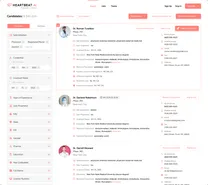
Heartbeat’s database is organized to make it possible to filter psychiatrists by location and specialization rather than working through an unsorted directory. A typical record includes:
- Psychiatrist name
- Location
- Contact numbers (work, cell, mobile)
- Email address
- Specialization
- Years of experience
- Sole proprietor status
- Licensed states
- License number
- Fax
- Address
 Accuracy & coverage of personal contact info were unrivaled by other platforms… this gives any healthcare recruiter a competitive advantage when engaging hard-to-reach healthcare providers.
Senior Growth Strategist






Psychiatrist Contact Lists by State
Heartbeat maintains psychiatrist contact data across all 50 states, so the same filtering approach used for North Carolina applies elsewhere.
| Psychiatrists by states |
|---|
| Psychiatrists in Alabama |
| Psychiatrists in Alaska |
| Psychiatrists in Arizona |
| Psychiatrists in Arkansas |
| Psychiatrists in California |
| Psychiatrists in Colorado |
| Psychiatrists in Connecticut |
| Psychiatrists in Delaware |
| Psychiatrists in Florida |
| Psychiatrists in Georgia |
| Psychiatrists in Hawaii |
| Psychiatrists in Idaho |
| Psychiatrists in Illinois |
| Psychiatrists in Indiana |
| Psychiatrists in Iowa |
| Psychiatrists in Kansas |
| Psychiatrists in Kentucky |
| Psychiatrists in Louisiana |
| Psychiatrists in Maine |
| Psychiatrists in Maryland |
| Psychiatrists in Massachusetts |
| Psychiatrists in Michigan |
| Psychiatrists in Minnesota |
| Psychiatrists in Mississippi |
| Psychiatrists in Missouri |
| Psychiatrists in Montana |
| Psychiatrists in Nebraska |
| Psychiatrists in Nevada |
| Psychiatrists in New hampshire |
| Psychiatrists in New jersey |
| Psychiatrists in New mexico |
| Psychiatrists in New york |
| Psychiatrists in North carolina |
| Psychiatrists in North dakota |
| Psychiatrists in Ohio |
| Psychiatrists in Oklahoma |
| Psychiatrists in Oregon |
| Psychiatrists in Pennsylvania |
| Psychiatrists in Rhode island |
| Psychiatrists in South carolina |
| Psychiatrists in South dakota |
| Psychiatrists in Tennessee |
| Psychiatrists in Texas |
| Psychiatrists in Utah |
| Psychiatrists in Vermont |
| Psychiatrists in Virginia |
| Psychiatrists in Washington |
| Psychiatrists in West virginia |
| Psychiatrists in Wisconsin |
| Psychiatrists in Wyoming |
How Heartbeat Compiles This Data
Heartbeat.ai pulls contact records from official, private, and public sources and applies predictive modeling to fill gaps where a direct cell number or personal email isn’t already on file. According to Heartbeat’s stated figures, the platform’s database covers roughly 11 million U.S. health professionals, including around 8.8 million direct cell numbers, 9.3 million personal emails, and 6 million direct dial numbers, with reported first-pass accuracy near 84% for cell numbers and 92% for personal emails. Treat any specific accuracy figure as a starting point rather than a guarantee — verification during outreach is still good practice, particularly for a specialty as unevenly distributed as psychiatry.
Who Uses a Psychiatrist Contact List
- Healthcare recruiters filling clinical staffing gaps
- Marketing teams promoting mental health products or services to a clinical audience
- Researchers and survey organizations recruiting study participants
- Non-profits building fundraising or awareness outreach
- Referral networks and collaborating clinicians
Using a Psychiatrist Email List Responsibly
A contact list is only as useful as the outreach built on top of it. A few practical guardrails:
- Keep messaging specific to the psychiatrist’s subspecialty rather than sending generic mass outreach.
- Respect opt-out requests immediately and don’t re-add removed contacts to future lists.
- Follow applicable communication and privacy regulations for professional outreach, including any state-specific rules.
- For recruitment outreach, lead with role details and location rather than a vague pitch — psychiatrists fielding recruiter messages tend to filter out anything that reads as spam.
The Bottom Line
North Carolina’s psychiatric workforce has grown over the past decade, but growth hasn’t closed the rural-urban gap, and dozens of counties still have no psychiatrist practicing locally. That distribution pattern should shape how any contact list gets built and used — a list intended for rural outreach or telepsychiatry recruiting needs different filtering than one built around academic medical center staffing. Heartbeat’s database is built to support that kind of targeted list-building rather than a one-size-fits-all directory.
Frequently Asked Questions
What services do psychiatrists in North Carolina provide?
Psychiatrists in North Carolina diagnose and treat mental health conditions, provide therapy and medication management, and coordinate care with other clinicians.
How can I find a psychiatrist in North Carolina?
Referrals from a primary care provider, insurance-network directories, and telepsychiatry programs are common starting points, particularly in counties without a locally practicing psychiatrist.
What qualifications should I look for in a psychiatrist in North Carolina?
Confirm active state licensure, board certification in psychiatry, and relevant subspecialty training such as child and adolescent, addiction, or geriatric psychiatry where applicable.
What does it cost to see a psychiatrist in North Carolina?
Costs vary by provider, location, and insurance coverage. Checking with the specific insurance plan and provider directly is the most reliable way to get current pricing.