What’s on this page:
Key takeaways
- Build CRNA contact segments by state and facility type so targeting and performance can be reviewed separately.
- Store each contact route’s verification status and last-checked date alongside suppression fields.
- Verify email and phone routes before use, and re-verify older records before re-contacting them.
- Track outreach measures such as connect, deliverability, bounce, and reply rates by segment.
- Propagate opt-outs across every recruiting tool that can contact candidates.
Last updated: August 29, 2026

Ben Argeband, Founder & CEO of Heartbeat.ai — Keep it narrow and respectful.
Who this is for
This is written for recruiters sourcing CRNAs who need working contact routes without burning a small, tight-knit market. CRNAs are busy, often shielded by scheduling gatekeepers, and they notice generic outreach immediately. A stale list or sloppy segmentation shows up fast: fewer connections, more bounces, more opt-outs.
The goal isn’t a bigger list. It’s a repeatable way to build CRNA contact data that fits an actual recruiting workflow — segmented by state and facility type, verified before use, and suppression-ready from day one.
Quick Answer
- Core Answer
- Build CRNA contact data by segmenting by state and facility type, storing verification status for email and phone, and enforcing opt-out suppression across every tool you use.
- Key Insight
- In CRNA recruiting, relevance beats volume. Smaller verified segments protect deliverability and keep the market receptive to future outreach.
- Best For
- Recruiters sourcing CRNAs who need fast, respectful outreach without creating downstream compliance or brand risk.
Compliance & Safety
This method is for legitimate recruiting outreach only. Always respect candidate privacy, opt-out requests, and local data laws. Heartbeat does not provide medical advice or legal counsel.
Relevance over volume: why smaller lists win
CRNA recruiting benefits from focused outreach. A useful list has four traits:
- Specific: state, facility type, and schedule reality are defined before anyone sends a message.
- Fresh: you can explain why a record is likely still current.
- Verifiable: you can test whether email and phone routes actually work before scaling outreach.
- Suppressible: you can stop contact quickly and permanently when someone asks.
The trade-off is real — you’ll build fewer records per hour this way. But you’ll waste fewer touches and keep your ability to recruit the same market again next quarter.
Step-by-step method
Step 1: Write a targeting spec your sourcers can follow
Before pulling contacts, write a short, operational spec:
- Geography: state, metro, commute radius, or a hard requirement for local candidates.
- Facility type: hospital, ASC, office-based, anesthesia group, academic.
- Schedule reality: call expectations, nights/weekends, shift pattern (keep this high-level).
- Credential signals: CRNA status, APRN context where applicable, active licensure footprint.
Skipping this step can lead to a large list that has to be filtered after an irrelevant message has already gone out.
Step 2: Build segments by state and facility type — don’t mix them
Build lists explicitly by state and facility type so you can measure and tune each one separately:
- State segments: keep separate lists per state so licensure context, outreach timing, and suppression handling stay clean.
- Facility-type segments: hospital, ASC, group, and academic settings each respond to different triggers and have different gatekeeping.
For a consistent state-based verification path, confirm that the person exists, holds appropriate credentials, and is plausibly active in the region. For CRNA-specific checks, use CRNA license lookup by state.
Step 3: Store verification status and suppression fields
For every record, store the contact route, its verification status and last-checked date, and suppression controls. That makes it easier to assess whether a segment is ready to reuse.
| Field to store | Why it matters in CRNA recruiting | What “good” looks like operationally |
|---|---|---|
| Name + location | Prevents wrong-market outreach | State/metro is explicit; segment membership is clear |
| Role signal (CRNA) + credential context (APRN where applicable) | Reduces mis-targeting and negative replies | Signal is documented; you can explain the source |
| Email + verification status + last verified date | Protects sender reputation and reduces bounces | Verified before send; re-verified before re-contact |
| Phone + verification status + last verified date | Improves calling efficiency and reduces wasted dials | Reachable via a channel appropriate for professional recruiting outreach; tested in controlled batches |
| Suppression fields (opt-out flag, channel, timestamp, notes) | Prevents accidental re-contact across tools | One source of truth; synced to every sending system |
Define your metrics consistently so you can compare segments week to week:
- Connect Rate = connected calls / total dials (per 100 dials).
- Deliverability Rate = delivered emails / sent emails (per 100 sent emails).
- Bounce Rate = bounced emails / sent emails (per 100 sent emails).
- Reply Rate = replies / delivered emails (per 100 delivered emails).
Step 4: Run small-batch outreach with relevance-first messaging
Keep CRNA outreach respectful and relevant. Use batches small enough to review and adjust based on responses.
- Batch discipline: size batches so you can review replies and adjust within a day or two.
- First line: state the facility type and schedule reality up front.
- One question: ask a single “is this worth a quick call?” question to cut down on back-and-forth.
- Opt-out: include opt-out language every time and honor it fast.
Plan for email and phone as separate contact routes. Email can provide context; use phone for follow-up when appropriate and preferred by the candidate. Verify both routes regularly rather than treating them as static assets.
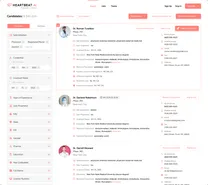
If you’re using Heartbeat.ai, the workflow is built for recruiter speed: search, preview, verify, segment, then outreach. Preview should surface key fields and verification status before you decide to export or contact. When you’re ready to build a segment, start free search & preview data.
Step 5: Refresh and suppress continuously
Contact data can become outdated. Treat access, refresh, verification, and suppression as an ongoing cycle rather than a one-time build:
- Refresh segments on a schedule, more often for high-churn geographies or facility types.
- Suppress immediately when someone opts out, and propagate that suppression across every tool.
- Re-verify before re-contacting older records.
For a deeper operational view of verification and decay, see data quality verification workflows.
Use cases
- Hospital coverage: build state-based segments and lead with schedule clarity — call burden, nights/weekends — to reduce wasted touches.
- ASC expansion: segment by facility type so your first line matches the work setting and avoids “wrong environment” replies.
- Anesthesia group backfill: run controlled batches per metro and keep suppression airtight so multiple recruiters don’t contact the same CRNA.
Diagnostic table
| Signal you see | What it usually means | Metric definition to use | Action |
|---|---|---|---|
| Low Connect Rate on calls | Stale phones, wrong call windows, weak segmentation | Connect Rate = connected calls / total dials (per 100 dials) | Re-verify phones; adjust call windows; tighten segment definition |
| Low Deliverability Rate or high Bounce Rate | Unverified emails, old domains, list decay | Deliverability Rate = delivered emails / sent emails; Bounce Rate = bounced emails / sent emails (per 100 sent emails) | Verify before send; remove risky domains; refresh the segment |
| Low Reply Rate | Not enough relevance or unclear ask | Reply Rate = replies / delivered emails (per 100 delivered emails) | Ask one clear question; lead with facility type; remove generic language |
| High opt-out volume | Message mismatch, too many touches, mixed facility types | Track opt-outs by segment (state + facility type) | Reduce touches; split facility types; rewrite first line to state facility type + schedule reality |
| Duplicate outreach from multiple recruiters | No shared suppression source of truth | Audit suppression sync across ATS/CRM and outreach tools | Centralize suppression; assign an owner; run a weekly suppression audit |
Weighted checklist
Small-batch outreach checklist (CRNA-specific) — score each segment before you send. Total 100 points.
- Targeting clarity (25): state + facility type + schedule reality written in one paragraph.
- Credential confidence (15): CRNA signal present; APRN context where applicable; licensure check path documented.
- Contact route quality (25): email verified recently; phone reachable via an appropriate channel; suppression fields present and opt-out ready.
- Message relevance (20): first sentence states facility type and schedule reality; no generic blast phrasing.
- Consent & opt-out handling (15): opt-out language included; suppression sync tested; owner assigned.
Add a mandatory “suppression proof” step before any second touch: confirm the record isn’t flagged opt-out in your ATS/CRM and in your outreach tool. This one habit prevents accidental re-contact when multiple recruiters share the same CRNA segment.
Sample second-touch attempts regularly and confirm that no suppressed records were contacted. If you find one, pause the segment and fix the sync before sending again.
Outreach templates
Template 1: Email (facility-type specific, respectful)
Subject: CRNA role — [Facility type] schedule question in [State/City]
Body:
Hi [First Name] — I recruit CRNAs for [facility type] coverage in [location]. Quick check: are you open to hearing about a schedule that looks like [high-level schedule reality]?
If yes, what matters most to you right now: call burden, team model, commute, or case mix?
If you’d rather not receive recruiting outreach from me, reply “opt-out” and I’ll stop. Thanks, [Your Name]
Template 2: Voicemail (10–15 seconds)
Hi [First Name], this is [Name]. I’m reaching out about a CRNA opening at a [facility type] in [location]. If you’re open to a quick schedule check, call/text me at [number]. If not, tell me to opt out and I will. Thanks.
Template 3: Follow-up email (one question)
Hi [First Name] — should I close the loop on the [facility type] CRNA role in [location], or is it worth a 5-minute call this week?
Reply “opt-out” if you don’t want future messages.
Common pitfalls
- Overbuilding before validating: you don’t need a huge list to learn your message is off. Start with one state and one facility type.
- Mixing facility types in one sequence: it forces generic messaging and increases opt-outs.
- Weak suppression discipline: if you can’t reliably honor opt-out across tools, you create compliance and brand risk.
- Chasing volume over relevance: scarcity markets punish generic outreach — you’ll see it in lower Connect Rate and lower Reply Rate.
How to improve results
Improvement comes from tight loops: segment, outreach, measure, refresh, suppress, repeat.
| Refresh trigger (by segment) | What to do next |
|---|---|
| Bounce Rate rises | Re-verify emails before the next send; remove risky domains; refresh the segment source |
| Deliverability Rate drops | Pause the sequence; verify before sending again; check suppression and list hygiene |
| Connect Rate drops | Re-verify phones; adjust call windows; tighten the state/facility-type definition |
| Reply Rate drops | Rewrite the first line to be facility-type specific; ask one clear question; reduce touches |
- Instrument by segment: track Connect Rate, Deliverability Rate, Bounce Rate, and Reply Rate separately for each state + facility type combination.
- Review weekly: identify the weakest segments and diagnose using the diagnostic table above.
- Refresh rules: when Bounce Rate rises or Deliverability Rate drops, re-verify emails before the next send; when Connect Rate drops, re-verify phones and adjust call windows.
- Suppression audit: sample recent opt-outs and confirm they’re suppressed in every system that can send — ATS, CRM, sequencer, dialer.
- Message iteration: keep the first line facility-type specific and ask one clear question. Cut anything that reads like a mass blast.
For a quality-first reference, use what contact data accuracy means in practice as your internal standard.
Legal and ethical use
Build CRNA outreach around consent, respect, and prompt opt-out handling:
- Consent: follow your organization’s policies and applicable laws for outreach. When in doubt, default to fewer touches and clearer context.
- Opt-out: make opt-out easy, honor it quickly, and keep a durable suppression record.
- Privacy: use data only for legitimate recruiting purposes, not unrelated marketing.
- Professional respect: CRNAs are in demand; relevance and clarity reduce annoyance and protect your brand.
Heartbeat.ai supports recruiting workflows. You are responsible for ensuring your use complies with applicable requirements in your jurisdiction.
Evidence and trust notes
Trust with contact data is operational: source transparency, verification, and suppression discipline. Review our approach here: Heartbeat trust methodology.
For licensure and regulatory context, use official sources such as NCSBN (National Council of State Boards of Nursing). This helps you validate state-by-state pathways instead of relying on stale third-party directories.
For broader context on this resource cluster, see provider contact data resources.
FAQs
What should be included in CRNA contact data for recruiting?
At minimum: name, location, CRNA role signal (and APRN context where applicable), email/phone with verification status and last verified date, and suppression fields (opt-out flag, channel, timestamp) you can enforce across tools.
How do I keep a CRNA list from going stale?
Refresh segments on a schedule, re-verify before re-contacting older records, and treat suppression as permanent unless the candidate explicitly opts back in.
Is it better to email or call CRNAs first?
Email often works well to provide context (facility type + schedule reality). Calls can speed up qualification when the candidate prefers phone. Use both thoughtfully and respect consent and opt-out.
How do I measure whether my CRNA outreach is working?
Track Connect Rate (connected calls / total dials per 100 dials), Deliverability Rate (delivered emails / sent emails per 100 sent emails), Bounce Rate (bounced emails / sent emails per 100 sent emails), and Reply Rate (replies / delivered emails per 100 delivered emails) by segment (state + facility type). Then adjust targeting, verification, and messaging based on the weakest segments.
Can I build CRNA lists by state and facility type?
Yes. State segmentation helps with licensure context and outreach timing; facility-type segmentation keeps your message relevant and reduces negative responses.
Next steps
- Build one pilot segment (one state + one facility type) and run a controlled batch so you can iterate fast.
- Set up verification and suppression using data quality verification as the baseline.
- For state-by-state credential checks, use the CRNA license lookup hub to keep your process consistent.
- When you’re ready to build and preview a segment in Heartbeat.ai, start free search & preview data.
About the Author
Ben Argeband is the Founder and CEO of Swordfish.ai and Heartbeat.ai. With deep expertise in data and SaaS, he has built two successful platforms trusted by over 50,000 sales and recruitment professionals. Ben’s mission is to help teams find direct contact information for hard-to-reach professionals and decision-makers, providing the shortest route to their next win. Connect with Ben on LinkedIn.