Last updated: August 31, 2026
Finding accurate contact information for a Chief Nursing Officer in New Hampshire is a narrower search than in bigger states simply because the pool of hospitals and health systems is smaller. That makes precision matter more, not less. A recruiter or vendor targeting nursing leadership in New Hampshire typically has fewer organizations to work with, so outdated or incomplete contact data wastes a larger share of the available opportunities.
This page walks through what a CNO actually does in the context of New Hampshire’s hospital landscape, why contact accuracy is a real bottleneck for recruiters and healthcare marketers, and how Heartbeat’s contact database can support outreach to nursing executives across the state.
What’s on this page:
Get an Email List of Chief Nursing Officers in New Hampshire from Heartbeat
Heartbeat.ai maintains a searchable database of licensed healthcare professionals across the United States, including nursing executives. You can filter by role, state, and organization type to build a list suited to your outreach goals.
The database covers several roles adjacent to the CNO title, including Chief Nursing Executives, Chief Nursing Informatics Officers, Associate and Deputy Chief Nursing Officers, and Vice Presidents of Nursing. These roles sit at different points in a hospital’s nursing hierarchy but share responsibility for patient care standards, staffing strategy, and clinical operations.
If your outreach depends on reaching one of these titles specifically, it’s worth filtering by exact role rather than assuming “CNO” covers every relevant contact ��� many systems split nursing leadership across multiple titles.
Overview of the Healthcare Landscape in New Hampshire
Dartmouth Hitchcock Medical Center (DHMC), the flagship campus of the Dartmouth Health system, is the U.S. state of New Hampshire’s only academic medical center, and DHMC is New Hampshire’s only Level I Trauma Center, one of only three in northern New England. Its nursing leadership sits within the broader Dartmouth Health system.
Concord Hospital is a teaching hospital affiliated with Dartmouth Geisel School of Medicine, New Hampshire’s only medical school, and it has the busiest emergency department in the state of New Hampshire. Nursing executives at institutions like these are responsible for department-level oversight, staffing decisions, and clinical quality standards that affect thousands of patients annually.
Beyond these two flagship systems, New Hampshire has a mix of community hospitals, regional health systems, and smaller specialty facilities, each with its own nursing leadership structure. Some smaller hospitals combine the CNO role with a Vice President of Nursing title, which is worth checking before you assume a facility has a dedicated CNO.
Why Accurate Contact Information Matters
Reaching a Chief Nursing Officer directly is useful in a few distinct situations, each with different stakes:
- Recruitment: Hiring managers and staffing agencies need a direct line to relay open positions, schedule interviews, or share candidate updates without delays caused by routing through general hospital contact forms.
- Vendor and product outreach: Companies selling clinical software, staffing tools, or nursing education programs need to reach the person who actually makes or influences purchasing decisions for nursing operations.
- Professional networking: Nurses pursuing leadership roles or seeking mentorship benefit from being able to reach established CNOs directly, rather than through a general HR inbox.
In each case, outdated contact information doesn’t just cause minor friction — it can mean a message never gets seen, or gets routed to someone who left the role months earlier.
Challenges in Finding a Chief Nursing Officer in New Hampshire
Recruiting or reaching a CNO in New Hampshire comes with a few practical constraints:
- Small candidate pool: New Hampshire’s population and number of hospital systems are modest compared to larger states, which limits the number of qualified nursing executives statewide.
- Competition among health systems: Hospitals and health systems compete for the same relatively small group of experienced nursing leaders, which can mean longer vacancies and more turnover pressure.
- Title inconsistency: As noted above, some facilities use titles like “Vice President of Nursing” instead of CNO, which complicates keyword-based searches on LinkedIn or general web searches.
- Contact information decay: Executive-level contacts change roles, get promoted, or move to different systems more often than lower-level staff, so lists compiled even a year ago may already be partly outdated.
Digital tools help address some of these constraints. A searchable, filterable database reduces the manual work of tracking down current titles and contact details one hospital at a time, and virtual interviewing has made it easier to include out-of-state candidates in a New Hampshire search without added travel cost.
What You Get With Heartbeat’s Chief Nursing Officer Contact Lists
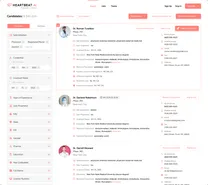
Heartbeat’s database is built to reduce the manual research work involved in tracking down current nursing leadership contacts. Each profile typically includes:
- Chief Nursing Officer name
- Location
- Contact numbers (work, cell, mobile)
- Email address
- Specialization
- Years of experience
- Sole proprietor status
- Licensed states
- License number
- Fax
- Address
Chief Nursing Officer Contact Lists by State
Explore our comprehensive email list of Chief Nursing Officers available across various states.
| Chief nursing officer by states |
|---|
| Chief nursing officer in Alabama |
| Chief nursing officer in Alaska |
| Chief nursing officer in Arizona |
| Chief nursing officer in Arkansas |
| Chief nursing officer in California |
| Chief nursing officer in Colorado |
| Chief nursing officer in Connecticut |
| Chief nursing officer in Delaware |
| Chief nursing officer in Florida |
| Chief nursing officer in Georgia |
| Chief nursing officer in Hawaii |
| Chief nursing officer in Idaho |
| Chief nursing officer in Illinois |
| Chief nursing officer in Indiana |
| Chief nursing officer in Iowa |
| Chief nursing officer in Kansas |
| Chief nursing officer in Kentucky |
| Chief nursing officer in Louisiana |
| Chief nursing officer in Maine |
| Chief nursing officer in Maryland |
| Chief nursing officer in Massachusetts |
| Chief nursing officer in Michigan |
| Chief nursing officer in Minnesota |
| Chief nursing officer in Mississippi |
| Chief nursing officer in Missouri |
| Chief nursing officer in Montana |
| Chief nursing officer in Nebraska |
| Chief nursing officer in Nevada |
| Chief nursing officer in New hampshire |
| Chief nursing officer in New jersey |
| Chief nursing officer in New mexico |
| Chief nursing officer in New york |
| Chief nursing officer in North carolina |
| Chief nursing officer in North dakota |
| Chief nursing officer in Ohio |
| Chief nursing officer in Oklahoma |
| Chief nursing officer in Oregon |
| Chief nursing officer in Pennsylvania |
| Chief nursing officer in Rhode island |
| Chief nursing officer in South carolina |
| Chief nursing officer in South dakota |
| Chief nursing officer in Tennessee |
| Chief nursing officer in Texas |
| Chief nursing officer in Utah |
| Chief nursing officer in Vermont |
| Chief nursing officer in Virginia |
| Chief nursing officer in Washington |
| Chief nursing officer in West virginia |
| Chief nursing officer in Wisconsin |
| Chief nursing officer in Wyoming |
Who Uses a Chief Nursing Officer Email List?
Recruiters and staffing agencies are the most common users, followed by healthcare marketing teams promoting clinical products, software vendors selling to hospital nursing departments, and consultants seeking introductions within a health system. Freelancers offering services to healthcare organizations also use these lists to identify the right point of contact rather than guessing at a general inbox.
Whatever the use case, any outreach list should be used in a way that complies with applicable data protection and communication laws — unauthorized use, resale, or spam-style outreach can create legal exposure regardless of how the data was sourced.
Getting the Most Out of a CNO Contact List
A contact list is only as useful as the outreach built around it. A few practical points worth keeping in mind:
- Match the title to the goal. If you’re recruiting for a bedside nursing role, a CNO may not be the right contact — a nurse manager or director might respond faster.
- Keep messages short and specific. Nursing executives manage large teams and tight schedules; a message that states its purpose in the first line gets read.
- Respect their time zone and shift patterns. Hospital leadership often works around clinical schedules, not standard office hours.
- Follow up once, not repeatedly. A single, well-timed follow-up is more effective than repeated messages that read as pressure.
None of this replaces good contact data — but even accurate contact information gets ignored if the message itself feels generic or mistimed.
Limitations to Keep in Mind
No contact database can guarantee real-time accuracy for every executive, especially in a state with a relatively small number of hospital systems where personnel changes can happen without much public announcement. It’s worth verifying a contact’s current title and employer, particularly for time-sensitive outreach like a recruitment offer, before relying solely on a purchased list.
Frequently Asked Questions
What are the responsibilities of a Chief Nursing Officer in New Hampshire?
A Chief Nursing Officer typically oversees nursing staff, develops and implements nursing policy, manages departmental budgets, monitors patient care quality, and works alongside other hospital executives on operational decisions.
What qualifications are typically required to become a Chief Nursing Officer?
Most CNO roles require an advanced nursing degree, several years of clinical and leadership experience, and an active nursing license in the state where the role is based.
What does a Chief Nursing Officer typically earn?
Compensation varies widely based on the size of the health system, years of experience, and location, so it’s best to check current, region-specific salary data rather than relying on a single fixed figure.