Last updated: August 28, 2026

Finding the right rheumatologist to contact isn’t simple. Patients researching joint or autoimmune conditions, physicians looking for a referral partner, and vendors trying to reach this specialty all run into the same problem: rheumatologists are relatively few in number, spread across hospital systems, private practices, and academic centers, and not easy to locate through a single directory.
A rheumatologist email list solves a narrower but practical problem. It’s a way to reach verified contacts directly, whether you’re coordinating referrals, pitching a product relevant to their practice, or recruiting for an open role. Used well, it cuts down the time spent hunting for contact information and lets you focus on the outreach itself.
This article covers what’s in Heartbeat’s rheumatologist email list, how the data is compiled, and how to use it without wasting your team’s time or running into compliance problems.
What’s on this page:
About HeartBeat’s Rheumatologist Email Lists: What You Will Get
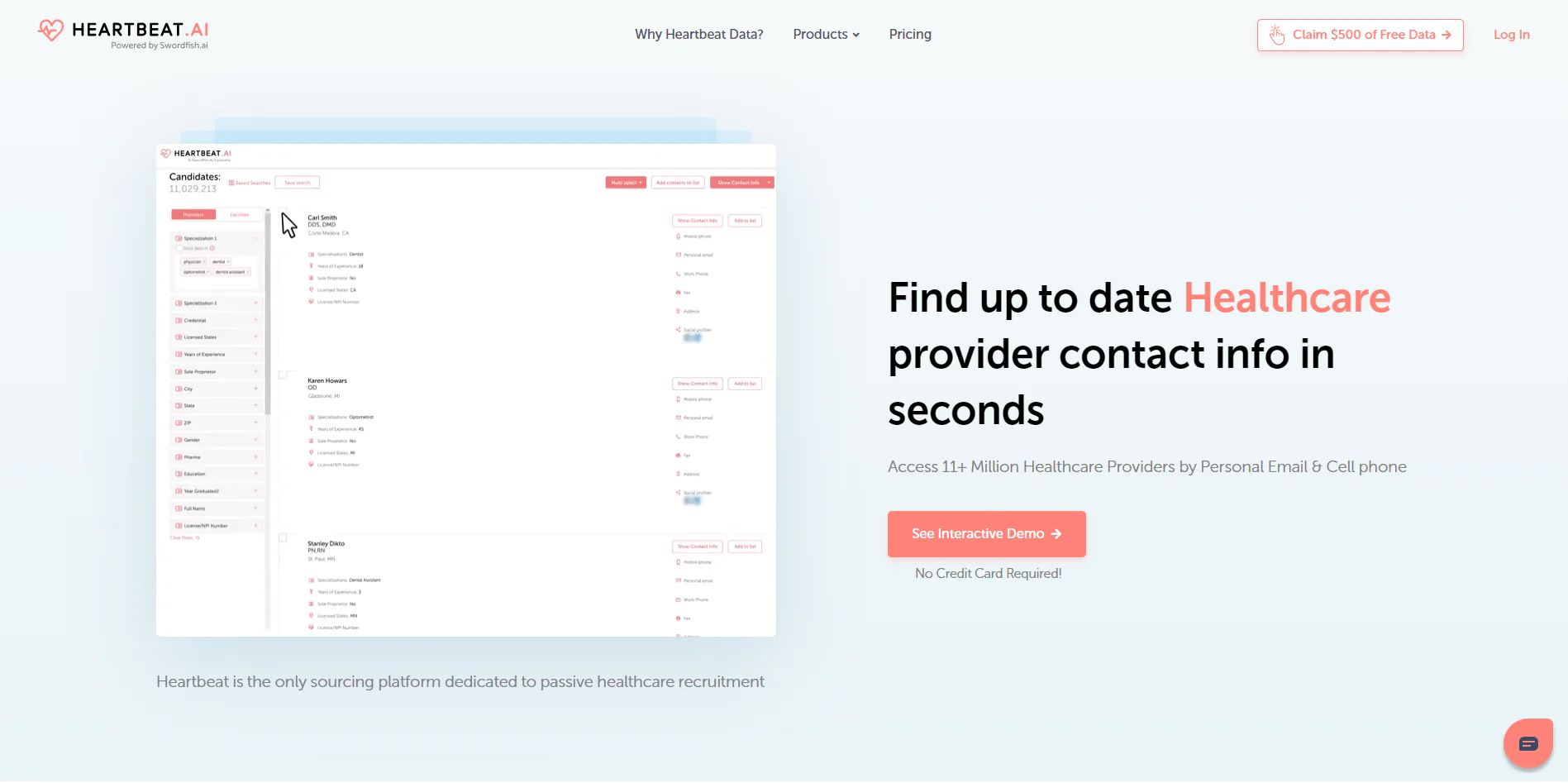
Heartbeat’s rheumatologist database is built to connect you with the rheumatology division across the United States. Here’s what the database includes.
- Nationwide coverage: Rheumatologist contact records across all 50 states.
- Verified contact data: Records sourced and cross-checked through Heartbeat’s network of data partners.
- Customizable filters: Narrow the list by specialization, credentials, or years of experience.
- Multiple use cases: Suitable for referral networking, recruitment, sales outreach, and market research.
- Regularly refreshed data: Sourced from over 200 network data partners to reduce the rate of outdated contacts.
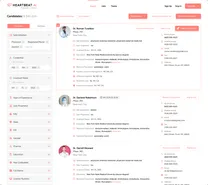
- Detailed profiles: Names, locations, phone numbers, email addresses, specializations, and experience levels.
Types of Data Included in Rheumatologist Mailing List:
- Rheumatologist name
- Location
- Contact numbers (work, cell, mobile)
- Email address
- Specialization
- Years of experience
- Sole proprietor status
- Licensed states
- License number
- Fax
- Address
 Accuracy & coverage of personal contact info were unrivaled by other platforms… this gives any healthcare recruiter a competitive advantage when engaging hard-to-reach healthcare providers.
Senior Growth Strategist






Benefits of Using the Right Rheumatologist Mailing List
A well-matched list changes how your outreach performs. A few practical benefits worth weighing:
- Targeted campaigns: Sending to a specialized rheumatologist list keeps promotional material in front of people who actually have use for it, rather than a generic physician audience.
- Better response rates: Relevant recipients are more likely to open and act on a message than a broad, unfiltered list.
- Efficient use of budget: Narrower targeting means less spend wasted on contacts who were never going to respond.
- Networking opportunities: A curated list can support referral relationships and professional collaboration within rheumatology.
- Market expansion: Access to a specialty-specific list makes it easier to test outreach in new geographic or clinical segments.
Explore our article on hematologist email list for targeted outreach strategies in the medical field. If you’re interested in reaching valid optometrists, check out our optometrists email list.
Who Are You Likely to See in Our Rheumatologist Mail List by Category?
The rheumatology field itself isn’t uniform — practitioners range from general rheumatologists to researchers focused on a single autoimmune condition. Knowing the categories helps you decide how narrow your list should be before you buy.
| Rheumatologist Categories |
| General Rheumatologists |
| Pediatric Rheumatologists |
| Clinical Immunologists |
| Osteoporosis Specialists |
| Lupus Specialists |
| Sports Medicine Rheumatologists |
| Research Rheumatologists |
| Autoimmune Disease Specialists |
Available Rheumatologist in Our Email List by States
The list is broken out by state so you can pull contacts for a single region or scale to a national campaign without sorting through irrelevant records.
| Rheumatologist by State |
| Rheumatologist in Alabama |
| Rheumatologist in Alaska |
| Rheumatologist in Arizona |
| Rheumatologist in Arkansas |
| Rheumatologist in California |
| Rheumatologist in Colorado |
| Rheumatologist in Connecticut |
| Rheumatologist in Delaware |
| Rheumatologist in Florida |
| Rheumatologist in Georgia |
| Rheumatologist in Hawaii |
| Rheumatologist in Idaho |
| Rheumatologist in Illinois |
| Rheumatologist in Indiana |
| Rheumatologist in Iowa |
| Rheumatologist in Kansas |
| Rheumatologist in Kentucky |
| Rheumatologist in Louisiana |
| Rheumatologist in Maine |
| Rheumatologist in Maryland |
| Rheumatologist in Massachusetts |
| Rheumatologist in Michigan |
| Rheumatologist in Minnesota |
| Rheumatologist in Mississippi |
| Rheumatologist in Missouri |
| Rheumatologist in Montana |
| Rheumatologist in Nebraska |
| Rheumatologist in Nevada |
| Rheumatologist in New Hampshire |
| Rheumatologist in New Jersey |
| Rheumatologist in New Mexico |
| Rheumatologist in New York |
| Rheumatologist in North Carolina |
| Rheumatologist in North Dakota |
| Rheumatologist in Ohio |
| Rheumatologist in Oklahoma |
| Rheumatologist in Oregon |
| Rheumatologist in Pennsylvania |
| Rheumatologist in Rhode Island |
| Rheumatologist in South Carolina |
| Rheumatologist in South Dakota |
| Rheumatologist in Tennessee |
| Rheumatologist in Texas |
| Rheumatologist in Utah |
| Rheumatologist in Vermont |
| Rheumatologist in Virginia |
| Rheumatologist in Washington |
| Rheumatologist in West Virginia |
| Rheumatologist in Wisconsin |
| Rheumatologist in Wyoming |
Why Choose Heartbeat.ai’s Rheumatologist Mailing List?
If you’re trying to email rheumatologists directly, here’s what sets this list apart from a generic physician database.
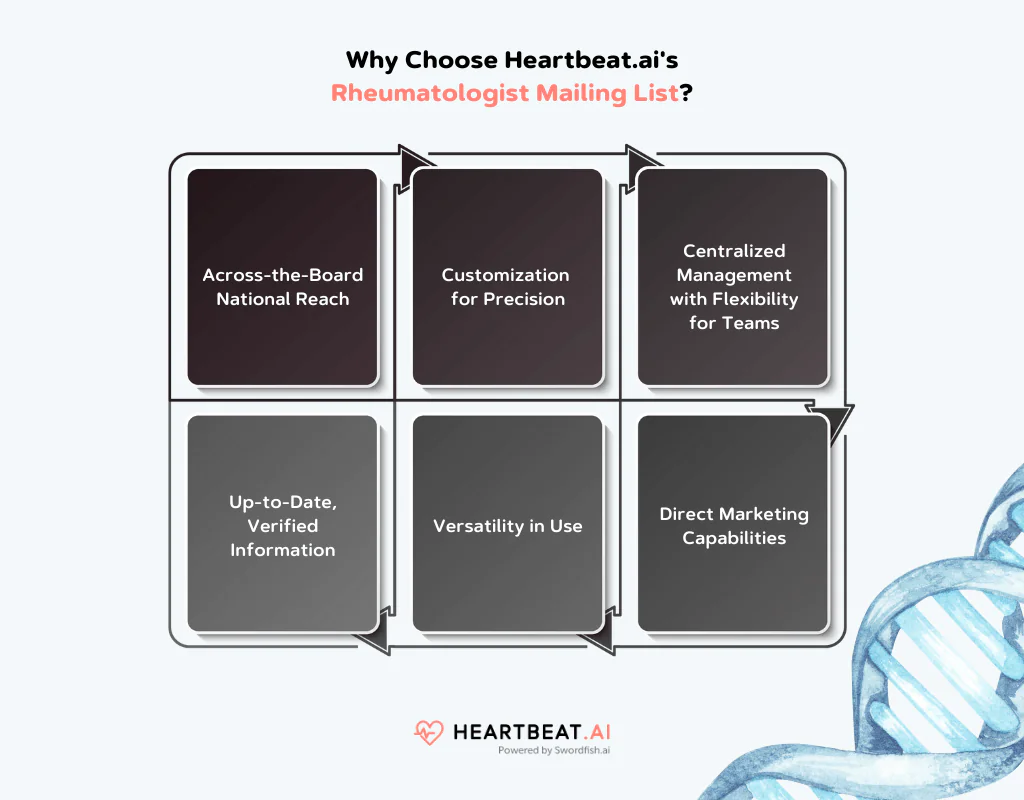
National Reach
The list spans rheumatologists in every state, so you can run a narrow regional campaign or scale to a national push without switching data sources.
Customization for Precision
Filter by specialization, experience, or geography. The narrower your filter, the more relevant your outreach — and typically the better your response rate, since you’re not emailing people outside their area of practice.
Centralized Management with Flexibility for Teams
A single account can support multiple administrators for centralized management, or individual teams can manage their own access while data still syncs back to the central account.
Regularly Verified Information
Data comes from 200+ network partners, with ongoing updates intended to reduce the number of stale or incorrect contacts you encounter.
Versatility in Use
The same underlying dataset supports recruitment, sales outreach, market research, or clinical networking — you’re not locked into one use case.
Direct Marketing Capabilities
Having direct emails and phone numbers on hand supports more personal, one-to-one outreach, which tends to matter more in a relationship-driven specialty like rheumatology than in broader consumer marketing.
How Do We Compile Our Data to Create a Mailing List of Rheumatologists?
Here’s a look at how the data behind these lists gets built and maintained.
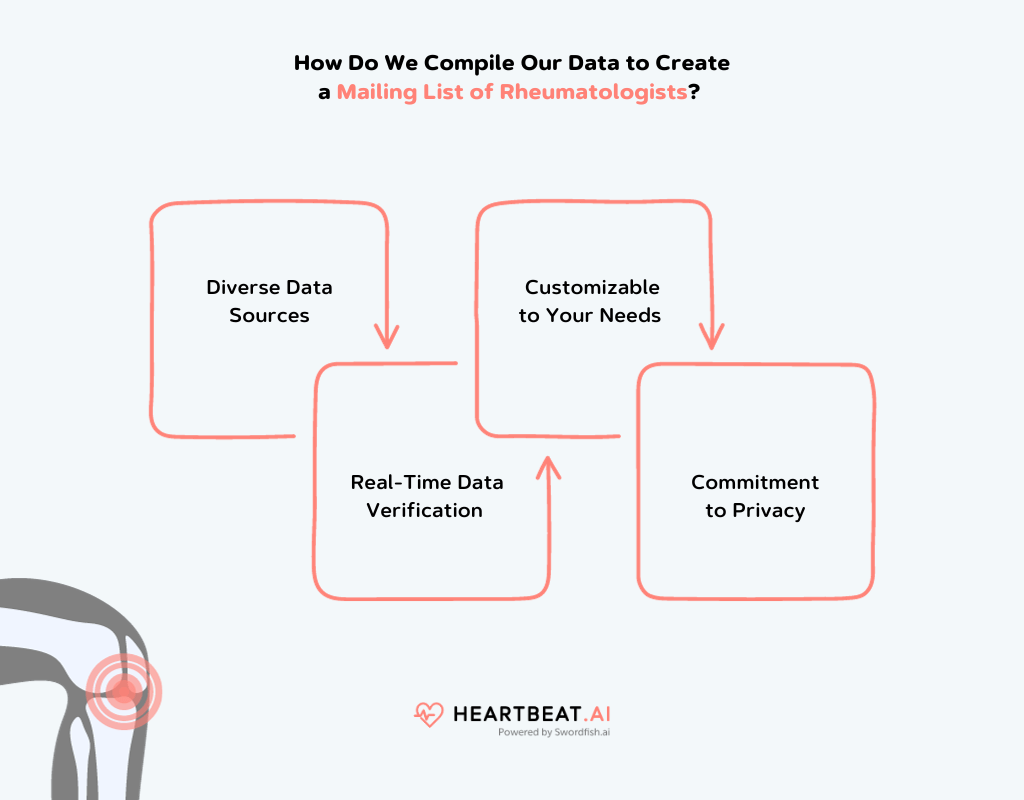
Diverse Data Sources
Records are pulled from multiple sources, including rheumatology associations, healthcare directories, and professional networks, rather than a single feed. This helps capture rheumatologists across different practice settings and specialties.
Ongoing Data Verification
Collaboration with 200+ data partners supports ongoing verification, which is meant to catch outdated or incorrect contact details before they reach you.
Customizable to Your Needs
Lists can be refined by area of expertise, location, or years of practice, and Heartbeat offers a pricing plan structured for different business sizes.
Commitment to Privacy
Data collection is meant to align with applicable privacy standards, which matters both for legal compliance and for the credibility of your outreach.
What to Consider When Getting a Rheumatologist Contact List
Picking a list provider is a decision worth slowing down for. A few factors to check before you commit:
- Current data: Confirm how recently the list was refreshed. Outdated emails waste time and hurt deliverability.
- Compliance: The provider should operate within applicable privacy and anti-spam regulations, such as CAN-SPAM or GDPR where relevant.
- Fit for your goals: If you need a specific region or subspecialty, make sure the list supports that level of filtering.
- Data sourcing: Ask where the contacts come from. Vague or unverifiable sourcing is a red flag.
- Update cadence: Contact information changes constantly in healthcare — hospital moves, practice changes, retirements. Ask how often the list is refreshed.
- CRM compatibility: Check that the list format works with your existing CRM software.
- Cost versus value: A cheaper list with a high bounce rate often costs more in wasted sends than a pricier, better-maintained one.
- Segmentation options: The ability to filter by location or specialty makes outreach more targeted from the start.
Who Can Use the Rheumatologist Email List?
This kind of list tends to serve a specific set of use cases rather than general marketing.
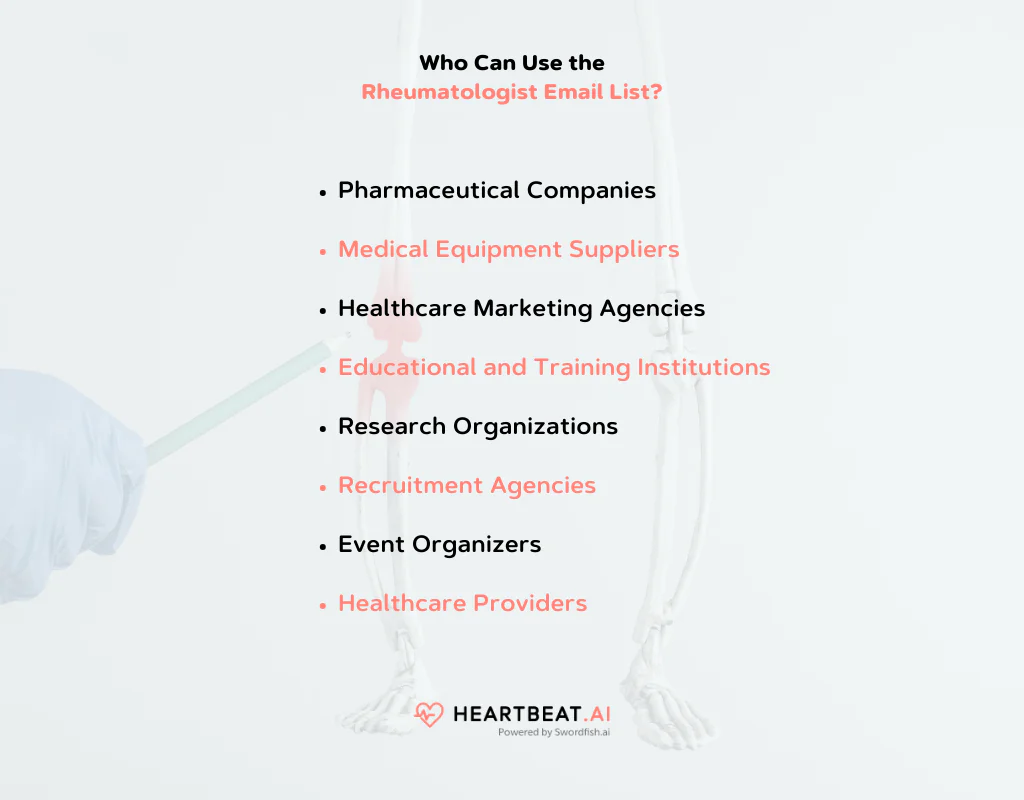
- Pharmaceutical companies: Selling treatments for rheumatic disease means reaching doctors who can prescribe or recommend them.
- Medical equipment suppliers: Vendors of devices used in rheumatology care can connect directly with the specialists who use that equipment.
- Healthcare marketing agencies: Campaigns can be aimed specifically at rheumatologists rather than a broader physician list.
- Educational and training institutions: Programs or courses relevant to rheumatology can be promoted directly to practicing specialists.
- Research organizations: Studies or surveys needing rheumatologist input can recruit participants more efficiently.
- Recruitment agencies: Sourcing candidates for open rheumatology positions becomes more targeted.
- Event organizers: Conference and webinar invitations reach the right specialty audience.
- Healthcare providers: Hospitals and clinics can use the list for referrals or care coordination.
How to Utilize Rheumatologist Email Lists Effectively
Owning a good list is only half the job. How you use it determines whether it actually generates results.
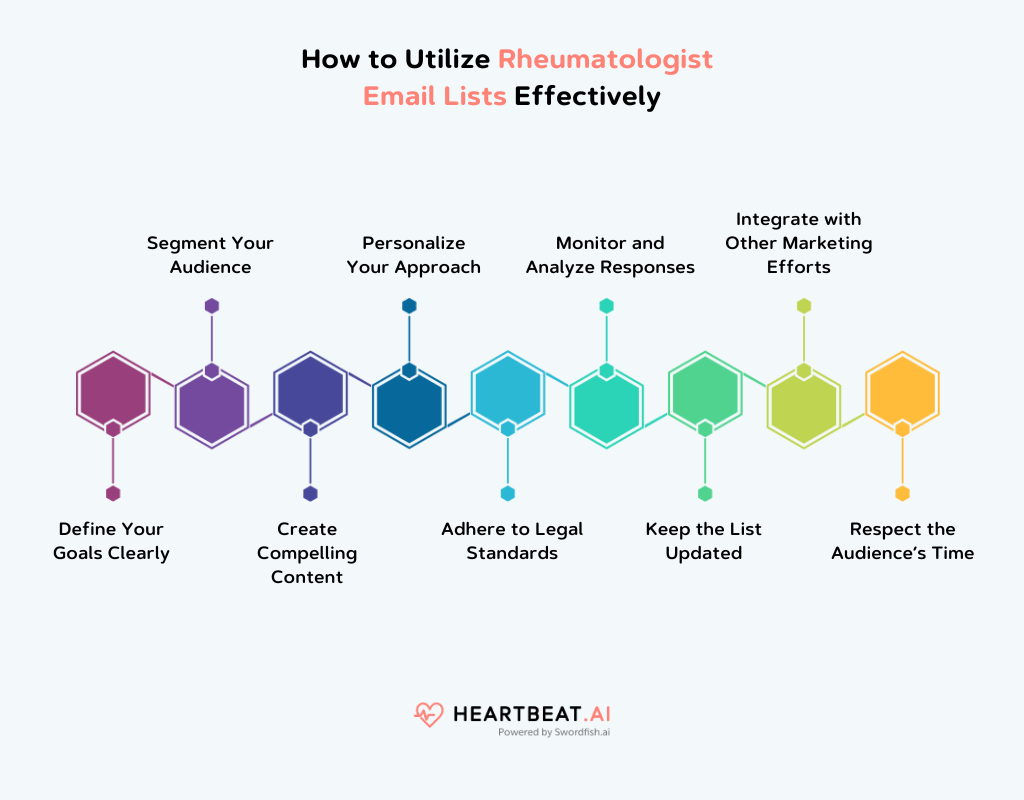
Define Your Goals Clearly
Know what you’re trying to accomplish before drafting anything — a product launch, a research collaboration request, or a recruitment pitch each calls for a different message.
Segment Your Audience
Rheumatologists don’t share identical interests. Segmenting by specialization, geography, or practice type makes each message more relevant.
Create Compelling Content
Give recipients a reason to read further — new research, a relevant webinar, or details on a treatment advancement. Generic sales copy tends to get ignored.
Personalize Your Approach
Referencing a recipient’s specialization or recent publication can noticeably improve engagement compared to a mass-blast template.
Adhere to Legal Standards
Email marketing should comply with applicable regulations like CAN-SPAM or GDPR, including clear opt-out mechanisms.
Monitor and Analyze Responses
Track open rates, click-throughs, and replies to see what’s working, then adjust future sends accordingly.
Keep the List Updated
Contact data degrades over time as physicians change practices or retire. Periodic list refreshes keep your outreach efficient.
Integrate with Other Marketing Efforts
Email works better alongside other channels — social, direct mail, or phone outreach — rather than as a standalone tactic.
Respect the Audience’s Time
Rheumatologists are busy clinicians. Keep messages concise and get to the point quickly.
Conclusion
A rheumatologist email list is only useful if the data behind it is accurate and the outreach built on top of it is relevant. The value isn’t in the size of the list — it’s in whether it gets your message to people who have a real reason to respond.
Heartbeat maintains rheumatologist contact data intended to be current and filterable by specialty, location, and experience, aimed at supporting outreach that doesn’t rely on guesswork.
FAQs
Who stands to gain from using Heartbeat’s rheumatologist mailing lists?
Pharmaceutical companies, medical equipment manufacturers, research organizations, healthcare marketing firms, educational institutions, medical publishers, and healthcare recruitment agencies are the most common users.
Why target rheumatologists specifically for marketing?
Rheumatology is a narrow specialty with specific clinical and product needs, so a targeted list tends to outperform generic physician outreach for anything related to rheumatic or autoimmune care.
Can you find reliable free rheumatologist contact lists?
Free lists exist but are typically inconsistent and go stale quickly. A maintained, verified list is usually a better investment if outreach accuracy matters to your results.