What’s on this page:
Key takeaways
- The article describes Idaho as having a limited psychiatric workforce and says provider contact records can become outdated.
- Recruiters and referral coordinators can benefit from checking that a psychiatrist is currently practicing and confirming contact details before outreach.
- Telepsychiatry can help connect people in remote areas with providers, while accurate practice and contact information remains important.
- Heartbeat.ai offers psychiatrist contact lists with fields such as location, contact details, specialty, and licensing information.
- The article recommends sampling and verifying records before launching a large outreach campaign.
Last updated: August 31, 2026
Finding reliable contact information for psychiatrists in Idaho can be difficult for recruiters, healthcare marketers, and organizations building referral networks. The article describes Idaho as having a small psychiatric workforce relative to its population, making current, accurate contact records especially important.
Idaho’s psychiatry workforce: what the numbers actually show
Idaho ranks the lowest in the United States for number of psychiatrists per capita, with one psychiatrist for every 16,264 residents, according to census data. State behavioral health officials have put the actual headcount in context: the state has roughly a little over 100 psychiatrists, with an estimated need closer to 250.
That gap didn’t appear overnight. Idaho’s shortage has been compounded by professionals leaving the field during the pandemic, with the state’s behavioral health division noting only a little over 100 practicing psychiatrists against an estimated need of around 250. A separate national workforce mapping analysis placed Idaho among the states with the lowest rate of psychiatric providers per 100,000 residents, alongside Alabama, Indiana, Oklahoma, and Nevada.
For anyone building a recruitment pipeline or referral network in Idaho, the article’s central point is that psychiatrists may be geographically dispersed and in demand from multiple health systems. Outdated contact records can slow outreach and make it harder to identify qualified candidates.
Why accurate contact data matters more in a shortage state
Where the number of psychiatrists exceeds the number of available positions, a stale email address may be an inconvenience. In a state facing a reported shortage, an incorrect phone number or bounced email can delay contact with a specialist. That can affect more than recruiting:
- Recruitment timelines stretch out. Health systems competing for the same small pool of candidates need to move fast, and chasing bad contact data adds weeks to a search.
- Referral networks break down. Primary care providers and therapists trying to refer patients to a psychiatrist need current, working contact details, not a name pulled from an old directory.
- Rural access gaps widen. Idaho’s geography already makes in-person psychiatric care difficult outside urban centers; inaccurate contact information compounds that by slowing down telepsychiatry coordination and cross-referrals.
Common obstacles when searching for psychiatrists in Idaho
A few recurring problems show up whenever someone tries to build a list of psychiatrists in this state:
- Small, concentrated supply. With roughly 100-plus practicing psychiatrists statewide, there’s little margin for outdated records — every accurate contact counts.
- Rural distribution. Many communities outside Boise, Coeur d’Alene, and Idaho Falls have few or no local psychiatrists, pushing patients and referring providers toward telepsychiatry.
- High turnover in directory listings. Practices change locations, join larger systems, or shift to telehealth-only models, and public directories often lag behind these changes.
- Stigma-related underreporting. Some providers keep a lower public profile, which can make them harder to find through standard search methods.
Telepsychiatry can help people in remote parts of Idaho connect with providers without traveling long distances. For recruiters and networking professionals, the challenge remains identifying who is currently practicing, where they practice, and how to contact them.
What a psychiatrist contact list from Heartbeat includes
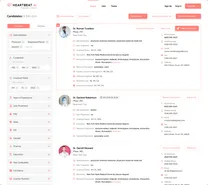
Heartbeat.ai offers psychiatrist contact records for searches focused on Idaho or spanning multiple states. The records are intended to provide outreach details beyond a provider’s name and general practice address.
Typical fields included in a psychiatrist contact record:
- Psychiatrist name
- Location
- Contact numbers (work, cell, mobile)
- Email address
- Specialization
- Years of experience
- Sole proprietor status
- Licensed states
- License number
- Fax
- Address
Heartbeat’s coverage spans multiple psychiatric specialties, including child and adolescent psychiatry, addiction psychiatry, geriatric psychiatry, forensic psychiatry, psychosomatic medicine, and neuropsychiatry. This kind of segmentation is useful if you’re recruiting for a specific clinical role rather than a general psychiatry position — a children’s hospital search and an addiction treatment center search need very different candidate pools.
 Accuracy & coverage of personal contact info were unrivaled by other platforms… this gives any healthcare recruiter a competitive advantage when engaging hard-to-reach healthcare providers.
Senior Growth Strategist






Available psychiatrist contact lists by state
Explore the available psychiatrist contact lists by U.S. state, including Idaho.
| Psychiatrists by states |
|---|
| Psychiatrists in Alabama |
| Psychiatrists in Alaska |
| Psychiatrists in Arizona |
| Psychiatrists in Arkansas |
| Psychiatrists in California |
| Psychiatrists in Colorado |
| Psychiatrists in Connecticut |
| Psychiatrists in Delaware |
| Psychiatrists in Florida |
| Psychiatrists in Georgia |
| Psychiatrists in Hawaii |
| Psychiatrists in Idaho |
| Psychiatrists in Illinois |
| Psychiatrists in Indiana |
| Psychiatrists in Iowa |
| Psychiatrists in Kansas |
| Psychiatrists in Kentucky |
| Psychiatrists in Louisiana |
| Psychiatrists in Maine |
| Psychiatrists in Maryland |
| Psychiatrists in Massachusetts |
| Psychiatrists in Michigan |
| Psychiatrists in Minnesota |
| Psychiatrists in Mississippi |
| Psychiatrists in Missouri |
| Psychiatrists in Montana |
| Psychiatrists in Nebraska |
| Psychiatrists in Nevada |
| Psychiatrists in New hampshire |
| Psychiatrists in New jersey |
| Psychiatrists in New mexico |
| Psychiatrists in New york |
| Psychiatrists in North carolina |
| Psychiatrists in North dakota |
| Psychiatrists in Ohio |
| Psychiatrists in Oklahoma |
| Psychiatrists in Oregon |
| Psychiatrists in Pennsylvania |
| Psychiatrists in Rhode island |
| Psychiatrists in South carolina |
| Psychiatrists in South dakota |
| Psychiatrists in Tennessee |
| Psychiatrists in Texas |
| Psychiatrists in Utah |
| Psychiatrists in Vermont |
| Psychiatrists in Virginia |
| Psychiatrists in Washington |
| Psychiatrists in West virginia |
| Psychiatrists in Wisconsin |
| Psychiatrists in Wyoming |
How Heartbeat compiles this data
Heartbeat.ai says it aggregates provider records from official, private, and public sources and uses predictive modeling to supplement contact details when public records are incomplete. The company describes its database as covering healthcare professionals nationwide and including direct cell numbers and personal email addresses. Contact details should be checked before use.
No dataset is perfect, and predictive contact matching works better for some provider types and regions than others. If you’re building an Idaho-specific list, it’s worth cross-checking a sample of records against a provider’s current practice listing before launching a large outreach campaign, especially given how quickly small-state directories go stale.
Who typically uses a psychiatrist contact list
- Healthcare recruiters filling clinical roles at hospitals, health systems, or private practices
- Marketing teams promoting relevant products, services, or continuing education to psychiatric specialists
- Researchers and professional associations coordinating outreach or survey work
- Referral coordinators trying to connect patients with specialists faster
Anyone using this kind of list needs to stay within applicable privacy and anti-spam regulations, and treat provider contact information with the same care expected of any professional outreach.
Getting more out of a psychiatrist contact list
A list is only as useful as the outreach built around it. A few practical guidelines:
- Lead with something specific. A generic pitch gets ignored; referencing a provider’s specialty or recent practice move signals you did your homework.
- Respect clinical schedules. Psychiatrists in a shortage state are often stretched thin — keep outreach short and easy to act on.
- Verify before you commit resources. Cross-check a sample of contacts before a full campaign, particularly for smaller states with fewer providers to reach.
- Refresh your list periodically. Practice changes happen quickly in a market this small; a list that’s a year old may already be missing key moves.
The bottom line
The article describes Idaho as having a psychiatric workforce shortage, which can make accurate contact information valuable for recruiting, referrals, and professional networking. Verify records before outreach, since provider details can change and no contact list is guaranteed to be fully current.
Frequently Asked Questions
What services do psychiatrists in Idaho offer?
Psychiatrists in Idaho offer services including therapy, medication management, and diagnosis of mental health conditions.
How can I find a psychiatrist in Idaho?
You can find a psychiatrist in Idaho by searching online directories, asking for referrals from a primary care physician, or contacting an insurance provider for a list of covered psychiatrists.
What qualifications should I look for in a psychiatrist in Idaho?
When choosing a psychiatrist in Idaho, look for board certification in psychiatry, relevant experience treating the specific condition in question, and a comfortable working rapport.
Do psychiatrists in Idaho accept insurance?
Many psychiatrists in Idaho accept insurance, but coverage varies by provider and plan, so it’s worth confirming directly with the psychiatrist’s office and the insurer beforehand.