Last updated: August 29, 2026
Ben Argeband, Founder & CEO of Heartbeat.ai — templates and targeting notes for recruiters working occupational therapist searches.
What’s on this page:
Who this is for
Sourcing OTs comes with predictable friction: packed clinic and school schedules, narrow call windows, and almost no patience for a generic pitch. Dialing more names doesn’t fix that. What works is targeting the right practice setting, confirming license context before you reach out, and running a short sequence with clean suppression and an easy opt-out.
This guide walks through using occupational therapist contact data the way it actually gets used on a recruiting desk: build a small list fast, verify it fast, and know when to stop.
Quick Answer
- Core Answer
- Build small OT lists segmented by setting, verify license status, apply suppression, then run a short email-and-call sequence with clear opt-out and stop rules.
- Key Insight
- Static, purchased lists decay quickly. A steadier approach treats data as something you access, refresh, verify, and suppress on an ongoing basis rather than a one-time export.
- Best For
- Recruiters sourcing occupational therapists across school, outpatient, inpatient rehab, and home health settings.
Compliance & Safety
This method is for legitimate recruiting outreach only. Respect candidate privacy, opt-out requests, and local data laws. Heartbeat does not provide medical advice or legal counsel.
Small lists beat big lists
OT recruiting is setting-driven. A school-based occupational therapist and one working inpatient rehab may be equally strong clinicians, but they run on different schedules and respond to different messaging and timing.
A few working principles keep outreach fast without burning your list:
- Small lists you can actually work end-to-end — build, verify, contact, disposition.
- Clear segmentation by setting and geography so the message matches the OT’s actual workday.
- Suppression-first so you never re-contact an opt-out or a record you already know is bad.
The trade-off is more time spent on list prep up front, in exchange for far less time wasted on wrong numbers, bounces, and outreach that misses the setting entirely.
Step-by-step method
Step 1: Define the OT profile, setting first
Write a one-line target definition before pulling any contacts:
- Setting: school-based, outpatient, inpatient rehab, acute care, home health, SNF/LTC, hand therapy, and so on.
- Geography: commute radius or specific counties.
- License requirement: which state license is needed, and whether it has to be active by the start date.
- Schedule reality: clinic hours versus school day versus travel blocks.
Skipping this step is the most common cause of outreach that reads as generic and gets ignored.
Step 2: Pull a small list and segment immediately
Start with a batch you can realistically finish. Cap segments at two to four groups — school-based versus outpatient versus inpatient rehab, for example — and keep them clean enough to measure separately.
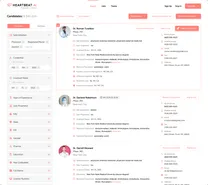
In Heartbeat.ai, you can start free search & preview data and build a targeted list without committing to one giant static export.
Step 3: Capture the fields your team can actually use
Contact data only helps if it lands in your ATS or CRM with the fields that drive routing, suppression, and follow-up. This is a workable minimum field set:
| Field | Why it matters | Example value format |
|---|---|---|
| Full name | Deduping and license matching | Last, First |
| Setting tag | Message relevance and routing | School-based / Outpatient / Inpatient rehab |
| State + license status | Eligibility and credibility | CA — Active |
| License checked date | Audit trail and refresh timing | YYYY-MM-DD |
| Email sequence and deliverability tracking | work/personal | |
| Phone | Call/text outreach and connect tracking | phone (type noted if known) |
| Opt-out flag | Compliance and brand protection | Yes/No + date |
| Last touch + outcome | Stop rules and recruiter coordination | 2026-01-05 — No answer |
| Source note | Trust and troubleshooting | License checked via state board + outreach list |
What’s included versus what isn’t: contact data helps you reach the right occupational therapist faster, but it doesn’t guarantee that a given email delivers or a given phone number connects. That’s the reason refresh, verification, and suppression sit ahead of outreach in this workflow, not after it.
Step 4: Verify license context before outreach
For OT recruiting, license verification is a gating step, not an afterthought. Check the state license status and record the date you checked. Use the internal hub to move across states quickly: occupational therapy license lookup by state.
This step still requires manual verification — boards update on different cadences, and name collisions happen more often than people expect.
Step 5: Apply suppression and dedupe before you send or dial
Suppression is where most teams either protect their pipeline or quietly damage it. Before any outreach goes out:
- Suppress prior opt-outs, prior bounces, and any “do not contact” requests across the whole team, not just one recruiter’s list.
- Dedupe so one occupational therapist isn’t sitting in two recruiters’ sequences at the same time.
- Route by setting tag so the right recruiter is using the right message.
The broader idea is to treat your list as accessed and refreshed rather than static — validate license context and channel readiness before outreach, and avoid workflows that rely on a one-time export sitting untouched for months.
For a QA workflow covering contactability and list hygiene, see: data quality verification for recruiting outreach.
Step 6: Use a consistent disposition taxonomy
Standardized outcomes let your team suppress correctly and actually learn what’s working. A workable set:
- Interested — schedule a screen.
- Not now — set a future follow-up date.
- Referral — capture referrer and referred contact, with consent.
- Opt-out — add to suppression immediately.
- Wrong number — stop dialing, flag for verification.
- Bounce — stop emailing, flag for refresh.
- No response — cool off after the sequence completes.
Step 7: Run a short, respectful sequence with stop rules
OTs respond better when the ask is small and the role is specific. Keep the sequence short and stop fast if there’s no signal:
- Email 1: setting-specific role plus one yes/no question.
- Call 1: short voicemail referencing the email; offer a two-minute screen.
- Email 2: clarify schedule and start date; offer two time windows.
- Call 2: final attempt; if there’s no engagement, stop and cool off the record.
Call windows vary by setting. Use this as a starting point and adjust based on your own connect data:
| Setting | Suggested call windows | Why it tends to work |
|---|---|---|
| School-based | Early morning; lunch; after school | Between student blocks and meetings |
| Outpatient | Early morning; lunch; end of day | Between patient appointments |
| Inpatient rehab / acute care | Early morning; late afternoon | Between rounds, treatments, and documentation |
| Home health | Early morning; lunch; early evening | Between travel and visits |
Stop rules protect both your brand and your recruiter time. If there’s no reply, no pickup, and no referral after the planned touches, disposition the record and move on.
Step 8: Track metrics that actually change behavior
- Deliverability Rate = delivered emails / sent emails (per 100 sent).
- Bounce Rate = bounced emails / sent emails (per 100 sent).
- Connect Rate = connected calls / total dials (per 100 dials).
- Reply Rate = replies / delivered emails (per 100 delivered).
A practical way to use these: run the same sequence against two setting segments — school-based versus outpatient, for example — and compare deliverability, connect rate, and reply rate. Fix targeting and suppression first; rewrite templates second.
Diagnostic table
| What you see | What it usually means | OT-specific fix | What to measure next |
|---|---|---|---|
| Bounce Rate spikes on OT segment | Stale emails or missing suppression | Refresh list, suppress prior bounces/opt-outs, keep segments tight by setting | Bounce Rate = bounced / sent (per 100 sent) |
| Low Connect Rate on calls | Calling during treatment blocks or wrong numbers | Shift call windows (early AM, lunch, after 5), verify numbers, reduce repeat dials | Connect Rate = connected / total dials (per 100 dials) |
| Replies: “Not my setting” | Targeting too broad | Rebuild list by setting tag; name the setting in the subject line | Reply Rate = replies / delivered (per 100 delivered) |
| OT says: “I’m not licensed there” | License not checked or wrong state | Verify state license before outreach; record state and date checked | Audit “license checked date” field completion |
| Complaints about unwanted contact | Opt-out not clear or not honored | Add opt-out line; centralize suppression; stop after planned touches | Time-to-suppress after opt-out request |
Weighted checklist
Score each item 0-2 (0 = no, 1 = partial, 2 = yes). If a segment scores under 10, fix the list before launching outreach.
- (2) Setting is defined and matches the job, not a generic “OT” tag.
- (2) State license status verified and “license checked date” recorded.
- (2) Suppression applied — opt-out, bounce, do-not-contact — across the whole team.
- (2) Outreach includes a clear opt-out and respects consent expectations.
- (2) Stop rules exist (max touches plus cooling-off period) and are followed.
- (2) Metrics tracked per segment: deliverability, bounce, connect, reply.
One workflow note worth flagging: if two recruiters can touch the same market, you need one shared suppression list and one shared dedupe rule. Otherwise you’ll double-tap the same occupational therapist and create avoidable opt-outs.
Outreach templates
Use these as starting points, not final copy. Keep the ask small, name the setting, and make opt-out obvious.
Template 1 — School-based OT (email)
Subject: Quick question — school-based OT availability?
Hi [First Name] — I’m recruiting for a school-based occupational therapist role in [City/Area]. Are you open to a quick call, or should I close the loop?
If you’re not interested but know someone who is, I’ll take a referral.
— [Your Name]
[Company] | [Phone]
Opt-out: reply “opt out” and I will stop contacting you.
Template 2 — Outpatient OT (call + voicemail)
Hi [First Name], this is [Your Name] with [Company]. I’m calling about an outpatient OT opening in [Area] with a schedule that looks like [brief schedule]. If you’re open to a two-minute screen, call me at [Number]. If not, reply “opt out” and I will stop contacting you.
Template 3 — Inpatient rehab OT (email)
Subject: Inpatient rehab OT — quick availability check
Hi [First Name] — I’m working an inpatient rehab occupational therapist need in [Facility/Area]. Are you open to hearing details, yes or no?
If yes, what’s the best time to talk: early AM, lunch, or after 5?
— [Your Name]
[Company] | [Phone]
Opt-out: reply “opt out” and I will stop contacting you.
The two-question OT screen
When an OT replies, don’t send a wall of text. Two questions sort fit fast:
- Q1 (setting fit): “Are you looking for [setting] specifically, or open to [alternate setting]?”
- Q2 (schedule fit): “What schedule is non-negotiable for you right now — days, hours, call, travel?”
This keeps the conversation moving and cuts down on ghosting because the OT can answer in one message.
Stop rules for every sequence
- If the OT asks to stop, confirm and add to suppression.
- If you get a bounce, stop emailing that address and mark it for refresh or verification.
- If you reach a wrong number, stop dialing and mark the record for verification.
- If there’s no engagement after planned touches, disposition and cool off the record.
Common pitfalls
- Working unsegmented lists. Mixing settings forces generic messaging and lowers replies.
- Skipping license context. You lose credibility fast pitching a role in a state the OT can’t work.
- No shared suppression. One opt-out has to suppress across the whole team, not one recruiter’s spreadsheet.
- Over-contacting with no signal. Repeated touches with no engagement create complaints and blocks.
- Not recording outcomes. Without disposition data, you can’t improve targeting or timing.
How to improve results
Improvement comes from tightening the workflow, not adding more steps:
- Pick one segment — school-based OTs within your commute radius, for example.
- Run one sequence with the same touches and timing for the whole segment.
- Track outcomes per segment: deliverability, bounce, connect, and reply rate.
- Fix in this order: suppression and bounces, then setting targeting, then call windows, then message.
For a deeper checklist on list QA and verification steps, see: data quality verification for recruiting outreach.
Legal and ethical use
Use occupational therapist contact data for legitimate recruiting outreach only. Respect privacy, keep messages role-specific, and make opt-out easy. Honor opt-out requests immediately and maintain a suppression list so you don’t re-contact the same person later.
License information is often public, but data handling rules vary by state and organization. Align your process with your own compliance requirements around consent, retention, and suppression.
Evidence and trust notes
We treat contact data as a workflow — source evaluation, refresh, verification, suppression — rather than a static file. For how Heartbeat.ai approaches trust and quality in resources, see: Trust & methodology for Heartbeat resources.
For state licensure context and links to state boards, see: AOTA state licensure information.
For broader navigation across this cluster, see the provider contact data hub.
FAQs
What should I store in my ATS/CRM when I pull occupational therapist contact data?
At minimum: setting tag, state license status, license checked date, email, phone, opt-out flag, last touch date, outcome, and a source note. Those fields drive routing, compliance, and measurement.
How do I verify an OT license before outreach?
Check the relevant state board lookup and record the state and date checked. Use this hub to move faster across states: occupational therapy license lookup by state.
How often should I refresh occupational therapist contact data?
Refresh based on triggers rather than a fixed calendar: refresh when you see bounces, wrong numbers, increased role urgency, or a record that hasn’t been touched since your last campaign. Always re-check suppression before any new sequence.
What metrics matter most for OT outreach?
Deliverability Rate, Bounce Rate, Connect Rate, and Reply Rate, each measured per segment rather than across the whole list. Segment comparisons tell you whether the problem is the list or the message.
How do I handle opt-out requests correctly?
Confirm the request, mark the record as opt-out, and add it to a shared suppression list so the OT is excluded from future outreach across your team.
How do I avoid wasting time on the wrong OT setting?
Segment by setting before outreach and name the setting in the subject line and first sentence. If replies still say “not my setting,” tighten your list filters and tags before changing the sequence.
Next steps
- Start free search & preview data and build a small OT segment by setting.
- Verify license status using the occupational therapy license lookup hub and record the date checked.
- Implement suppression and QA using our data quality verification workflow.
About the Author
Ben Argeband is the Founder and CEO of Swordfish.ai and Heartbeat.ai. With deep expertise in data and SaaS, he has built two successful platforms trusted by over 50,000 sales and recruitment professionals. Ben’s mission is to help teams find direct contact information for hard-to-reach professionals and decision-makers, providing the shortest route to their next win. Connect with Ben on LinkedIn.