Last updated: August 31, 2026
Recruiters, marketers, and healthcare organizations searching for prescriptive nurses in Wisconsin run into a familiar problem: the right candidate exists, but their contact information is outdated, incomplete, or simply not public. Getting a targeted list of verified emails and phone numbers is what turns a search into an actual conversation.
This guide covers what a prescriptive nurse credential means in Wisconsin, the state’s healthcare landscape, the practical challenges of finding accurate contact details, and how a data provider like Heartbeat.ai fits into that workflow.
What’s on this page:
Wisconsin Is Changing How It Credentials Prescriptive Nurses
APNP (Advanced Practice Nurse Prescriber) is Wisconsin’s current credential title for advanced practice nurses with prescriptive authority, while APRN (Advanced Practice Registered Nurse) is the term used in most other states for the same type of license. That’s changing. Under 2025 WI Act 17, Wisconsin will officially transition the credential name to APRN, effective September 1, 2026, and until then the credential is still issued as APNP.
On August 8, 2025, Wisconsin Governor Tony Evers signed 2025 Wisconsin Act 17 into law, modernizing APRN practice and prescriptive authority and creating a pathway to independent practice. The act formally recognizes four distinct APRN roles: nurse practitioner, certified nurse-midwife, clinical nurse specialist, and certified registered nurse anesthetist.
Independent practice is not automatic under the new law. The act eliminates mandatory physician collaboration only for nurse practitioners who clear a high bar of combined RN and supervised APRN clinical experience hours, and independence is not automatic with the new APRN license. Current APNP certificate holders receive their license without reapplication, but the independent practice credential requires a separate verification of hours, fee payment, and malpractice coverage. Anyone building outreach lists that reference “independent practice” status should treat that as a distinct, verifiable data point rather than something that applies broadly to all APRNs.
Licensing Requirements at a Glance
- A graduate degree and national certification are both required, with the degree coming from an institution accredited by CHEA or another Board-approved agency.
- 45 pharmacology hours are required before applying, and the clinical pharmacology or therapeutics coursework must be completed within five years before the application date.
- The jurisprudence exam is part of the application process, and after submitting an application, candidates complete the Wisconsin statutes and rules exam online.
- Every APRN must complete 16 contact hours per biennium in clinical pharmacology or therapeutics relevant to their area of practice, and those with prescriptive authority must complete at least 2 contact hours on responsible prescribing of controlled substances.
For collaboration requirements specifically tied to pain management, APRNs treating pain are required to work in a collaborative relationship with a physician meeting specified criteria, unless the APRN has qualified for independent practice and is practicing in a hospital or hospital-associated clinic or holds hospital privileges.
Why Contact Accuracy Matters More in a Transition Year
Credential names, license categories, and collaboration requirements are all shifting in Wisconsin at the same time. That makes outdated directories and stale contact lists riskier than usual for outreach — a nurse’s title, scope notation, or practice status listed six months ago may no longer be accurate. Recruiters and vendors reaching out to this population should treat license verification and contact freshness as separate but related checks.
- Recruitment: Incorrect emails or phone numbers stall hiring pipelines and waste recruiter time chasing dead leads.
- Vendor and product outreach: Sales teams targeting nurse practitioners for clinical tools or services need current work emails and direct numbers, not general clinic lines.
- Professional networking: Continuing education partners, associations, and referral networks depend on being able to reach the right specialist directly.
Challenges in Locating Prescriptive Nurses Across Wisconsin
Wisconsin’s healthcare system spans large academic medical centers and thinly staffed rural clinics. That geographic spread creates a few recurring problems for anyone trying to build a contact list:
- Rural counties have fewer providers, so any given specialty or role may be represented by only a handful of individuals statewide.
- Public directories often list a general facility phone number rather than a direct line or personal email.
- Role titles are inconsistent across sources — some list “APNP,” others “nurse practitioner,” and going forward some will list “APRN,” which can cause list-matching errors during the credential transition.
- Specialty and certification details (family practice, psychiatric, pediatric, and so on) aren’t always current in public license lookups.
A verified contact database that’s updated on a rolling basis helps offset these gaps, but it’s worth checking any list against the Wisconsin Board of Nursing’s license lookup for high-stakes outreach, especially during a credentialing transition year.
What Heartbeat.ai’s Prescriptive Nurse Contact List Includes
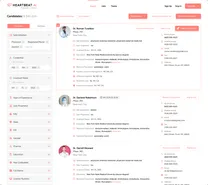
Heartbeat.ai compiles contact and professional details for licensed healthcare providers, including prescriptive nurses, across the United States. A Wisconsin-specific list typically includes:
- Prescriptive nurse name
- Location
- Contact numbers (work, cell, mobile)
- Email address
- Specialization
- Years of experience
- Sole proprietor status
- Licensed states
- License number
- Fax
- Address
Who Actually Uses These Lists
The use cases are narrower than “anyone who wants contact data.” In practice, the people pulling prescriptive nurse contact lists tend to fall into a few categories:
- Healthcare recruiters and staffing agencies filling nurse practitioner or clinical specialist roles.
- Medical device and pharma sales teams targeting prescribers by specialty.
- Continuing education and association outreach teams promoting credentialing programs or conferences.
- Healthcare marketing agencies running campaigns on behalf of clinics or health systems.
Freelance researchers and smaller practices sometimes need a handful of contacts rather than a bulk list — in those cases, a filtered, small-batch pull is usually more cost-effective than a full state list.
A Practical Workflow for Using a Prescriptive Nurse Contact List
- Define the specific role and specialty you need before pulling data — “nurse practitioner” is too broad if you’re targeting psychiatric or pediatric prescribers specifically.
- Filter by location if you’re running regional campaigns; Wisconsin’s rural-urban split means a Milwaukee-focused list looks very different from a statewide one.
- Cross-check license status against the Wisconsin Board of Nursing lookup for any contact you plan to rely on for compliance-sensitive outreach.
- Respect opt-out and privacy preferences and keep outreach professional and clearly purposed.
- Refresh the list periodically — contact details and credential titles change, particularly during Wisconsin’s current APNP-to-APRN transition.
Limitations Worth Knowing
No third-party contact database can guarantee real-time accuracy on license status changes, especially during a year when Wisconsin is actively reissuing credentials under Act 17. Treat any purchased list as a strong starting point for outreach, not a substitute for verifying license and scope-of-practice details directly with the state board when it matters.
Prescriptive Nurse Contact Lists by State
| Prescriptive nurse by states |
|---|
| Prescriptive nurse in Alabama |
| Prescriptive nurse in Alaska |
| Prescriptive nurse in Arizona |
| Prescriptive nurse in Arkansas |
| Prescriptive nurse in California |
| Prescriptive nurse in Colorado |
| Prescriptive nurse in Connecticut |
| Prescriptive nurse in Delaware |
| Prescriptive nurse in Florida |
| Prescriptive nurse in Georgia |
| Prescriptive nurse in Hawaii |
| Prescriptive nurse in Idaho |
| Prescriptive nurse in Illinois |
| Prescriptive nurse in Indiana |
| Prescriptive nurse in Iowa |
| Prescriptive nurse in Kansas |
| Prescriptive nurse in Kentucky |
| Prescriptive nurse in Louisiana |
| Prescriptive nurse in Maine |
| Prescriptive nurse in Maryland |
| Prescriptive nurse in Massachusetts |
| Prescriptive nurse in Michigan |
| Prescriptive nurse in Minnesota |
| Prescriptive nurse in Mississippi |
| Prescriptive nurse in Missouri |
| Prescriptive nurse in Montana |
| Prescriptive nurse in Nebraska |
| Prescriptive nurse in Nevada |
| Prescriptive nurse in New hampshire |
| Prescriptive nurse in New jersey |
| Prescriptive nurse in New mexico |
| Prescriptive nurse in New york |
| Prescriptive nurse in North carolina |
| Prescriptive nurse in North dakota |
| Prescriptive nurse in Ohio |
| Prescriptive nurse in Oklahoma |
| Prescriptive nurse in Oregon |
| Prescriptive nurse in Pennsylvania |
| Prescriptive nurse in Rhode island |
| Prescriptive nurse in South carolina |
| Prescriptive nurse in South dakota |
| Prescriptive nurse in Tennessee |
| Prescriptive nurse in Texas |
| Prescriptive nurse in Utah |
| Prescriptive nurse in Vermont |
| Prescriptive nurse in Virginia |
| Prescriptive nurse in Washington |
| Prescriptive nurse in West virginia |
| Prescriptive nurse in Wisconsin |
| Prescriptive nurse in Wyoming |
Conclusion
Wisconsin’s prescriptive nurse credentialing is in the middle of a real transition — APNP is becoming APRN, and the rules around independent practice are being phased in through 2026 and beyond. Anyone building outreach or recruitment lists for this group should pair a verified contact database with a habit of checking license status directly when accuracy matters most.
Frequently Asked Questions
What is a prescriptive nurse in Wisconsin?
A prescriptive nurse in Wisconsin is an advanced practice nurse — currently credentialed as an APNP and transitioning to APRN under state law — who has completed additional education and training and holds authority to prescribe medications within their scope of practice.
What qualifications are required to become a prescriptive nurse in Wisconsin?
Candidates need an active Wisconsin RN license, a graduate degree in nursing from an accredited program, current national certification in their role, completion of required pharmacology coursework, and passage of the state’s jurisprudence exam.
What is the scope of practice for a prescriptive nurse in Wisconsin?
Scope of practice generally includes assessing, diagnosing, and treating patients, prescribing medications, ordering and interpreting diagnostic tests, and collaborating with physicians where required by law or the nurse’s specific practice status.
How can I verify if a nurse is authorized to prescribe in Wisconsin?
You can check licensure and prescriptive authority status through the Wisconsin Department of Safety and Professional Services license lookup or by contacting the Wisconsin Board of Nursing directly.