Last updated: August 30, 2026
Physician assistants make up a large share of New York’s clinical workforce, and reaching the right ones — for recruiting, device sales, research outreach, or professional networking — usually comes down to one thing: whether your contact data is current. PA license status, employer affiliations, and specialties shift often enough that a list built even a year ago can carry a meaningful error rate.
This guide covers what accurate PA contact data actually enables, where sourcing typically breaks down, and what to check before you rely on a vendor’s list for outreach in New York State.
What’s on this page:
Why Accurate Contact Data Matters for New York PAs
Three groups depend on correct PA contact information for different reasons:
- Recruiters and health systems need working phone numbers and emails to move candidates through hiring pipelines without losing them to slower-moving competitors.
- Vendors and marketers — medical device reps, CME providers, pharma outreach teams — need to reach PAs by specialty and location without wasting sends on outdated addresses.
- Peer networking and referral coordination depends on knowing how to reach a specific PA quickly, particularly across large health systems where directory information isn’t always public.
Bad contact data doesn’t just waste time. In recruiting specifically, a missed connection with a qualified candidate has a real cost — the position stays open longer, and hiring managers fall back on slower channels.
New York’s Healthcare Landscape and PA Scope of Practice
New York’s health systems — NewYork-Presbyterian, NYU Langone Health, Mount Sinai, and others — employ physician assistants across primary care, emergency medicine, surgery, and specialty practices, often with academic affiliations that shape how PAs are integrated into care teams.
New York’s supervision rules for PAs have changed recently and are worth knowing if you’re building outreach around scope-of-practice messaging. A 2024 law allows physicians to supervise up to six physician assistants in outpatient and private practices, increasing the limit from four. In hospital settings, no physician may supervise more than six licensed physician assistants or registered specialist assistants or any combination thereof. While under the supervision of a physician, physician assistants can prescribe medication in New York. Separately, a 2025 legislative proposal would allow PAs with over 6,000 practice hours to work within a limited scope without supervision, aimed at addressing healthcare shortages — this has not been enacted as law, so treat it as a proposal rather than current practice.
Where Sourcing PA Contacts Gets Difficult
A few recurring problems come up when teams try to build or buy PA contact lists in New York:
- Turnover and mobility. PAs move between employers, specialties, and practice settings more frequently than some other licensed roles, which ages out static lists quickly.
- Geographic concentration. Coverage tends to cluster around major metro health systems, leaving gaps in outreach data for PAs in smaller practices or rural areas.
- Fragmented public sources. No single public directory reliably combines license status, current employer, specialty, and direct contact details in one place.
- Generic vs. direct contact info. Many available lists only offer front-desk or department lines rather than a PA’s direct mobile number or personal email — which matters if your outreach depends on a fast, individual response.
A practical way to evaluate any PA data source is to check it against these criteria before you commit budget to it:
- Does it distinguish between direct contact info (cell, personal email) and generic office lines?
- Can you filter by specialty, state license, and years of experience — not just by employer name?
- Is there a stated refresh cadence, or does the vendor simply claim the data is “updated”?
- Does the provider disclose how contact match rates are calculated, rather than presenting a single unverifiable accuracy figure?
What a Heartbeat PA Contact Record Typically Includes
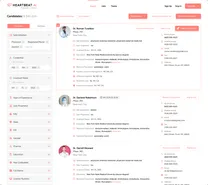
Heartbeat’s healthcare provider database is built for this kind of targeted, specialty-level outreach. A physician assistant record typically includes:
- Name
- Location
- Contact numbers (work, cell, mobile)
- Email address
- Specialization
- Years of experience
- Sole proprietor status
- Licensed states
- License number
- Fax
- Address
Filters let you narrow by specialty — primary care, surgical, emergency medicine, pediatric, and other PA disciplines — and by state, so a New York-specific search returns only PAs licensed or practicing in the state rather than a national list you have to manually sort.
Physician Assistant Contact Lists by State
Browse Heartbeat’s physician assistant contact data by state:
| Physician assistants by states |
|---|
| Physician assistants in Alabama |
| Physician assistants in Alaska |
| Physician assistants in Arizona |
| Physician assistants in Arkansas |
| Physician assistants in California |
| Physician assistants in Colorado |
| Physician assistants in Connecticut |
| Physician assistants in Delaware |
| Physician assistants in Florida |
| Physician assistants in Georgia |
| Physician assistants in Hawaii |
| Physician assistants in Idaho |
| Physician assistants in Illinois |
| Physician assistants in Indiana |
| Physician assistants in Iowa |
| Physician assistants in Kansas |
| Physician assistants in Kentucky |
| Physician assistants in Louisiana |
| Physician assistants in Maine |
| Physician assistants in Maryland |
| Physician assistants in Massachusetts |
| Physician assistants in Michigan |
| Physician assistants in Minnesota |
| Physician assistants in Mississippi |
| Physician assistants in Missouri |
| Physician assistants in Montana |
| Physician assistants in Nebraska |
| Physician assistants in Nevada |
| Physician assistants in New hampshire |
| Physician assistants in New jersey |
| Physician assistants in New mexico |
| Physician assistants in New york |
| Physician assistants in North carolina |
| Physician assistants in North dakota |
| Physician assistants in Ohio |
| Physician assistants in Oklahoma |
| Physician assistants in Oregon |
| Physician assistants in Pennsylvania |
| Physician assistants in Rhode island |
| Physician assistants in South carolina |
| Physician assistants in South dakota |
| Physician assistants in Tennessee |
| Physician assistants in Texas |
| Physician assistants in Utah |
| Physician assistants in Vermont |
| Physician assistants in Virginia |
| Physician assistants in Washington |
| Physician assistants in West virginia |
| Physician assistants in Wisconsin |
| Physician assistants in Wyoming |
How Heartbeat Builds Its Provider Data
Heartbeat aggregates U.S. healthcare provider data — including cell numbers and personal emails — from a wide range of official, private, and public sources, then applies predictive modeling to fill in gaps and flag likely-current contact details. No dataset covering millions of licensed professionals stays perfectly current; providers change jobs, get new numbers, and update emails constantly. The practical takeaway is to treat any large contact database as a strong starting point that still benefits from periodic verification, especially for high-value outreach like recruiting.
Who Uses PA Contact Lists — and Who Shouldn’t
Legitimate uses include healthcare recruiters, medical device and pharma sales teams, research organizations, CME and event organizers, and nonprofits running outreach relevant to PAs’ clinical work. These lists are not intended for cold consumer marketing unrelated to healthcare, and using them for spam, phishing, or any activity that violates privacy and anti-spam law is both against platform terms and a legal risk. If you’re building a campaign, confirm your use case fits applicable regulations — including CAN-SPAM for email and TCPA considerations for phone outreach — before sending.
A Practical Outreach Checklist
- Segment by specialty and location first, rather than sending one generic message to all New York PAs.
- Lead with something specific to their role — a relevant opening, event, or opportunity — not a mass template.
- Respect response norms: PAs are balancing clinical schedules, so concise, low-friction messages perform better than long pitches.
- Track bounce and response rates by list segment so you can flag which records need re-verification.
- Keep a compliance record of consent and opt-out handling for any email or SMS outreach.
Bottom Line
Finding and reaching New York’s physician assistants is less about volume and more about precision — the right specialty, the right license status, and a contact method that actually gets a response. A well-maintained database narrows that gap, but no list replaces basic verification discipline for high-stakes outreach like recruiting.
Frequently Asked Questions
What is the role of physician assistants in New York?
Physician assistants in New York provide primary and specialty care under the supervision of a licensed physician, with duties assigned based on the supervising physician’s scope of practice.
How do I become a physician assistant in New York?
Candidates must complete a PA program accredited by the Accreditation Review Commission on Education for the Physician Assistant (ARC-PA) and pass the Physician Assistant National Certifying Exam (PANCE), then obtain state licensure.
Are physician assistants in New York allowed to prescribe medication?
Yes. Physician assistants in New York may prescribe medication, including certain controlled substances, when assigned by and under the supervision of a licensed physician.
How many physician assistants can one physician supervise in New York?
As of a 2024 law, physicians may supervise up to six physician assistants in outpatient and private practice settings, up from the previous limit of four; hospital settings also cap supervision at six.