What’s on this page:
Key takeaways
- A New York dental assistants email list may support relevant marketing, recruiting, continuing education, and professional networking outreach.
- Potential list sources include professional associations, industry events, training programs, online directories, professional networks, and data vendors.
- Before buying a list, ask how contacts are sourced and refreshed, request a sample, and spot-check records.
- Segment contacts and tailor messages to the audience, while following applicable commercial email requirements and honoring opt-outs.
- Treat purchased contact data as a starting point that may need periodic re-verification; no list should be assumed fully current.
Last updated: August 29, 2026
Dental assistants support New York dental practices with tasks such as scheduling, patient preparation, sterilization, and chairside support. If your business sells to dental offices, offers continuing education, or recruits clinical staff, reaching this group directly may be more useful than relying only on a practice’s general inbox, where messages may be screened before reaching clinical staff.
This guide explains potential uses for a New York dental assistants email list, ways to find or verify contacts, what to evaluate in a provider, and how to conduct outreach responsibly.
Why a targeted list beats a general healthcare list
A list focused on dental assistants in New York can be more useful than a broad healthcare contact list when your outreach is specifically relevant to this audience:
Relevance drives response
Messages about dental-specific tools, continuing education credits, or job openings can be tailored to dental assistants rather than using generic healthcare marketing. A focused audience makes it easier to write relevant content, though it does not guarantee higher open or reply rates.
Segmentation supports better targeting
New York includes urban and rural communities, and practices may differ in staffing, patient volume, and technology needs. A list that can be segmented by region or practice type may help you tailor outreach instead of sending the same message to every contact.
Budget efficiency
A defined audience may reduce spending on contacts who have little reason to respond, although results depend on the list and campaign.
Recruitment and networking value
Beyond marketing, a contact list may support recruiting by helping you reach candidates who are not actively browsing job boards, or connect with professionals for partnerships and referrals.
How to find or build a verified list
The article identifies no single official public directory of every dental assistant in New York. Building or buying a usable list may therefore involve combining several sources:
Professional associations
State and national dental organizations, including the New York State Dental Association and the American Dental Assistants Association, sometimes maintain member directories. Access to contact details may require membership or a fee, and coverage will only include members, not every licensed assistant in the state.
Industry events
Dental conferences and continuing education seminars in New York may provide opportunities to collect contact details with consent, though the number of contacts depends on the events you attend.
Online directories
General healthcare directories sometimes list dental support staff. Check when a directory was updated before relying on it; outdated contact details may contribute to bounced emails.
Dental schools and training programs
Dental assistant training programs may offer a way to reach current students or alumni, often through the school rather than by scraping individual contact details.
LinkedIn and professional networks
Filtering by location and role on LinkedIn may work for smaller, manual outreach, but it may not scale well, and activity on the platform varies among healthcare workers.
Purchasing from a data vendor
Buying a list from a vendor may be a faster way to reach a larger audience. Ask for a sample, spot-check contacts before committing, and confirm how the vendor sources and refreshes its data.
Comparing three list providers
Here’s how three providers commonly used for healthcare contact data compare, based on their publicly stated offerings.
1. Heartbeat AI
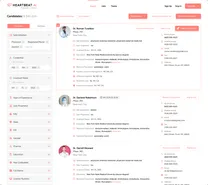
Heartbeat AI provides access to a healthcare contact database that includes dentists and other healthcare professionals across the United States, with direct dial numbers alongside emails, which can help bypass practice-level filtering that often blocks generic outreach.
About Heartbeat AI
- Founded: 2020
- Headquarters: Delaware
- Company size: 11–50 employees
Key features
Email verification
The provider says emails are checked before delivery to help reduce bounce rates; ask what those checks cover and how recently they were performed.
Chrome extension and Prospector tool
The Chrome extension pulls contact data from platforms like LinkedIn, Facebook, and Twitter, while the Prospector tool lets you search by specialty and location.
File upload
You can upload existing contact files for enrichment or verification.
CRM sync
CRM syncing may help keep contact records consistent across systems.
Custom list building
The provider says lists can be filtered by specialty, geography, or practice size; confirm which filters are available for the contacts you need.
Privacy compliance
Heartbeat AI states it follows relevant privacy frameworks including GDPR and HIPAA considerations for handling contact data.
Pricing
Pricing isn’t publicly listed; contact sales for a quote based on volume and list scope.
Pros
- Useful for reaching passive candidates not actively job-hunting
- Reduces reliance on saturated job boards
- Automated list building cuts down on manual data entry
Cons
- Large datasets can require time to filter down to a usable, relevant segment
2. MedicoReach
MedicoReach describes itself as a healthcare contact-list provider that includes dental assistant contacts, and says it offers regular data updates and CRM integration. Confirm these details directly with the company.
About MedicoReach
- Founded: 2014
- Headquarters: Leander, Texas
- Company size: 11–50 employees
Features
- Healthcare specialty: Serves only the healthcare sector with custom lists.
- Data verification: Runs checks intended to reduce bounced emails.
- CRM integration: Connects with common CRM and marketing automation tools.
- Consultative support: Offers guidance on refining email strategy.
Pricing
Not publicly disclosed; contact the company directly.
Pros
- Verification processes aimed at data accuracy
- Healthcare-only focus
- CRM integration simplifies campaign setup
Cons
- Narrow focus means it won’t cover non-healthcare needs
3. UpLead
UpLead describes itself as a general B2B contact database that can be filtered for dental and healthcare contacts, with email verification offered in the platform. Confirm current capabilities with the provider.
About UpLead
- Founded: 2017
- Headquarters: Walnut, CA
- Company size: 51–200 employees
Features
- Data enrichment: Confirms and fills in contact details.
- CRM integration: Connects with major CRM platforms.
- Intent data: Flags prospects showing research activity around related products.
- API access: Supports real-time verification through an API.
Pricing
Free trial available; paid subscriptions start around $99 per month.
Pros
- Real-time verification supports data freshness
- Intuitive interface for lead management
Cons
- Limited list customization options
- Some browser compatibility issues reported
How to choose a provider
Use this checklist to assess a vendor before committing:
- Reputation: Check reviews and industry forum feedback, not just vendor-provided testimonials.
- Data sourcing: Ask exactly where contacts come from — associations, conferences, licensing boards — and how often the list refreshes.
- Compliance: Confirm the provider’s practices align with HIPAA where relevant, and with the CAN-SPAM Act’s requirements for commercial email, which applies to B2B messages the same as consumer ones.
- Data freshness: Stale lists produce bounces and hurt sender reputation; ask how frequently records are cleaned.
- Customization: Can you segment by region, specialty, or experience level?
- Pricing transparency: Avoid vendors that won’t clearly explain what a quote covers.
- Support responsiveness: Test how quickly they respond to a pre-sale question — it’s a reasonable proxy for post-sale support.
- Sample or trial: Request a small sample and verify a handful of contacts manually before buying the full list.
Running outreach responsibly
The CAN-SPAM Act applies to commercial email, including B2B messages. Such email must accurately identify the sender, use honest subject lines, include a valid physical postal address, and provide a working opt-out mechanism that is honored as required. Build these requirements into your process from the start, regardless of list size.
A practical workflow after obtaining a list:
- Set a clear goal for the campaign — product promotion, CE invitation, or recruiting — before writing any copy.
- Segment the list by region, experience level, or specialty so messaging stays relevant.
- Write content that’s actually useful to dental assistants specifically, not repurposed general healthcare copy.
- Personalize where possible — name, region, or role context improves engagement.
- Optimize for mobile since many recipients will open email on a phone between patients.
- Test send times rather than assuming one schedule works; early mornings or late afternoons on weekdays are common starting points.
- Include one clear call to action per email rather than several competing asks.
Limitations to keep in mind
No third-party list should be assumed to be fully current: dental assistants change jobs, practices close or merge, and email addresses change. Treat a purchased list as a starting point that may need periodic re-verification, not as a permanent asset. Association directories cover members rather than everyone, and aggregated data may not reflect recent staffing changes at individual practices.
Conclusion
A well-sourced New York dental assistants email list may support marketing, recruiting, or professional networking if the data is checked, kept current, and used responsibly. The article describes different approaches from Heartbeat AI, MedicoReach, and UpLead; verify each provider’s current capabilities, data quality, compliance practices, pricing, and customization options before choosing one.
Frequently Asked Questions
What should I do if I find outdated or incorrect information in the database?
Report it to the provider — most vendors have a process for correcting records and expect some feedback loop from customers using the data.
How can I buy a New York dental assistants email list?
Contact a healthcare-focused data provider directly, confirm the list is current and sourced ethically, and request a sample before purchasing.
What precautions should I take when using these lists?
Comply with the CAN-SPAM Act and any applicable state privacy rules, honor opt-out requests promptly, and send content that’s genuinely relevant to dental assistants rather than generic marketing.