Last updated: August 31, 2026

Ben Argeband, Founder & CEO of Heartbeat.ai — Balanced; workflow-first.
What’s on this page:
Who this is for
You already use Doximity, and you still can’t get enough physicians on the phone or into a scheduled call fast enough to keep submittals moving. This is written for recruiters who need a practical way to add reach — not just more profiles to scroll through — while keeping consent and opt-out handling intact.
Doximity is a network, and network messaging works when a physician logs in and checks messages. Contactability varies by specialty, schedule, and individual habit, so it’s best treated as one channel with measurable response rather than a guaranteed line to every physician on your list.
Quick Answer
- Core Answer
- A Doximity alternative for recruiters adds off-platform reach — a direct mobile number and personal email where available — so you can contact physicians without waiting on network logins.
- Key Insight
- Network messaging is permissioned but inconsistent. Direct dial and email close the gap only if you pair them with suppression, opt-out handling, and per-channel measurement.
- Best For
- Recruiters already on Doximity who still can’t reach enough physicians quickly enough.
Compliance & Safety
This method is for legitimate recruiting outreach only. Respect candidate privacy, opt-out requests, and local data rules. Heartbeat does not provide medical advice or legal counsel.
- Use network-first when the req has a longer runway and your target physicians are active on-platform.
- Use direct-first when the req is time-sensitive and you can’t afford to wait on logins.
- Use both when you need redundancy and want clean attribution by channel.
Framework: the “will I reach them?” test
When a recruiter asks about a Doximity alternative, the first question isn’t about features. It’s whether you’ll reach the physician in the next 24 to 72 hours. Run every req through a three-lane test:
- Lane 1 — Network message: Works when the physician logs in and is receptive to inbound messages. Low operational overhead, but limited by login habits and inbox attention.
- Lane 2 — Direct dial: Best for speed and real-time qualification. Requires clean, current data, reasonable call windows, and disciplined opt-out handling.
- Lane 3 — Email: Best for asynchronous follow-up and multi-touch sequences. Requires deliverability hygiene and suppression so you don’t damage your sending domain.
Network-first outreach is simpler to run, but it caps your reachable pool at whoever logs in and responds. Adding direct dial and email expands that pool — but only if verification and suppression are built into the workflow, not bolted on afterward.
Step-by-step method
Step 1: Define “enough reach” for this req
Before switching tools, define what “enough” means for this specific role: how many qualified conversations you need this week, and how many submittals you need to hit your SLA. If network messaging alone gets you there, there’s no reason to complicate the workflow.
Step 2: Segment physicians by reachability, not interest
Build three buckets in your ATS or CRM for the same physician list:
- Network-reachable: you can message them and reasonably expect a response window.
- Phone-reachable: you have a direct mobile number you’re confident calling (and texting only where permitted).
- Email-reachable: you have a personal email you can use for recruiting outreach under deliverability controls.
Most teams lose days by treating “has a profile” as “reachable.” It isn’t. Reachability is something you can actually measure, and it should drive the channel decision, not assumptions about who seems interested.
Step 3: Decide when Doximity is enough vs when you need direct contacts
- Doximity is enough when the search has a longer cycle, the specialty tends to be responsive on-platform, and you can tolerate waiting on logins.
- You need direct contacts when the req is time-sensitive, you’re competing with other recruiters calling the same physician, or the physician works in a setting where they rarely check network messages.
What an “alternative” is not: a static list you pull once and reuse forever. Contact data decays, preferences shift, and opt-outs need to be honored across every future touch. The workable standard is access plus refresh plus verification plus suppression, running together.
Step 4: Build a two-channel sequence that matches physician reality
Physicians have short windows and gatekeepers. Plan your sequence assuming you’ll miss the first attempt and still need to be specific and respectful:
- Touch 1 (Day 0): Direct dial during a reasonable local window; leave a voicemail only if the message is specific.
- Touch 2 (Day 0): Email follow-up referencing the call attempt plus one concrete fit detail — schedule, comp structure, or location.
- Touch 3 (Day 1–2): Second dial attempt; if no answer, send a short permission-check email.
- Touch 4 (Day 3–5): Network message as a backstop, or as the first touch if you know the physician is active there.
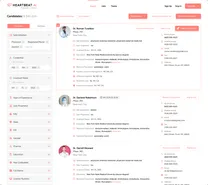
Heartbeat.ai supports this off-platform workflow with operational features like suppression and ranked mobile numbers by answer probability, so recruiters can prioritize calls without guessing. You can start free search & preview data to see whether your target physicians are reachable off-platform.
Step 5: Track the right metrics
If you’re comparing network messaging against direct contacts, you need shared definitions and consistent logging:
- Connect Rate = connected calls / total dials (per 100 dials).
- Answer Rate = human answers / connected calls (per 100 connected calls).
- Deliverability Rate = delivered emails / sent emails (per 100 sent emails).
- Bounce Rate = bounced emails / sent emails (per 100 sent emails).
- Reply Rate = replies / delivered emails (per 100 delivered emails).
Diagnostic table
Use this to pick a channel mix for the req you’re holding today. It answers the real question: will you reach them in time?
| Req situation | Start with Doximity (network-first) when… | Start with direct contacts (dial/email) when… | Primary failure mode to watch | What to do next |
|---|---|---|---|---|
| Urgent req / short SLA | You already have warm inbound and the physician is active on-platform | You need same-week conversations and can’t wait for logins | Waiting on logins instead of creating conversations | Pull a targeted list, prioritize direct mobile number, run a dial+email sprint with opt-out captured |
| Hard-to-reach setting (busy clinic, private practice) | You have prior engagement history on the network | Gatekeepers block office lines; you need off-platform reach | Only calling main lines and never reaching the physician | Use direct dial attempts in local windows plus a short permission-check email; document consent preferences |
| High-volume outreach | You can tolerate slower response and want minimal overhead | You need predictable throughput and channel redundancy | Over-sending email and hurting deliverability | Split by reachability bucket; cap sends; suppress bounces and opt-outs immediately |
| Candidate says “I don’t check that app” | They explicitly prefer network messaging | They prefer phone/email or respond faster off-platform | Ignoring stated preferences and getting blocked | Capture preference and consent notes; route future touches accordingly |
| Recruiter comparison worksheet: network vs dial vs email (log these fields) | Use when the decision needs to be tied to outcomes, not features | Use when the decision needs to be tied to outcomes, not features | Choosing tools by “features” instead of reachability outcomes | For each channel, record dials, connects, human answers, emails sent, delivered, bounces, and replies; compare using the metric definitions in Step 5 |
Weighted checklist
Score each item 0–5, multiply by weight, and compare totals. This keeps the decision grounded in workflow fit and measurable outcomes rather than gut feel.
| Category | Weight | What “good” looks like for recruiters | Your score (0–5) |
|---|---|---|---|
| Off-platform reach (direct mobile number) | 25 | Direct dial where available; clear provenance; supports opt-out and suppression | |
| Email reach (personal email) | 15 | Personal email where available; deliverability controls; bounce handling and suppression | |
| Suppression & opt-out workflow | 20 | One-click suppression across future outreach; opt-out honored across channels | |
| Speed: search to first touch | 15 | Search-to-outreach in minutes; exports/CRM handoff doesn’t slow the recruiter down | |
| Measurement by channel | 15 | Easy logging so you can compute connect, answer, deliverability, bounce, and reply rates | |
| Trust & transparency | 10 | Explains sources, update approach, and limitations without overpromising |
To see how Heartbeat.ai approaches provider records and sourcing, review how Heartbeat.ai approaches provider data.
Outreach templates
Template 1: Direct dial opener (30 seconds)
Goal: confirm fit fast, then move to a scheduled call.
Script: “Hi Dr. [Last Name]—this is [Name]. I recruit physicians for [Org/Service Line]. I’ll be brief: we have a [role] with [one constraint: schedule/location/call]. Is it worth 60 seconds to see if it fits, or should I email details?”
Consent/opt-out line: “If you’d rather not get recruiting outreach from me, tell me and I’ll mark you as opt-out.”
Template 2: Follow-up email after missed call
Subject: [Role] — quick fit check
Body: “Dr. [Last Name]—I tried you by phone. Recruiting question: are you open to hearing about a [role] with [one key detail]? If yes, what’s the best number/time window? If not, reply ‘opt out’ and I won’t follow up.”
Template 3: Network message (backstop)
Message: “Dr. [Last Name]—quick fit check for a [role] in [market]. If you prefer, I can send details by email or schedule a 5-minute call. What’s easiest?”
These templates work when the workflow is disciplined: capture preferences, suppress opt-outs, and stop pushing on a channel that isn’t working. You can start free search & preview data and test reachability on your exact req list.
Common pitfalls
- Assuming “profile = reachable.” A physician can exist on a network and still be unreachable in your timeframe. Treat reachability as a measurable attribute, not an assumption.
- Over-indexing on one channel. Network-only can be slow; phone-only can be noisy; email-only can hurt deliverability. Build in redundancy with clear rules for when to switch.
- Slow opt-out handling. If you can’t suppress a physician across future outreach, you’re creating compliance and brand risk.
- Letting reps freestyle messaging. Inconsistent scripts produce inconsistent outcomes. Standardize the first two touches, then personalize from there.
- Comparing tools without controlling the experiment. If one recruiter is simply better on the phone, you’ll “prove” the phone channel is better regardless of the tool. Control for sequence, timing, and logging before drawing conclusions.
How to improve results
Run a controlled two-week channel test on one specialty and one market, then decide based on logged outcomes instead of opinions.
1) Run a two-week channel attribution test
- Pick one specialty and one market — keep it narrow.
- Build a list of physicians you’d normally contact.
- Split into two equal groups: network-first vs direct-contact-first.
- Use the same value proposition, same recruiter, and similar time windows.
- Log outcomes by channel and compute the metrics below.
2) Use canonical metric definitions
- Connect Rate = connected calls / total dials (per 100 dials).
- Answer Rate = human answers / connected calls (per 100 connected calls).
- Deliverability Rate = delivered emails / sent emails (per 100 sent emails).
- Bounce Rate = bounced emails / sent emails (per 100 sent emails).
- Reply Rate = replies / delivered emails (per 100 delivered emails).
3) Fix the bottleneck you actually have
- If Connect Rate is low: tighten targeting, call at better local windows, and prioritize records with a direct mobile number.
- If Answer Rate is low: the opener is too long or too vague — shorten to one constraint and one question.
- If Deliverability Rate drops or Bounce Rate rises: slow down sends, clean suppression, and stop blasting cold domains.
- If Reply Rate is low: the email is asking for too much — switch to a permission check and offer an opt-out.
For deeper guidance on evaluating a contact workflow, see how a physician contact database should be evaluated for recruiting.
Legal and ethical use
Recruiting outreach isn’t a free-for-all. Use contact data only for legitimate hiring and staffing conversations, and build guardrails:
- Consent & expectations: If a physician asks how you got their information, answer plainly and professionally.
- Opt-out: Provide an easy opt-out path in email and honor it across future outreach. Suppress quickly.
- Data minimization: Only collect and store what you need to recruit; don’t hoard sensitive data.
- Local laws and policies: Follow applicable privacy and communications rules and your organization’s compliance policies.
Follow your organization’s policy on which email types are permitted for outreach. If you’re unsure about a specific jurisdiction or policy, involve counsel. Heartbeat.ai does not provide legal counsel.
Evidence and trust notes
For factual descriptions of Doximity’s product support resources, reference the official Doximity help center. This article isn’t asserting platform performance; it’s describing operational reachability variability recruiters see across channels. For how Heartbeat.ai evaluates data sourcing, verification workflows, and limitations, review the Trust Methodology.
If your core issue is reaching physicians who aren’t active on professional networks, read how to find physicians not on LinkedIn for an off-platform workflow that stays compliant.
FAQs
Is Doximity enough for physician recruiting?
Sometimes. If your target physicians are active on the network and your req timeline is flexible, network messaging can carry the search. If you need faster throughput, add direct dial and email so you’re not waiting on logins.
What should I look for in a Doximity alternative for recruiters?
Prioritize reachability and workflow: direct mobile number availability, personal email availability, suppression/opt-out controls, and the ability to measure connect rate and deliverability rate by channel.
How do I compare network messaging vs direct dial fairly?
Run a controlled two-week test: same specialty, same recruiter, same value proposition, similar time windows. Track connect rate (connected calls per 100 dials) and answer rate (human answers per 100 connected calls) alongside reply rate (replies per 100 delivered emails).
How should I handle opt-out across phone, email, and network messages?
Use one suppression rule: if a physician opts out in any channel, suppress them across future outreach in all channels. Log the opt-out source and date, and don’t re-add them via exports later.
Where does Heartbeat.ai fit in this workflow?
Heartbeat.ai is built for off-platform reach: finding physicians with a direct mobile number and personal email where available, then running compliant outreach with suppression and measurement. You can start free search & preview data to test your exact req list.
Next steps
- Use the Diagnostic Table to choose your starting channel for the req you’re holding today.
- Run the two-week attribution test and compute outcomes using the metric definitions in this article.
- If you need more off-platform reach, start free search & preview data and validate contactability on your target physician list.
To understand how Heartbeat.ai thinks about provider records and sourcing, see our data overview.
About the Author
Ben Argeband is the Founder and CEO of Swordfish.ai and Heartbeat.ai. With deep expertise in data and SaaS, he has built two successful platforms trusted by over 50,000 sales and recruitment professionals. Ben’s mission is to help teams find direct contact information for hard-to-reach professionals and decision-makers, providing the shortest route to their next win. Connect with Ben on LinkedIn.