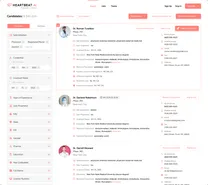
Locum tenens physician database
Ben Argeband, Founder & CEO of Heartbeat.ai — Speed + clarity. Simple plan + scripts.
What’s on this page:
Who this is for
This is for locums recruiters searching for a database that helps book coverage fast—when you’re losing time to “wrong state,” “can’t start,” and schedule mismatch.
Locum tenens recruiting is a speed-and-availability problem. A database that’s just a directory won’t help you. You need a cohort you can filter, prioritize, and refresh so day-one outreach produces qualified conversations and submittals.
Quick Answer
- Core Answer
- A locum tenens physician database is a refreshed, filtered cohort of physicians prioritized for fast coverage: license fit, schedule fit, reachability, and suppression—so you can submit quickly.
- Key Insight
- Locums wins on speed and availability; filtering by state license first reduces wasted outreach and protects recruiter time.
- Best For
- Locums recruiters searching for a database that helps book coverage fast.
Compliance & Safety
This method is for legitimate recruiting outreach only. Always respect candidate privacy, opt-out requests, and local data laws. Heartbeat does not provide medical advice or legal counsel.
Framework: The “Coverage First” Database Workflow: Target → Reach → Book → Refresh
- Target: Define the coverage cohort (who belongs, and who does not).
- Reach: Prioritize channels that connect quickly; suppress opt-outs and bounces.
- Book: Convert interest into a submittal-ready record with minimal back-and-forth.
- Refresh: Update the cohort continuously because lists decay quickly and availability changes week to week.
The trade-off is… you’ll build a smaller, higher-fit cohort instead of a giant directory. For locums, that’s how you win speed-to-submittal.
Step-by-step method
Step 1: Write the cohort definition (one sentence)
A cohort is a group of physicians selected by shared, job-relevant criteria so you can run repeatable outreach and measure outcomes. If you can’t define the cohort in one sentence, you can’t manage it.
Use this format:
- Specialty + must-have skills
- State license requirement (active vs in-process acceptable)
- Setting (ED, inpatient, clinic, anesthesia model, etc.)
- Schedule constraints (call, nights, weekends, block schedule)
- Start window (ASAP vs future)
- Ownership segment when you need decision-makers or different availability patterns
What this database is not
- Not a static spreadsheet you buy once and work forever (lists decay quickly).
- Not a promise of availability or interest; it’s a way to prioritize verification and speed.
- Not a compliance shield; you still need consent-aware outreach and strict opt-out handling.
Filters that matter (coverage-first)
| Filter | Why it matters in locums | How to use it |
|---|---|---|
| State license status | Hard constraint for startability | Filter first; split ready-now vs pipeline |
| Start window | Availability changes quickly | Tag as ASAP vs future; run different cadences |
| Setting | Mismatch creates drop-off after initial interest | Separate cohorts by setting when needed |
| Call tolerance | Call-heavy roles fail late if not screened early | Maintain a call-tolerant cohort |
| Sole proprietor segment | Ownership can change decision speed and schedule constraints | Use for decision-maker targeting and tailored messaging |
| Suppression (opt-out/bounce) | Protects compliance and deliverability | Suppress immediately; keep a suppression list |
| NPI | Identity matching and deduping | Require for submittal-ready records |
Step 2: Filter by state license first (before you write outreach)
Targeting by state license reduces wasted outreach. In locums, license fit is a hard constraint; everything else is secondary.
- Confirm what the client will accept: active license only, or in-process acceptable.
- Filter your cohort to the assignment state(s) and the accepted status.
- Split the cohort into two operational segments: ready-now vs pipeline.
Step 2b: License-first segmentation (ready-now vs pipeline)
| Segment | Who goes here | How you work it | What you expect |
|---|---|---|---|
| Ready-now | Active license for assignment state; start window aligns | Fast cadence; prioritize calls; request earliest start date on first touch | Higher speed-to-submittal |
| Pipeline | In-process or likely eligible; start window later | Slower cadence; nurture; re-check status before each new push | Bench building for future coverage |
Step 3: Use the sole proprietor segment as an availability and decision-maker signal
Not every physician has the same control over their schedule. Segmenting by sole proprietor can help because practice ownership often changes availability patterns and decision paths.
- Availability: owners may prefer predictable blocks or specific gaps.
- Decision path: owners can decide without employer approvals, but may require different terms and lead time.
- Messaging: owners respond to schedule control and disruption-minimization, not generic “great opportunity.”
Important: This is not tax or legal advice. Treat “sole proprietor” as an operational targeting signal for practice owners/decision-makers, not as a compliance classification.
Step 4: Prioritize reachability for speed-to-submittal
Locums is about speed and availability. Your database should prioritize who you can actually reach today, not just who exists in a directory.
At Heartbeat.ai, we focus on connectability and workflow fit, including ranked mobile numbers by answer probability so recruiters spend more time in live conversations and less time in voicemail loops.
Track these metrics consistently (with denominators):
- Connect Rate = connected calls / total dials (per 100 dials).
- Answer Rate = human answers / connected calls (per 100 connected calls).
- Deliverability Rate = delivered emails / sent emails (per 100 sent emails).
- Bounce Rate = bounced emails / sent emails (per 100 sent emails).
- Reply Rate = replies / delivered emails (per 100 delivered emails).
Step 5: Build the minimum viable submittal-ready record
A locum tenens physician database record is only useful if it supports a clean submittal without extra cycles.
Submittal-ready record fields (minimum)
| Field | Why you need it | Notes |
|---|---|---|
| Physician name + specialty | Basic identification and routing | Standardize specialty naming to avoid duplicates |
| NPI | Identity matching and deduping | Use as a stable identifier when names vary |
| State license status | Startability for the assignment | Record state + status + last checked date |
| Primary location | Travel feasibility and market context | City/state is usually enough for recruiting ops |
| Outreach channels | Speed to first conversation | Keep suppression flags attached to channels |
| Opt-out / suppression status | Compliance and deliverability protection | Suppress immediately and permanently unless re-consented |
| Setting + schedule notes | Prevents late-stage mismatch | Call tolerance and start window belong here |
Step 6: Refresh and suppress continuously (lists decay quickly)
Refresh fast; lists decay quickly. In locums, “stale” means wrong availability, wrong employer, or outdated channels—not just a typo.
- Refresh your cohort before each new assignment push.
- Suppress anyone who opted out, bounced, or asked not to be contacted.
- Roll “recently engaged” physicians into a warm cohort with a different cadence.
For a practical view on refresh timing, see provider data refresh cadence for recruiting workflows.
Data hygiene loop (run every push)
- Refresh: update license status and channel validity before outreach.
- Dedupe: merge duplicates using NPI as the stable identifier.
- Suppress: apply opt-out and bounce suppression before sending or dialing.
- Re-rank: prioritize channels and records based on recent outcomes (connects, answers, replies).
Use cases (how this database gets used in real locums work)
- ASAP coverage: work the ready-now segment first; require license fit and start window alignment before deep selling.
- Credentialing lead time vs start window: if the start window is tight, prioritize physicians whose license status and responsiveness reduce downstream delays.
- Call-heavy assignments: build a separate cohort for call-tolerant physicians; don’t contaminate your main cohort with mismatched schedules.
- Multi-state clients: maintain one cohort per state license requirement; don’t merge states unless the assignment truly allows it.
- Rural or hard-to-fill: prioritize reachability and decision speed; tailor messaging for owners when appropriate.
Diagnostic Table:
Use this to diagnose why your current database isn’t producing fast coverage.
| Symptom | Likely cause | Database-level fix | What to measure |
|---|---|---|---|
| Lots of dials, few conversations | Low connectability; wrong channel priority | Re-prioritize channels; remove stale records; segment by best channel | Connect Rate (connected calls / total dials) per 100 dials |
| Good conversations, slow submittals | Missing submittal-ready fields; unclear start window | Standardize record: NPI, license status, setting preference, start window | Time from first contact to submittal-ready record completion |
| High interest, then drop-off | Availability mismatch (call, schedule, setting) | Split cohorts by schedule/call tolerance; tighten cohort definition | Reply Rate (replies / delivered emails) per 100 delivered emails |
| “Wrong state” responses | License filter missing or too loose | Filter by assignment state license first; separate ready-now vs pipeline | License disqualification rate (% of engaged responses failing license fit) |
| Owners respond differently than employed physicians | Ownership not segmented | Use sole proprietor as a decision-maker/availability segment; tailor script | Conversion to submittal by ownership segment |
Weighted Checklist:
This scoring model helps you decide if a physician belongs in your coverage-first cohort for a specific assignment. Total = 100 points.
- State license fit (30): Active/eligible for assignment state; correct status documented.
- Setting + schedule fit (25): Matches call model, shift type, and start window.
- Reachability (20): Recent channel performance and no suppression flags (opt-out/bounce).
- Identity match quality (15): NPI present and deduped; correct specialty mapping.
- Ownership segment (10): Flag sole proprietor when you need decision-makers or want to tailor availability messaging.
Coverage urgency decision guide (DECISION_TREE):
- If start date is soon: require high license-fit and reachability scores; deprioritize records missing NPI.
- If call burden is heavy: require high schedule-fit; keep a separate call-tolerant cohort.
- If you need a decision-maker fast: prioritize the sole proprietor segment and lead with schedule control and predictability.
- If you’re building a bench: tighten identity match quality and refresh rules so the bench stays clean.
Ownership filter use cases: Use the sole proprietor segment when you’re staffing short blocks, rural coverage, or when the client needs rapid commitment without multi-layer approvals.
Outreach Templates:
These templates assume you already filtered by specialty + state license and you’re recruiting locum tenens coverage. Keep them short and specific.
Template 1: Fast coverage call opener (30 seconds)
Goal: confirm availability window and setting fit.
Script: “Hi Dr. [Last], this is [Name]. I’m staffing a locum tenens [specialty] need in [State] with a [setting] schedule starting [date window]. Are you open to hearing details if the schedule fits?”
Follow-up question: “What’s your earliest realistic start date in [State] given licensing and credentialing?”
Template 2: Owner/decision-maker angle (sole proprietor segment)
Script: “Dr. [Last], quick one—this is coverage that’s predictable: [block schedule], [call details], [start window]. If you control your schedule, this can fit into gaps without disrupting your practice. Worth a 2-minute run-through?”
Template 3: Email for speed-to-submittal
Subject: [State] locum tenens [Specialty] — [Start window], [Schedule]
Body: “Dr. [Last]—I’m staffing a locum tenens [specialty] assignment in [City/State]. Schedule: [details]. Start: [window]. If you’re licensed in [State] (or in-process if acceptable), reply with your earliest start date and preferred contact number. If you’d rather not receive outreach, reply ‘opt out’ and I’ll suppress you.”
Template 4: Text message (only where appropriate and compliant)
“Dr. [Last]—[Name] here. Quick check: open to a locum tenens [specialty] block in [State] starting [window]? Reply YES and I’ll send schedule/rate; reply STOP to opt out (where supported by your messaging program).”
Common pitfalls
- Building a directory instead of a cohort. If you can’t define who’s in it, you can’t run a repeatable workflow.
- Skipping license-first filtering. You’ll burn time on clinicians who can’t start where you need them.
- Not segmenting ready-now vs pipeline. You’ll either over-message the pipeline or under-work the ready-now group.
- Ignoring suppression. If you don’t honor opt-out and bounce suppression, you’ll hurt deliverability and create compliance risk.
- Using one script for everyone. Owners and employed physicians often respond to different framing; segmenting helps.
- Assuming availability. Do not promise guaranteed availability; use the database to prioritize verification and speed.
How to improve results
Measure this by… running the same cohort definition for 2–4 weeks and tracking outcomes by segment (ready-now vs pipeline; owner vs not; channel priority). If you change the cohort every day, you won’t know what’s working.
Measurement instructions (required)
- Lock the cohort definition for one assignment type (specialty + state license + setting + start window).
- Run a consistent cadence and log outcomes by segment.
- Track the canonical metrics with denominators:
- Connect Rate = connected calls / total dials (per 100 dials).
- Answer Rate = human answers / connected calls (per 100 connected calls).
- Deliverability Rate = delivered emails / sent emails (per 100 sent emails).
- Bounce Rate = bounced emails / sent emails (per 100 sent emails).
- Reply Rate = replies / delivered emails (per 100 delivered emails).
- Add two locums outcomes:
- Speed to submittal: time from first contact to complete submittal-ready record.
- License disqualification rate: % of engaged responses that fail license fit for the assignment state.
Time math (no invented numbers)
Here’s the operational math without making up numbers. Let:
- D = dials per recruiter per day
- C = Connect Rate (connected calls / total dials)
- A = Answer Rate (human answers / connected calls)
- Q = qualification rate after answer (fraction who match license + schedule)
Your qualified live conversations per day are proportional to D × C × A × Q. License-first filtering increases Q. Better channel prioritization increases C and A. That’s how a database build turns into faster submittals without adding recruiter headcount.
Workflow upgrades that usually move the needle
- Tighten the cohort definition until license disqualifications drop.
- Refresh before each push and suppress aggressively to protect deliverability.
- Standardize the submittal-ready record so recruiters aren’t re-collecting the same basics.
Related workflow reading
If you want a broader way to slice cohorts, start from the right universe with physician list by specialty and state, then apply the locums filters above.
Legal and ethical use
Use a locum tenens physician database for legitimate recruiting outreach only. Build compliance into the workflow:
- Consent and expectations: use appropriate channels and respect professional boundaries.
- Opt-out: honor opt-out requests immediately and maintain suppression lists.
- Suppression governance: only designated admins should remove suppression, and only with documented re-consent.
- Data minimization: store only what you need to recruit and credential efficiently.
- Auditability: keep notes on source, refresh date, and suppression status.
Heartbeat.ai does not provide legal counsel. If you operate across jurisdictions, get guidance for your specific outreach practices.
Evidence and trust notes
When we say “database,” we mean a workflow-backed cohort that can be refreshed, verified, and suppressed—not a static spreadsheet. For how we evaluate sources, refresh, and quality controls, see Heartbeat’s trust methodology.
Baseline identity and enumeration reference: NPPES (CMS) NPI Registry. NPPES is an identity baseline; it does not guarantee current availability or preferred contact channel.
FAQs
What should be included in a locum tenens physician database record?
At minimum: physician name, specialty, NPI, assignment-relevant state license status, location, outreach channels, and suppression flags (opt-out/bounce). Add schedule and start-window notes for locums speed.
How do I build cohorts for urgent coverage without spamming everyone?
Start with a tight cohort definition (license + setting + start window), then segment ready-now vs pipeline. Run a fast cadence to ready-now and a slower cadence to pipeline, refreshing between pushes.
Why does filtering by state license matter so much for locums?
Because it prevents “good conversation, impossible start.” License fit is a hard constraint; filtering early reduces wasted outreach and speeds up submittals.
How should I use the sole proprietor segment in locums recruiting?
Use it to segment practice owners/decision-makers and tailor messaging around schedule control and predictability. Don’t treat it as legal or tax classification advice—use it as an operational signal.
How often should I refresh a locums recruiting cohort?
Before each major outreach push and whenever assignment requirements change. Lists decay quickly, and availability changes fast in locums. Use a refresh + suppression loop to protect deliverability and recruiter time.
Next steps
- Build one cohort for one assignment type, then run a short test with consistent tracking by segment.
- Operationalize refresh: review provider data refresh cadence for recruiting workflows and set a standard refresh step before each push.
- If you want to see how Heartbeat.ai supports cohort building and outreach prioritization, start free search & preview data.
- For commercial details, see Heartbeat.ai pricing.
About the Author
Ben Argeband is the Founder and CEO of Swordfish.ai and Heartbeat.ai. With deep expertise in data and SaaS, he has built two successful platforms trusted by over 50,000 sales and recruitment professionals. Ben’s mission is to help teams find direct contact information for hard-to-reach professionals and decision-makers, providing the shortest route to their next win. Connect with Ben on LinkedIn.