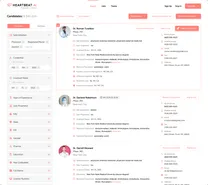
Dental assistant contact data
Ben Argeband, Founder & CEO of Heartbeat.ai — Keep it respectful and practical.
What’s on this page:
Who this is for
This page is for dental recruiters staffing assistants for practices/DSOs who need to reach the right dental assistant quickly without damaging the practice brand or wasting time on stale records.
In this market, the friction is consistent: assistants change workplaces, clinic hours limit call windows, and long messages get ignored. The workflow below is built for speed-to-response while staying compliant and respectful.
Quick Answer
- Core Answer
- Dental assistant contact data is role- and location-matched phone/email details used for short recruiting outreach, with recency tracking and suppression to avoid stale or unwanted contact.
- Key Insight
- Assistants move between practices; your outcomes depend on recency, channel fit, and suppression hygiene more than list size.
- Best For
- Dental recruiters staffing assistants for practices/DSOs.
Compliance & Safety
This method is for legitimate recruiting outreach only. Always respect candidate privacy, opt-out requests, and local data laws. Heartbeat does not provide medical advice or legal counsel.
Framework: The “Short Message Wins” Rule: role → location → pay range if possible
If your first message doesn’t answer “what role, where, and what’s the pay range,” you’ll lose the reply window. Keep it short enough to read between rooms.
- Role: chairside vs. specialty (ortho/peds/oral surgery), lead vs. entry, expanded functions if applicable.
- Location: city/neighborhood and a commute anchor (cross-street, landmark, or “near {area}”).
- Pay range (if possible): a real range beats “competitive.” If you can’t share it, share one concrete lever (schedule, benefits, training, stability).
The trade-off is… shorter messages reduce friction, but they force you to be precise about role fit and location so you don’t create extra back-and-forth.
Step-by-step method
Step 1: Define the target dental assistant (so you don’t blame the data)
Before you pull contact data, write a one-paragraph intake you can paste into your ATS/CRM:
- Role subtype (GP chairside, ortho assistant, peds, oral surgery, sterilization lead, float)
- Required skills (x-rays, impressions, sterilization flow, charting system)
- Schedule pattern and start date
- Pay range or pay structure (hourly, differential, bonus)
- Commute boundary (what “local” means)
Step 2: Pull dental assistant contact data with a “perishable inventory” mindset
When you source dental assistant contact data, treat it like inventory that decays. You’re not collecting “dental assistant phone numbers” for the sake of it; you’re building a reachable pool for a specific role and market.
Use the compact table below to standardize what you capture and how you use it.
| Field | Why it matters | How you use it | Suppression rule |
|---|---|---|---|
| Role tag (dental assistant + subtype) | Prevents mismatched pitches | Segment outreach by subtype | If they say “not an assistant,” correct role and stop assistant outreach |
| Location signal (city/area) | Commute is a primary filter | Send only roles within boundary | If they say “not in that area,” suppress for that market |
| Phone (mobile if available) | Fastest path to a reply for many assistants | SMS-first only where permitted/appropriate; call only by permission | If STOP/opt-out, suppress phone/SMS immediately |
| Good for details and documentation | Short email with role/location/pay range | If opt-out, suppress email immediately | |
| Recency (days since last verified/observed valid) | Predicts reachability | Prioritize fresher segments | If stale, refresh segment before scaling |
| Suppression flags (opt-out, wrong person, do-not-contact) | Protects brand and compliance | Block future outreach across channels | Always honor opt-out; keep timestamped log |
How to evaluate a contact data source for assistants
- Recency field exists: you can see when a record was last verified/observed valid, not just when it was imported.
- Suppression support: you can flag opt-out, wrong person, and do-not-contact and keep those flags enforced.
- Role subtype tagging: you can separate GP chairside vs. ortho/peds/oral surgery so your message matches the job.
- Export + logging fit: you can push outcomes back to your ATS/CRM (interested, not interested, wrong contact, opt-out) so the list improves over time.
Step 3: Build suppression and “cooling-off” into the workflow
Two lists matter as much as your outreach list:
- Suppression list: opt-out, wrong person, wrong role, do-not-contact.
- Cooling-off list: already interviewed/submitted/placed/declined recently. Suppress for a defined period unless they re-engage.
Opt-out handling should be immediate and enforced across SMS, email, and calls. Keep a timestamped note of the request and the channel.
Step 4: Run a two-touch sequence that fits clinic reality
Assistants are busiest during patient flow. Your sequence should be short, specific, and easy to answer.
- Touch 1 (SMS where permitted/appropriate, or email): role + location + pay range if possible + one yes/no question.
- Touch 2 (bump): one new detail (schedule, benefits, training, commute anchor) + clean opt-out line.
Avoid “bulk messaging” framing. Your goal is connectability and trust, not volume.
Timing notes for dental assistant outreach
- Assume they’re in patient flow. Lead with a message that can be answered with “yes/no” and offer to send details.
- Ask permission before calling. Use the first touch to confirm the best time window.
- Offer two options. “Can I call at {Window A} or {Window B}?” reduces back-and-forth.
Step 5: Track the right metrics (with correct definitions)
Optimize for reach and response, not activity.
- Connect Rate = connected calls / total dials (e.g., per 100 dials).
- Answer Rate = human answers / connected calls (e.g., per 100 connected calls).
- Deliverability Rate = delivered emails / sent emails (e.g., per 100 sent emails).
- Bounce Rate = bounced emails / sent emails (e.g., per 100 sent emails).
- Reply Rate = replies / delivered emails (e.g., per 100 delivered emails).
- Recency (definition): days since the contact record was last verified/observed as valid for outreach in your system.
Common use cases (so you can pick the right motion)
- Urgent backfill: short first message (SMS where permitted/appropriate, otherwise email) with role/location/schedule; ask permission to call.
- New practice opening: email-first with schedule and pay range; follow with a short bump.
- DSO multi-site: segment by site; assistants screen by commute, so avoid “anywhere in the metro.”
- Specialty office (ortho/peds/oral surgery): lead with specialty and training expectations; keep it short.
- Pipeline building: slower cadence, heavier suppression discipline, and clear opt-out handling.
Diagnostic Table:
Use this to diagnose why outreach isn’t converting without guessing.
| Symptom | Likely cause | What to check | Fix (fast) |
|---|---|---|---|
| Lots of dials, few connects | Stale numbers or wrong segment | Connect Rate (connected calls / total dials) per 100 dials; recency by segment | Refresh the segment; tighten geo; prioritize the freshest records |
| Connects happen, few human answers | Calling during patient flow | Answer Rate (human answers / connected calls) by hour/day | Shift call windows; ask permission via a short message first |
| Email delivered, replies low | Message too long or vague | Reply Rate (replies / delivered emails) per 100 delivered emails | Rewrite using role → location → pay range if possible; cut to 2–4 lines |
| Bounces spike | Bad addresses or list hygiene issues | Bounce Rate (bounced emails / sent emails) per 100 sent emails | Clean the segment; pause that source; improve hygiene |
| “Stop” replies increase | Over-contacting or poor targeting | Opt-out rate by source and by recruiter | Increase suppression; reduce touches; tighten role/location filters |
Weighted Checklist:
Score your workflow before you scale it. Total 100 points.
- (25) Role clarity: the dental assistant profile is specific (skills + schedule + start date).
- (20) Location precision: commute boundary is defined; you’re not blasting an entire metro.
- (15) Recency discipline: you track recency (days since last verified/observed valid) and refresh segments that decay.
- (15) Suppression hygiene: opt-out requests are logged and enforced across SMS/email/calls.
- (10) Message quality: first touch follows role → location → pay range if possible.
- (10) Measurement: Connect Rate, Answer Rate, Deliverability Rate, Bounce Rate, Reply Rate are tracked with correct denominators.
- (5) Practice alignment: the practice or DSO has approved the schedule and pay range you’re advertising.
Outreach Templates:
Visual note: Add 3 templates + stop rules and suppression logging reminder. (Templates below are copy/paste-ready.)
OUTREACH_TEMPLATES Worksheet: 3-Field Personalization Grid (uniqueness hook)
Before you send anything, fill these three fields for the specific dental assistant segment. Then log which field you used so you can tie it back to Reply Rate and opt-outs.
| Field | Pick one | Example | Log as |
|---|---|---|---|
| Role subtype | GP / ortho / peds / oral surgery / lead | “Ortho assistant” | role_subtype |
| Location anchor | Neighborhood / landmark / cross-street | “Near {Landmark}” | loc_anchor |
| One concrete lever | Pay range / schedule / benefits / training | “4x10s, no weekends” | lever |
This requires manual verification. If your intake doesn’t confirm schedule and pay range, don’t guess in outreach; use a lever you can stand behind (hours, commute anchor, training, stability) and update once confirmed.
Template 1 — SMS (first touch)
Hi {FirstName} — recruiting for a dental assistant role in {City/Area} (near {Landmark/Neighborhood}). {Schedule}. Pay: {PayRange if available}. Interested, or should I close the loop?
If you prefer no texts, reply STOP and I’ll log an opt-out.
Template 2 — Email (first touch)
Subject: Dental assistant role in {City/Area} — {Schedule}
Hi {FirstName},
I’m hiring a dental assistant for a {PracticeType} practice in {City/Area} (near {Landmark/Neighborhood}). Schedule: {Schedule}. Pay: {PayRange if available}.
Worth a quick call if you’re open to it, or should I take you off my outreach list for this market?
— {YourName}
P.S. If you’d like an opt-out, reply “opt out” and I’ll suppress you.
Template 3 — Follow-up bump (SMS or email)
Quick bump, {FirstName}: this role is {OneNewDetail} in {City/Area}. Want the details?
Reply STOP for opt-out and I’ll suppress immediately.
Stop rules (use these every time)
- If they say STOP / opt out / don’t contact: suppress across all channels and log the timestamp.
- If wrong person: mark as wrong contact and suppress that channel.
- If “not a dental assistant”: correct the role tag and do not re-message for assistant roles.
- If no response after 2 touches: pause for at least 14 days unless the candidate re-engages.
Common pitfalls
- Scaling decay. If you increase volume without managing recency and suppression, you’ll get more wrong numbers and more opt-outs.
- Not leading with location. Assistants screen for commute and schedule first.
- Vague pay. If you can’t share a range, share one concrete lever you can stand behind.
- Channel mismatch. Don’t treat SMS, email, and calls as interchangeable. Honor preferences and opt-outs across channels.
- No outcome logging. Without consistent tags (interested, not interested, wrong contact, opt-out), your list quality degrades fast.
How to improve results
Run a weekly scorecard per recruiter and per market, then change only one variable at a time (message, timing, segment, or channel) so you know what actually improved outcomes.
Measurement instructions
- Segment first: market + role subtype (GP chairside vs. ortho assistant, etc.).
- Track recency: store “days since last verified/observed valid” for each record and report the median recency per segment.
- Score calls weekly: Connect Rate (connected calls / total dials) per 100 dials; Answer Rate (human answers / connected calls) per 100 connected calls.
- Score email weekly: Deliverability Rate (delivered emails / sent emails) per 100 sent; Bounce Rate (bounced emails / sent emails) per 100 sent; Reply Rate (replies / delivered emails) per 100 delivered.
- Audit suppression: review 20 random records weekly to confirm opt-outs are honored across channels and logged.
For a practical cadence approach, see provider data refresh cadence for recruiting outreach.
Legal and ethical use
Recruiting outreach must be respectful, accurate, and compliant. Build your process around consent, transparency, and suppression. This page is not legal advice.
- Email: use truthful subject lines, identify yourself, and include a clear opt-out mechanism. Reference: CAN-SPAM guidance (FTC).
- Calls and texts: follow applicable calling/texting requirements and your internal policies, especially for automated dialing/texting. Reference: TCPA overview (FCC).
- Opt-out: if someone requests an opt-out, suppress immediately and keep a timestamped record of the request and channel.
Heartbeat.ai supports legitimate recruiting workflows; you are responsible for how you use contact data and for meeting local legal requirements.
Evidence and trust notes
We treat contact data like operational infrastructure: it needs verification, suppression, and measurement to stay useful. Review how we think about sourcing quality, verification, and responsible use in our Trust Methodology.
- Compliance references: CAN-SPAM (FTC); TCPA (FCC).
- What we do: support legitimate recruiting outreach with suppression-first workflows and measurable list hygiene.
- What we don’t do: we don’t advise bypassing opt-outs, and we don’t recommend harassment or repeated unwanted contact.
- Why cadence matters: assistants change workplaces, so refresh discipline and suppression logging keep outreach accurate and respectful.
FAQs
What should dental assistant contact data include for recruiting?
At minimum: role tag (dental assistant + subtype), location signal, a reachable channel (phone and/or email), recency (days since last verified/observed valid), and suppression fields for opt-out and wrong contact.
How often should I refresh dental assistant contact data?
Refresh more often in high-churn markets and for urgent openings. Use recency to decide when a segment is too stale to keep dialing or emailing.
What’s the safest first message to send a dental assistant?
Short and specific: role + location + pay range if possible, then a yes/no question. Include a clear opt-out path and honor it immediately.
How do I know if my outreach is working?
Track Connect Rate (connected calls / total dials), Answer Rate (human answers / connected calls), Deliverability Rate (delivered emails / sent emails), Bounce Rate (bounced emails / sent emails), and Reply Rate (replies / delivered emails), each reported with a per-100 denominator.
How should I handle opt-outs across channels?
If someone opts out on one channel, suppress them across SMS, email, and calls unless they explicitly re-consent. Log the timestamp and channel so suppression is enforceable.
Next steps
- Ready to build a reachable assistant pipeline? start free search & preview data and set up suppression and recency tracking from day one.
- Hiring dentists too? Use the sibling resource: dentist contact database for recruiting outreach.
- Set your operating rhythm: provider data refresh cadence.
Reminder: keep outreach short and clear, prioritize role fit and location, and log every opt-out so your pipeline stays reachable and respectful.
About the Author
Ben Argeband is the Founder and CEO of Swordfish.ai and Heartbeat.ai. With deep expertise in data and SaaS, he has built two successful platforms trusted by over 50,000 sales and recruitment professionals. Ben’s mission is to help teams find direct contact information for hard-to-reach professionals and decision-makers, providing the shortest route to their next win. Connect with Ben on LinkedIn.