


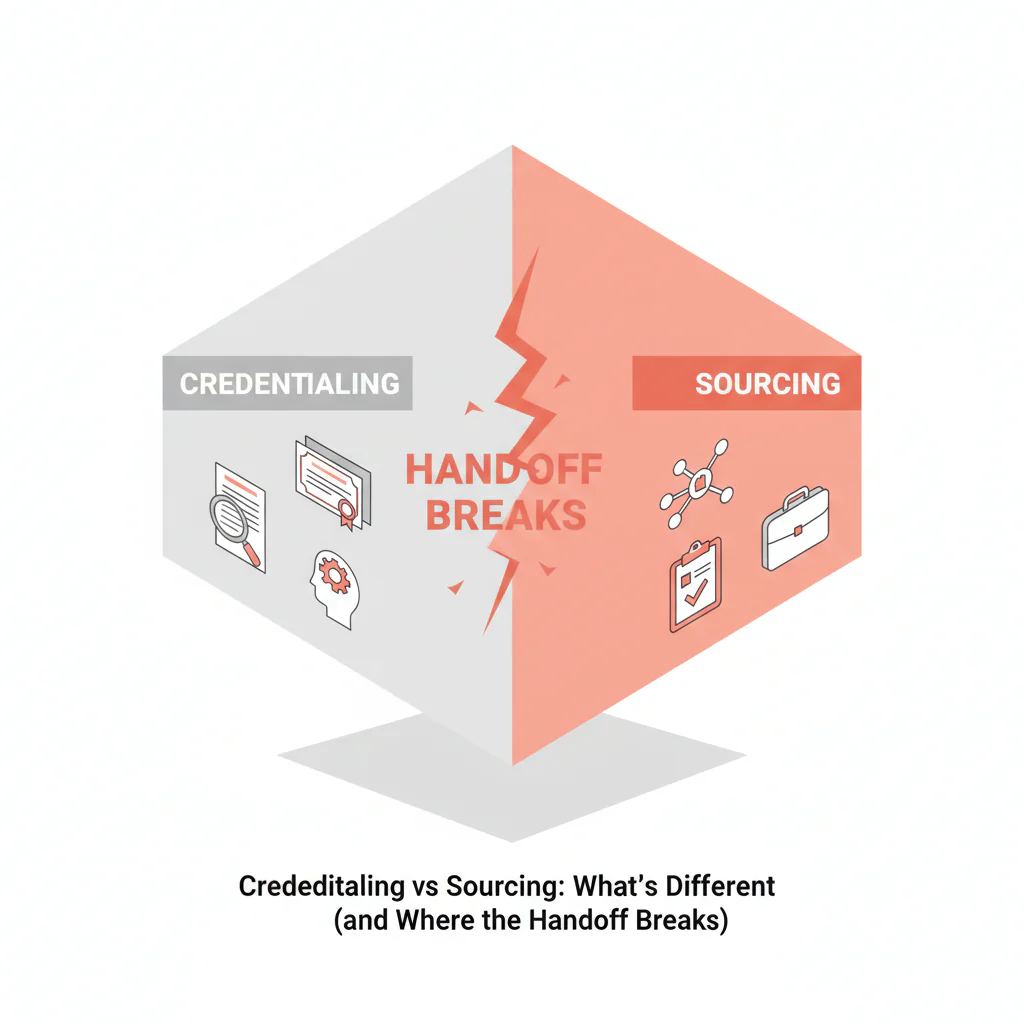
Credentialing vs sourcing: what’s different (and how to stop the handoff from breaking)
By Ben Argeband, Founder & CEO of Heartbeat.ai — Simple and calming.
When teams move fast, sourcing and credentialing get blended into one bucket. That’s when recruiters slow down collecting paperwork, ops can’t verify the right person, and submittals stall because identifiers are missing. This article draws a clean boundary between the two workflows and gives you a copy/paste handoff packet that prevents rework.
Definitions (required): Sourcing = find the right clinicians and reach them with compliant outreach. Credentialing = verify identity and qualifications and document proof for downstream requirements. Both depend on identity resolution (matching the right person to the right records) using identifiers like NPI and license details.
What’s on this page:
Who this is for
This is for recruiters and new ops hires mixing up sourcing and credentialing tasks—especially in physician recruiting where similar names, multiple practice locations, and multiple state licenses create avoidable verification loops.
- Recruiters who want faster speed-to-submittal without creating credentialing cleanup
- Recruiting ops / coordinators who inherit incomplete candidate packets
- Agency owners who need workflow boundaries that protect margin and reduce churn
Quick Answer
- Core Answer
- Credentialing verifies and documents identity and qualifications; sourcing finds and reaches candidates. The handoff is a minimal identity packet (NPI, license, verification links) that ops can validate.
- Key Insight
- Most delays come from missing identifiers (NPI, license state/number, legal name variants) that force re-verification and back-and-forth between teams.
- Best For
- Recruiters and new ops hires mixing up sourcing and credentialing tasks.
Compliance & Safety
This method is for legitimate recruiting outreach only. Always respect candidate privacy, opt-out requests, and local data laws. Heartbeat does not provide medical advice or legal counsel.
Minimum handoff packet (what sourcing must provide):
- Legal name + known name variants
- NPI (or “unknown” + best match clues)
- License state + license number (if available)
- Specialty/subspecialty
- Primary practice city/state
Example handoff packet (sample values, not real PII):
- Legal name: [First Last], variants: [First M. Last], [First Last, DO]
- NPI: [##########] or “unknown” + clue: [clinic name], [city/state]
- License: [TX] [########]
- Specialty: [Internal Medicine]
- Primary practice: [Austin, TX]
If you remember one line: sourcing is find + reach; credentialing is verify + document; the handoff is a minimal identity packet ops can validate.
Framework: The “Two Pipelines” Map: Outreach pipeline vs credentialing pipeline
Run two pipelines on purpose. Don’t let them blur.
- Outreach pipeline (Sourcing): define target → build list → contact → qualify → secure interest → schedule → submit.
- Credentialing pipeline: identity resolution → verification → documentation → facility packet readiness (as required) → start readiness.
Where “recruiting” fits: recruiting is the umbrella. Sourcing is the front end that creates qualified interest and a submittable candidate. Credentialing is the downstream verification and documentation work that makes the candidate usable for facility processes. The boundary artifact between the two is the handoff packet.
Role ownership map (who does what):
- Recruiter: target definition, outreach, qualification, interest confirmation, capture identifiers (NPI, license state/number, name variants), set expectations.
- Recruiting ops / credentialing coordinator: identity resolution, license verification, documentation (source link + date), discrepancy tracking, packet readiness.
- Compliance / leadership: outreach policy, opt-out handling standards, access controls, audit expectations.
The pipelines connect at one point: the handoff packet. If the handoff packet is incomplete, ops starts with guesswork. If the handoff packet is too heavy too early, recruiters lose momentum and candidates go dark.
The trade-off is… collecting enough identity data early to prevent rework, without turning first contact into a paperwork session.
Step-by-step method
Step 1: Define “done” for sourcing (so credentialing starts clean)
Sourcing is “done” when you have (1) confirmed interest and (2) enough identity data for ops to verify the right person. For most physician recruiting workflows, the minimum handoff packet is the list above.
If you can’t confidently attach an NPI or license to the right person, you don’t have a credentialing-ready handoff yet—you have a lead.
Step 2: Capture identifiers during normal qualification (without slowing the call)
Identity resolution is the shared dependency. Recruiters can capture identifiers as part of normal qualification without doing credentialing work. Prompts that keep momentum:
- “To avoid mixing you up with someone with a similar name, what state is your active license in?”
- “Do you know your NPI, or the name it’s listed under?”
- “What’s the best email for paperwork, and do you want texts for scheduling only?”
For how Heartbeat.ai approaches data quality and sourcing methodology, share this internally with new hires: Heartbeat trust methodology and data quality notes.
Step 3: Credentialing starts with reproducible verification (link + date + match notes)
Credentialing is verification plus documentation. “Verified” should mean someone can reproduce the check later using the stored source link and verification date.
- Verification: confirm the record matches the candidate (name, specialty, location, identifiers).
- Documentation: store the verification source link, the date/time, and any discrepancies for follow-up.
Operational rule: store the source link and date, not just “license verified” in a note.
Step 4: Set a handoff SLA and a bounce-back rule
To stop churn between teams, set two rules and enforce them:
- Handoff SLA: sourcing provides the minimum identity packet within your defined window after interest is confirmed.
- Bounce-back rule: credentialing can return a packet only for missing identity fields (not for “nice-to-have” items).
This keeps recruiters recruiting and keeps ops from doing detective work with partial data.
Step 5: Route state license verification to the right place
State license verification belongs in the credentialing pipeline. If your ops team needs a starting point by state, use: state license lookup resources by board.
If you’re building a locums workflow, keep the sourcing side tight and fast: locum tenens sourcing playbook.
Diagnostic Table:
Use this compact table to stop internal confusion and to standardize the handoff packet. It’s designed for physician recruiting ops and includes the exact fields that prevent wrong-record verification.
| Sourcing tasks (find + reach) | Credentialing tasks (verify + document) |
|---|---|
|
|
Output
|
Output
|
Handoff fields (copy/paste into your ATS form)
|
Ops verification fields (credentialing-owned)
|
Uniqueness hook (COMPACT_TABLE): Make the “Handoff fields” list above a required form in your ATS/CRM. It prevents the most common failure mode: interest is real, but ops can’t confidently match the right clinician record to verify.
Weighted Checklist:
Use this to assign ownership fast. Score each question; if one column totals 6+ points, that team owns the task. If it’s split, define the exact handoff field and “done” condition.
| Question | Points to Sourcing | Points to Credentialing |
|---|---|---|
| Does this task directly increase contactability or response? | +2 | 0 |
| Does this task require checking an official record and documenting proof? | 0 | +2 |
| Is the output a conversation outcome (interest, availability, comp range)? | +2 | 0 |
| Is the output a verified artifact (status, dates, source link, discrepancy resolution)? | 0 | +2 |
| Would a wrong answer create facility rejection or compliance risk? | 0 | +2 |
| Can it be completed during a normal recruiting call without slowing momentum? | +1 | 0 |
| Does it depend on identity resolution (matching the right person to the right record)? | +1 (capture identifiers) | +1 (verify + document) |
Boundary rule: recruiters capture identifiers; credentialing verifies and documents. If you break this rule, you’ll feel it as recruiter slowdown or ops rework.
Outreach Templates:
These templates keep sourcing focused on interest and fit while collecting the identifiers credentialing needs later. Customize to your policies and always honor opt-outs.
Template 1: First touch (email)
Subject: Quick question about your availability
Hi Dr. [Last Name] — I’m reaching out about a [role type] opportunity in [City/State]. If you’re open to a quick call, what’s the best time this week?
To avoid any mix-ups in our system, can you confirm your primary licensed state (and your preferred email for paperwork)?
— [Name], [Company]
Sent for recruiting outreach only. Reply STOP to opt out.
Template 2: First touch (text)
Hi Dr. [Last Name] — [Name] here. Are you open to a quick call about a [role type] role in [City]? If yes, what’s your best time? Reply STOP to opt out.
Template 3: Voicemail (short, physician-friendly)
Hi Dr. [Last Name], this is [Name] with [Company]. I’m calling about a [role type] opportunity in [City/State]. If you’re open to a quick conversation, call me back at [number]. To make sure I’m referencing the right record, I may ask which state you’re actively licensed in. Again, [number].
Template 4: Qualification call close (handoff capture)
Before I loop in ops for verification, I want to make sure we match the right records. What state is your active license in, and do you know your NPI (or the name it’s listed under)?
Template 5: Candidate asks “Why do you need my license state?”
Totally fair question. We use your license state (and NPI if you have it) to make sure we verify the correct record and don’t mix you up with someone with a similar name. It keeps the process faster and reduces back-and-forth.
Template 6: Recruiter-to-ops handoff note (paste into your ATS)
Candidate interested: Yes
Identity packet: Legal name [ ], Name variants [ ], NPI [ ], License state/number [ ], Primary practice city/state [ ], Specialty [ ]
Contact preferences: Best channel [ ], Opt-out notes [ ]
Next step requested: Verify license + document source link/date; flag discrepancies.
If you need to build a contactable list for outreach, start free search & preview data.
Common pitfalls
- Credentialing too early: asking for full document packets before interest is confirmed slows response and increases drop-off.
- Credentialing too late: submitting without a minimal identity packet forces ops to guess, which creates rework and facility rejections.
- No identity resolution step: common names + multiple locations = wrong record risk. Anchor to NPI and license details when possible.
- “Verified” without proof: “license verified” without a source link and date is not reproducible verification.
- Ownership drift: recruiters doing verification work (or ops doing outreach) breaks accountability and throughput.
- Overpromising outcomes: credentialing reduces risk and improves readiness; it does not guarantee acceptance by every facility.
How to improve results
1) Standardize the handoff packet in your ATS/CRM
Make the handoff fields from the Diagnostic Table required. If a recruiter can’t fill them, keep the record in “lead” status, not “ready for credentialing.”
2) Add an “identity confidence” field for triage
Use a simple dropdown: High / Medium / Low.
- High: NPI and license match the candidate.
- Medium: one identifier missing (for example, NPI unknown but license state confirmed).
- Low: name-only or conflicting details.
Ops can prioritize verification effort and reduce time wasted on low-confidence records.
3) Measurement instructions (required)
Measure this by… tracking these weekly from your ATS/CRM and credentialing checklist:
- Handoff completeness rate = complete handoff packets / total handoffs (per 100 handoffs). Pull from required-field completion at the moment the record moves to “credentialing.”
- Bounce-back rate = packets returned to sourcing for missing identity fields / total packets sent to credentialing (per 100 packets). Pull from a “returned” status or tag.
- Time-to-verification start = time from “candidate interested” to “verification initiated” (median hours). Pull from stage timestamps or task creation timestamps.
If you also track outreach performance, keep definitions consistent:
- Deliverability Rate = delivered emails / sent emails (per 100 sent emails).
- Bounce Rate = bounced emails / sent emails (per 100 sent emails).
- Reply Rate = replies / delivered emails (per 100 delivered emails).
- Connect Rate = connected calls / total dials (per 100 dials).
- Answer Rate = human answers / connected calls (per 100 connected calls).
4) Use the right tool for the right pipeline
Heartbeat.ai supports the outreach pipeline: finding and reaching clinicians, then passing a clean identity packet into ops. Credentialing systems support verification and documentation. Don’t force one tool to do both jobs poorly.
Legal and ethical use
Both sourcing and credentialing touch personal data. Keep your process defensible:
- Use data only for legitimate recruiting outreach and candidate evaluation.
- Honor opt-out requests immediately across channels.
- Limit access: recruiters don’t need full document packets; ops doesn’t need to run outreach sequences.
- Document verification sources and dates for auditability.
Heartbeat.ai does not provide legal advice. If you need policy language for your jurisdiction, involve counsel and your compliance lead.
Evidence and trust notes
For medical licensure context and board verification norms, see the Federation of State Medical Boards (FSMB): https://www.fsmb.org/.
For NPI context and how NPI records are used for identification, see the CMS NPPES NPI Registry: https://npiregistry.cms.hhs.gov/.
For how Heartbeat.ai evaluates data quality and sourcing methodology, review: Heartbeat trust methodology and data quality notes.
Related internal resources for workflow execution:
- State license lookup hub (ops verification starting point)
- Locum tenens sourcing playbook (outreach pipeline SOP)
FAQs
Is credentialing part of recruiting?
It supports recruiting, but it’s a different pipeline. Recruiting (including sourcing) creates qualified interest and a submittable candidate; credentialing verifies and documents identity and qualifications for downstream requirements.
What’s the minimum info sourcing should collect before handing off to credentialing?
At minimum: legal name (and variants), primary license state (and number if available), specialty, primary practice location, and a reliable identifier like NPI when applicable. That’s enough for ops to verify the right record.
Should I use NPI or license number for identity matching?
Use both when you can. NPI helps disambiguate clinicians with similar names, and license state/number helps confirm the correct state record. If one is missing, include “best match clues” (practice city/state, clinic name, specialty) so ops can verify confidently.
Why do sourcing and credentialing both need identity resolution?
Sourcing needs it to avoid contacting the wrong person and to keep records clean. Credentialing needs it to ensure verification and documentation match the correct clinician (especially with common names and multiple locations).
Where do state license lookups fit in?
They’re part of credentialing verification. Sourcing can capture the license state/number, but ops should run the official verification and store the source link and date. Use: state license lookup resources.
How do I stop recruiters from getting pulled into credentialing work?
Make the handoff packet required, define “done” for sourcing, and enforce the bounce-back rule (only missing identity fields come back). Everything else stays with ops.
Next steps
- Copy the handoff fields from the Diagnostic Table into your ATS/CRM as required fields.
- Assign owners: sourcing owns identifiers + interest; credentialing owns verification + documentation.
- Build your outreach list, then pass a clean identity packet to ops: start free search & preview data.
About the Author
Ben Argeband is the Founder and CEO of Swordfish.ai and Heartbeat.ai. With deep expertise in data and SaaS, he has built two successful platforms trusted by over 50,000 sales and recruitment professionals. Ben’s mission is to help teams find direct contact information for hard-to-reach professionals and decision-makers, providing the shortest route to their next win. Connect with Ben on LinkedIn.

