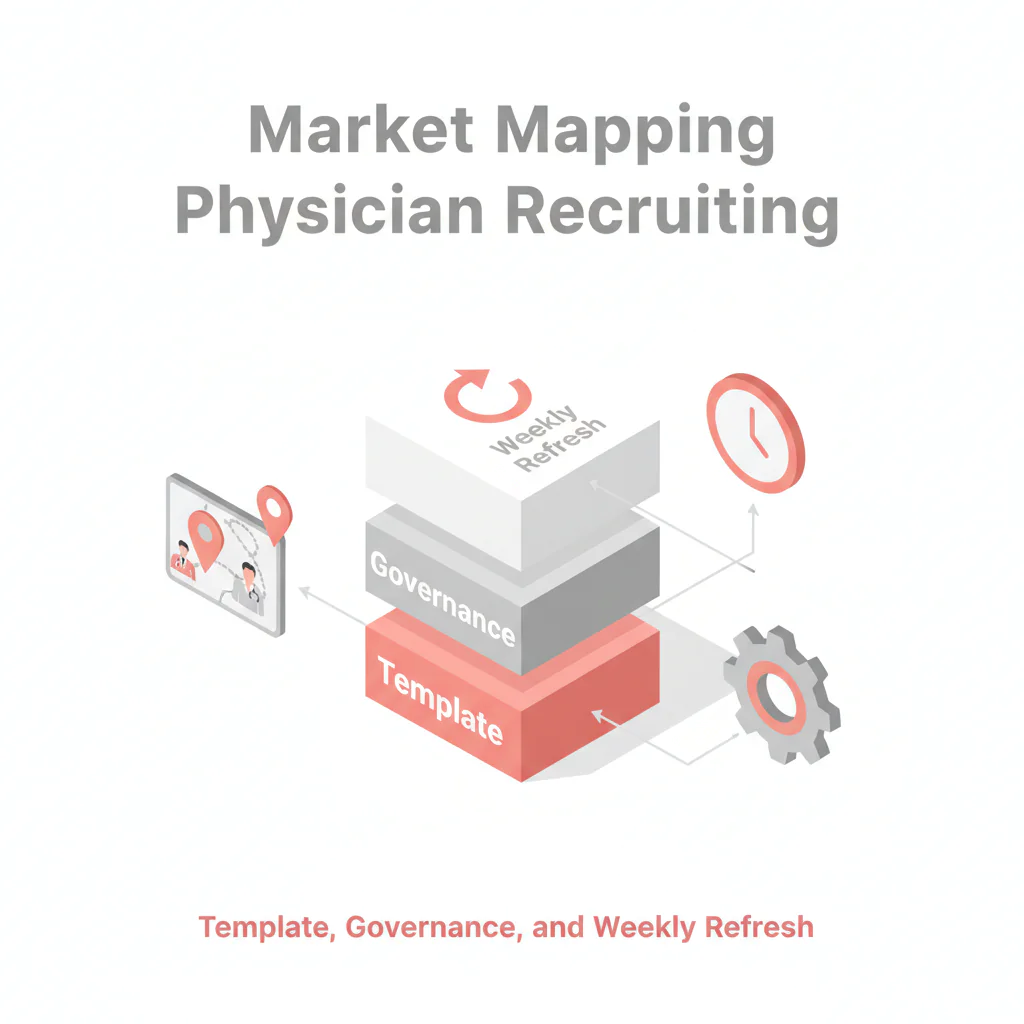
Market mapping physician recruiting
Ben Argeband, Founder & CEO of Heartbeat.ai — Show exactly what to put in the sheet and how to use it weekly.
What’s on this page:
Who this is for
This is for Recruiters building a physician target market list for recurring hiring who need a market map that holds up across multiple reqs, multiple recruiters, and weekly list decay.
Physician recruiting has three predictable frictions: public sources are strong on identifiers but weak on reachability, duplicates explode when teams work the same market, and contact data goes stale fast enough to break cadence.
Quick Answer
- Core Answer
- Build a physician market map from public identifiers, dedupe by NPI/license, enrich missing contacts, then run a repeatable outreach sequence with weekly refresh and suppression.
- Key Statistic
- Heartbeat observed typicals: outreach attempts per placement (100–200) to justify list scale; include a measurement plan for coverage.
- Best For
- Recruiters building a physician target market list for recurring hiring.
Compliance & Safety
This method is for legitimate recruiting outreach only. Always respect candidate privacy, opt-out requests, and local data laws. Heartbeat does not provide medical advice or legal counsel.
Framework: The “Map → Enrich → Sequence” Workflow: build list once, reuse forever
Map gives you a stable identifier spine (so your dataset survives refresh). Enrich adds reachability (so you can actually connect). Sequence turns the map into weekly output (so you get submittals without rebuilding).
- Map: Start with public sources (government sites) to capture NPI and license fields, plus specialty and location.
- Enrich: Add mobile/direct/email fields, provenance, and last-verified dates.
- Sequence: Run consistent outreach, log outcomes, and feed suppression + updates back into the map.
Market maps start with public sources; enrichment completes reachability. Dedupe by NPI/license.
Use cases (where market mapping pays back fast)
- New req launch: stand up a cohort quickly because the identifier spine already exists.
- Recurring quarterly hiring: reuse the same cohort and refresh what decayed (contacts + org changes), instead of rebuilding the list.
- Facility expansion: clone the schema, adjust the boundary, and keep dedupe consistent across markets.
- Team recruiting: prevent duplicate outreach by enforcing cohort ownership, suppression, and merge logs.
Step-by-step method
Step 1: Define the market boundary (so the map doesn’t sprawl)
Write your boundary in one sentence before you touch data:
- Specialty scope: which physician specialty(ies) you’re targeting for this req cycle.
- Geography: the area you can realistically hire into.
- Setting: hospital-employed vs private practice vs academic (changes contact paths).
Then create a cohort label that encodes that boundary (example format: Specialty | Market | Setting | Wave).
Step 2: Build the identifier spine from government sites
Start with government sites because they give you stable identifiers and a defensible audit trail. For physicians, the most useful stable identifier is the NPI.
- Pull NPI records for your boundary and capture the fields you’ll use for matching and refresh.
- Where available, capture license number + state and license status from state verification sources.
At this stage, you’re not trying to find the best phone number. You’re building a clean backbone that can survive refreshes and merges.
Step 3: Add practice signals (Doximity + web) without letting them become your primary key
Use Doximity to validate specialty focus, current org, and location signals. Store the profile URL as a reference field, not as the dedupe key.
- Capture Doximity URL, current org, and location as signals.
- If Doximity conflicts with NPI/license, treat NPI/license as the anchor and flag the conflict for review.
Step 4: Normalize names and organizations (so dedupe works)
Normalize the fields that cause false duplicates:
- Name: split into first/middle/last/suffix; store a separate display_name if you want it.
- Organization: store org_raw and org_normalized (strip punctuation, standardize abbreviations).
- Location: store city/state/ZIP; keep a separate market field that matches your boundary definition.
Step 5: Dedupe using NPI + license matching rules
Make your dedupe rules explicit so every recruiter merges the same way.
- Primary dedupe key: NPI (exact match).
- Secondary dedupe key: license number + state (exact match) when NPI is missing or ambiguous.
- Tertiary review bucket: name + city + specialty + org (manual review only).
Dedupe definition: a dedupe event is when two or more rows represent the same physician and are merged into one canonical record, preserving all source references.
License matching is what keeps your map stable when you combine multiple sources that don’t always carry NPI cleanly.
Step 6: Enrich for reachability (phones/emails) and track provenance
Once the spine is clean, enrich the records to make them usable for outreach. In practice, customers use government sites + Doximity for mapping, and Heartbeat.ai fills missing contacts via enrichment and matching.
- Add separate fields for mobile, direct line, office line, and email(s).
- Store contact_source and contact_last_verified_date so you can refresh intelligently.
- Maintain a suppression flag for opt-outs and do-not-contact requests.
Enrichment trigger rules (simple and enforceable):
- Re-enrich a record when an email bounces.
- Re-enrich a record when a call outcome is wrong number or disconnected.
- Re-enrich a record when the contact_last_verified_date is stale for your team’s cadence.
For P1 recruiting ops workflows, the goal is fewer dead dials, fewer bounces, and faster submittals. Heartbeat.ai can support that by providing contacts and, in some workflows, ranked mobile numbers by answer probability.
Step 7: Sequence outreach and feed outcomes back into the map
Don’t treat the market map as a static spreadsheet. Treat it as a system where every outcome updates suppression, verification dates, and next-touch routing.
- Run a consistent outreach sequence (call + email + follow-up).
- Log outcomes (connected, wrong number, voicemail, bounce, reply, opt-out).
- Update the map: replace bad contacts, suppress opt-outs, and tag reached vs not reached.
The trade-off is… you’ll spend more time upfront on structure, but you’ll stop paying the rebuild tax every time a new req opens.
Step 8: Assign ownership + suppression governance (so teams don’t collide)
Market mapping fails in multi-recruiter teams when ownership is vague. Put governance into the sheet.
- Single owner per cohort: every row has an owner for the current wave (even if ownership rotates next wave).
- Central suppression: opt-outs and do-not-contact requests are applied in the master map, not personal notes.
- Merge log: track who merged duplicates and when (simple merged_by and merged_date fields are enough).
Team handoffs (so the map stays clean)
- Recruiting ops or lead recruiter: owns dedupe rules, merge conflicts, and the weekly dedupe run.
- Each recruiter: owns outcome logging (wrong number, bounce, reply, opt-out) and keeps notes minimal.
- One designated owner per cohort: owns suppression enforcement and decides when to refresh enrichment for that cohort.
Diagnostic Table:
Use this to diagnose why your current market map isn’t producing reachable candidates fast enough.
| Symptom | Likely cause | Fix in the map | Fix in the workflow |
|---|---|---|---|
| High wrong-number rate on calls | Office main lines stored as the primary phone field | Separate mobile vs direct vs office; store provenance + last verified date | Prioritize mobile/direct; route office lines to a gatekeeper script |
| Low Answer Rate | Calling at the wrong times or relying on office lines | Tag preferred call windows when learned; keep office lines separate from mobile/direct | Shift call windows by cohort; prioritize mobile/direct before office lines |
| Duplicates across recruiters | No canonical key; inconsistent name formatting | Make NPI the primary key; add license matching as secondary | Centralize the master sheet; enforce merge rules + merge log |
| Email bounces rise over time | List decay; no suppression or refresh routine | Add bounce flag + last sent date + last delivered date | Weekly refresh + suppression before each send |
| Low coverage in a cohort | Boundary too tight, missing identifiers, or suppression applied inconsistently | Audit NPI/license fields, expand boundary if needed, and separate suppress from not-yet-enriched | Re-pull identifiers from government sites, re-run dedupe, then enrich missing channels before sequencing |
Weighted Checklist:
Score your market map readiness before you launch outreach. Total 100 points (internal rubric). If you’re under 70, fix the sheet first before scaling outreach.
- (25) NPI present and validated for most rows in scope (set your own threshold by cohort and track it weekly).
- (15) License matching fields present (license state + license number + status where available).
- (15) Dedupe rules documented and followed (NPI first, license second, manual review bucket third).
- (10) Dedupe merge log maintained (merged_by, merged_date, merge_reason).
- (15) Contact fields separated (mobile/direct/office/email) with source + last verified date.
- (10) Suppression fields exist (opt-out, do-not-contact, wrong specialty, retired/moved).
- (10) Cohort definition is set and used for assignment and reporting.
Cohort definition: a cohort is a labeled subset of the market map used for routing and measurement (example: Hospitalist | Metro North | Employed | Wave 1). Cohorts must be consistent enough to compare week over week.
Outreach Templates:
These templates are built for physician recruiting realities: short windows, gatekeepers, and low tolerance for fluff. Customize the bracketed fields and keep the first touch short.
Template 1: Direct-to-physician voicemail (mobile)
“Hi Dr. [Last], this is [Name]. I’m recruiting for a [Specialty] opening with [Org] near [City]. If you’re open to a quick, confidential chat, call or text me at [Number]. If not, reply ‘no’ and I’ll suppress future outreach. Thanks.”
Template 2: Gatekeeper call opener (office line)
“Hi—can you help me reach Dr. [Last]? This is recruiting outreach about a [Specialty] opportunity. What’s the best number or time window to reach them directly?”
Template 3: Email (first touch)
Subject: [Specialty] near [City] — quick question
“Dr. [Last] — I’m recruiting for a [Specialty] position with [Org] near [City]. Are you open to a brief call this week, or should I close the loop? If you prefer text, reply with a number and I’ll keep it short.”
Template 4: Email (follow-up with specifics)
Subject: Re: [Specialty] near [City]
“Following up once. I can send comp range, call schedule, and clinic mix in one message. If you’re not interested, reply ‘no’ and I’ll suppress future outreach.”
Common pitfalls
Pitfall 1: Treating a list like a market map
A list is a one-time export. A market map is a maintained dataset with identifiers, provenance, and outcomes. If you can’t answer where a contact came from and when it was last verified, you don’t have a map you can run weekly.
Pitfall 2: Dedupe after outreach starts
If two recruiters contact the same physician because you didn’t dedupe by NPI/license first, you burn trust and waste attempts. Do the merge work before the first send.
Pitfall 3: No suppression discipline
Opt-outs, wrong specialty, retired, moved—these must be suppressed centrally. If suppression lives in personal notes, you’ll keep re-contacting the same people every quarter.
Pitfall 4 (Uniqueness Hook): CSV_TEMPLATE that survives weekly refresh
Most teams fail because their sheet can’t survive weekly refresh. Use this CSV_TEMPLATE as your canonical schema. It supports government sites + Doximity mapping, then enrichment, then sequencing—without breaking dedupe.
Copy/paste market map template columns: physician_id, npi, license_state, license_number, first_name, last_name, specialty_primary, city, state, org_raw, org_normalized, doximity_url, phone_mobile, phone_direct, phone_office, email_primary, contact_source, contact_last_verified_date, cohort, owner, status, suppression_reason, merged_by, merged_date, merge_reason, last_touch_date, notes.
| Column | Type | Required? | Notes / rules |
|---|---|---|---|
| physician_id | string | Yes | Internal stable ID (do not change). If blank on import, generate once. |
| npi | string | Preferred | Primary dedupe key. Exact match only. |
| license_state | string | Preferred | Used with license_number for secondary dedupe. |
| license_number | string | Preferred | Secondary dedupe key with license_state. |
| specialty_primary | string | Yes | Use a controlled list for reporting. |
| org_normalized | string | No | Lowercase, remove punctuation, standardize abbreviations. |
| contact_source | string | No | e.g., government sites, Doximity, Heartbeat.ai enrichment. |
| contact_last_verified_date | date | No | Update when you confirm deliverability/connection. |
| cohort | string | Yes | Used for routing + measurement. |
| suppression_reason | string | No | opt_out, wrong_specialty, retired, moved, do_not_contact, duplicate. |
How to improve results
Improvement comes from two loops: (1) better reachability data and (2) better routing and cadence decisions. If you only do one, you’ll plateau.
Define the metrics (so your team measures the same thing)
- Deliverability Rate = delivered emails / sent emails (per 100 sent emails).
- Bounce Rate = bounced emails / sent emails (per 100 sent emails).
- Connect Rate = connected calls / total dials (per 100 dials).
- Answer Rate = human answers / connected calls (per 100 connected calls).
- Reply Rate = replies / delivered emails (per 100 delivered emails).
Coverage definition: the percent of physicians you can identify within your defined market boundary that exist in your map with a valid identifier spine (NPI and/or license match) and at least one usable outreach path (phone or email) that is not suppressed.
Dedupe definition: the process of merging multiple rows that represent the same physician into one canonical record using NPI first, then license matching, while preserving source references.
Cohort definition: a labeled subset of the market map used for assignment and measurement; cohorts should be consistent and comparable over time.
Weekly refresh routine (what to do every week, in order)
- Import updates from government sites (new NPIs, address changes) and internal notes that affect suppression.
- Run dedupe using NPI + license matching rules; merge and preserve provenance.
- Refresh enrichment for records missing mobile/direct/email or with stale verification dates.
- Apply suppression before any outreach (opt-outs, do-not-contact, wrong specialty).
- Re-cohort if the req boundary changed (new facility, new radius, new specialty mix).
- Launch sequence and log outcomes back into the map as part of your weekly routine (ideally same day).
Measurement plan (required)
Measure this by… running a cohort-based weekly report that includes:
- Map size (rows after dedupe) by cohort.
- Coverage (as defined above) by cohort, split into: phone-available, email-available, both.
- Suppression rate = suppressed records / total records (per 100 records) by cohort.
- Outreach outcomes: Deliverability Rate, Bounce Rate, Connect Rate, Answer Rate, Reply Rate (using the definitions above).
- Speed to first reach: median days from new to reached status (by cohort).
If/then actions when metrics drift
| If you see… | It usually means… | Do this next |
|---|---|---|
| Bounce Rate rising | Decay or bad domains in the cohort | Suppress bounces, refresh enrichment for that cohort, and re-send only to delivered addresses |
| Low Connect Rate | You are dialing office lines or stale numbers | Prioritize mobile/direct fields, move office lines to gatekeeper workflow, refresh phones for wrong-number outcomes |
| Good Deliverability Rate but low Reply Rate | Message is not specific enough to the role | Add call schedule + setting + location specifics to follow-up; tighten the ask to one question |
| Suppression rate climbing | You are re-touching the same market without respecting outcomes | Audit suppression reasons, enforce centralized suppression, and rotate cohorts instead of blasting the full map |
Use the Heartbeat observed typicals note (outreach attempts per placement) as a planning constraint: if your cohort is too small after dedupe and suppression, you will run out of reachable candidates before you get to submittals.
Legal and ethical use
Market mapping is legitimate when it supports lawful recruiting outreach and respects candidate preferences.
- Use data from public sources and reputable providers; document sources in your sheet.
- Honor opt-out requests quickly and permanently (suppression should be centralized).
- Follow applicable privacy and communications laws for your jurisdiction and the candidate’s location.
- Do not store sensitive personal data you do not need to recruit (keep notes minimal and job-relevant).
- Keep suppression reasons minimal and standardized so they are auditable and consistently applied.
- Do not represent your map as complete and do not claim guaranteed completeness; list decay is real.
Evidence and trust notes
When you build a market map, you are making operational decisions based on data quality. Anchor your identifier spine to NPI and keep a source trail so refresh and dedupe are auditable. NPI is an identifier for matching and dedupe, not a guarantee of reachability.
- NPI reference sources: NPPES NPI Registry and CMS NPI overview.
- For how Heartbeat.ai evaluates data quality and trust, see our trust methodology.
FAQs
What is market mapping in physician recruiting?
It is the process of building and maintaining a structured dataset of physicians in a defined boundary (specialty + geography), anchored by NPI/license, then adding reachability fields for outreach.
Where should I start building a physician market map?
Start with government sites for identifiers (NPI and license where available), then use Doximity and web sources for practice signals, and finally add enrichment for phones/emails.
How do I dedupe a physician market map correctly?
Dedupe by NPI first (exact match). If NPI is missing or inconsistent, use license matching (license state + license number). Put name/org-only matches into a manual review bucket.
How big should my market map be?
Big enough to support your outreach reality after dedupe and suppression. Plan cohort size around expected outreach attempts per placement, not around how many names you can export.
How do I keep the map fresh without rebuilding it?
Run a weekly refresh routine: import identifier updates, dedupe, refresh enrichment for missing or stale contacts, apply suppression, then sequence outreach and log outcomes back into the map.
Next steps
- If you need a starting dataset, see physician list by specialty and state and adapt it to the CSV schema above.
- If your issue is missing phones/emails, read physician contact enrichment to understand what to enrich and how to track provenance.
- If you are merging multiple sources, use NPI and license matching to tighten dedupe and reduce duplicate outreach.
- When you are ready to operationalize this, start free search & preview data and build your first cohort with enrichment + suppression from day one.
About the Author
Ben Argeband is the Founder and CEO of Swordfish.ai and Heartbeat.ai. With deep expertise in data and SaaS, he has built two successful platforms trusted by over 50,000 sales and recruitment professionals. Ben’s mission is to help teams find direct contact information for hard-to-reach professionals and decision-makers, providing the shortest route to their next win. Connect with Ben on LinkedIn.