Healthcare contact data accuracy: verification workflow + vendor scorecard
Ben Argeband, Founder & CEO of Heartbeat.ai — Buyer survival guide; measurable scorecard; no hype.
What’s on this page:
Who this is for
If you’re a recruiter evaluating vendors and tired of dead numbers, this hub is for you. I’m writing this from the operator seat: you’re trying to move reqs, protect recruiter time, and avoid paying twice (once for data, again in wasted outreach).
This page is the anchor for healthcare contact data accuracy across phone and email: what to verify, what to measure, and how to hold a vendor accountable with a scorecard tied to outcomes.
- Quick Answer
- Framework: Trust But Verify
- Step-by-step method
- Diagnostic Table (what’s actually broken)
- Vendor Scorecard (how to compare vendors)
- Outreach Templates (after verification)
- Legal and ethical use
- Evidence and trust notes
Quick Answer
- Core Answer
- Healthcare contact data accuracy is proven by verifying phone and email records, then tracking deliverability, connect, and answer outcomes by source and recency—not by a single vendor percentage.
- Key Statistic
- Heartbeat observed typicals: Heartbeat internal: mobile accuracy 82% (first mobile); email accuracy 95%; connect rate ~10% typical. (Accuracy here means correct-to-person at time of use in internal QA samples; not a guarantee.)
- Best For
- Recruiters evaluating vendors and tired of dead numbers.
Compliance & Safety
This method is for legitimate recruiting outreach only. Always respect candidate privacy, opt-out requests, and local data laws. Heartbeat does not provide medical advice or legal counsel.
Framework: The “Trust But Verify” Model: Evidence → Recency → Outcomes
In healthcare recruiting, “accurate” is meaningless unless you can answer three questions:
- Evidence: What proof links this phone/email to the specific clinician or decision-maker you’re targeting?
- Recency: When was it last verified? Old data is the fastest way to burn call blocks and email reputation.
- Outcomes: Does it produce delivered emails, connected calls, and human answers in your workflow?
Use this model to evaluate any source: vendor exports, enrichment, your ATS/CRM, or lists you inherited.
Step-by-step method
Step 1: Stop treating “accuracy” as one number
Accuracy isn’t one number; channel metrics differ. A dataset can look “good” on email but fail on phone, or vice versa. If you don’t split the channels, you can’t fix the bottleneck.
Standardize these definitions across your team and vendors:
- Contact data accuracy: the share of records where the contact point (email or phone) correctly belongs to the intended person at the time you use it.
- Deliverability Rate = delivered emails / sent emails (per 100 sent emails).
- Bounce Rate = bounced emails / sent emails (per 100 sent emails).
- Reply Rate = replies / delivered emails (per 100 delivered emails).
- Connect Rate = connected calls / total dials (per 100 dials).
- Answer Rate = human answers / connected calls (per 100 connected calls).
Here’s the fast comparison recruiters should use when a vendor throws around “accuracy”:
| Term | What it means (operationally) | What it does not mean | Where it shows up |
|---|---|---|---|
| Accuracy | Correct-to-person contact point at time of use | Not the same as delivered email or connected call | QA samples, recruiter feedback loops, downstream outcomes |
| Deliverability | Inbox acceptance: delivered emails / sent emails | Doesn’t prove it’s the right person | Email platform logs, Postmaster signals |
| Connect | Call connection: connected calls / total dials | Doesn’t mean a human answered | Dialer logs, carrier outcomes |
| Answer | Human pickup: human answers / connected calls | Doesn’t guarantee interest or fit | Call dispositions, recruiter notes |
If you want the nuance between phone outcomes, use: connect rate vs. answer rate (recruiting calls).
Step 2: Verify before outreach (pre-flight), then suppress
Two field truths that show up in every recruiting org:
- Line testing reduces dead dials: you learn whether a number rings, is disconnected, or routes in a way that can’t reach the person.
- Verification reduces bounces: you remove obvious invalid emails before you send, which protects deliverability and saves recruiter time.
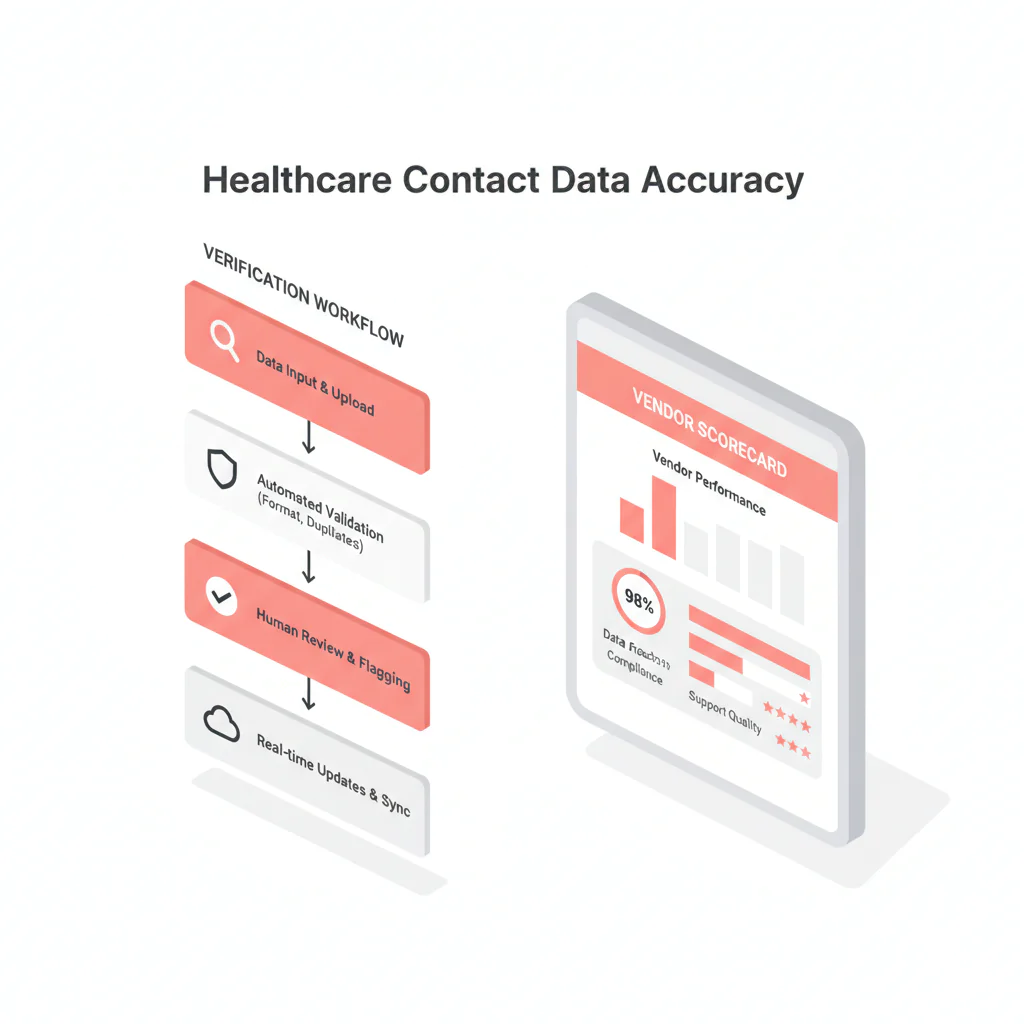
Build a pre-flight step that runs before sequences and dialer blocks:
- Pull your target segment (from ATS/CRM or a vendor export).
- Normalize identity fields (name, specialty, facility, location; add NPI if you use it internally).
- Run email verification and suppress invalid/risky addresses.
- Run phone validation plus line testing and suppress disconnected/non-working lines.
- Launch outreach and tag outcomes by source and last-verified recency.
If you’re trialing Heartbeat.ai, you can start free search & preview data and run this pre-flight on a real req segment before you commit.
Step 3: Decide what you’re optimizing for (coverage vs. efficiency)
Recruiting teams usually want maximum reach and maximum efficiency at the same time. The trade-off is… broader coverage tends to include more stale or indirect contact points, while tighter verification reduces volume but improves outcomes.
Make the choice per campaign:
- Hard-to-fill roles: prioritize phone validation and line testing so recruiters aren’t burning prime call windows on dead lines.
- High-volume email: prioritize email verification and deliverability hygiene to protect sending reputation.
- Practice owners / decision-makers: prioritize person-level evidence and suppression so you don’t create repeat outreach to the wrong person.
Step 4: Instrument outcomes so “accuracy” becomes auditable
Vendors will sell you a story. Your workflow metrics are the audit trail. Track outcomes by (1) source, (2) segment, and (3) recency label.
- Email: Deliverability Rate, Bounce Rate, Reply Rate.
- Phone: Connect Rate, Answer Rate.
- Business: screens booked, submittals, and hires (using your own internal denominators).
For teams that need speed, Heartbeat.ai can prioritize calling order with ranked mobile numbers by answer probability so your first call block isn’t wasted on low-likelihood lines.
Trial setup (what to require in the export)
- Record ID: stable unique ID per person so you can de-dupe and track outcomes.
- Last-verified timestamp: record-level for phone and email (separate fields if possible).
- Verification outputs: email status/risk flags; phone type/working status; line testing result if available.
- Suppression fields: opt-out flag and suppression reason (bounce, disconnected, do-not-contact).
- Source tags: vendor/source name and any confidence tier so you can segment reporting.
Diagnostic Table:
Use this to diagnose where your “accuracy” problem actually lives. Most teams blame the vendor when the real issue is channel mismatch or missing suppression.
| Symptom | What it usually means | What to measure (with denominator) | Next action |
|---|---|---|---|
| High bounces | Invalid/stale emails or weak verification | Bounce Rate = bounced / sent (per 100 sent emails) | Run email verification; suppress risky; refresh high-value segments |
| Delivered emails, low replies | Wrong person, wrong inbox type, or weak targeting | Reply Rate = replies / delivered (per 100 delivered emails) | Improve person-level evidence; tighten segment; adjust message |
| Low connect rate | Disconnected/non-working lines or non-dialable types | Connect Rate = connected calls / total dials (per 100 dials) | Phone validation + line testing; suppress dead lines |
| Connects, low answer rate | Voicemail, gatekeepers, bad call windows | Answer Rate = human answers / connected calls (per 100 connected calls) | Test call windows; prioritize mobile; adjust cadence |
| Good phone/email outcomes, weak submittals | Offer mismatch or wrong target profile | Submittals per internal denominator (define: per 100 conversations or per 100 replies) | Re-cut the segment; tighten must-haves; update pitch |
Channel playbooks: email verification for healthcare recruiting and phone validation for provider direct dials.
Weighted Checklist:
This is the vendor scorecard (uniqueness hook: VENDOR_SCORECARD). Score each line item 0–2, multiply by weight, and compare vendors on what impacts recruiter throughput.
| Category | 0–2 scoring rubric | What evidence to request (artifact) | Weight |
|---|---|---|---|
| Evidence (person match) | 0 = unclear match logic; 1 = partial; 2 = documented match + examples | Sample export showing person identifiers and match confidence notes | 20 |
| Recency labeling | 0 = no timestamps; 1 = coarse; 2 = record-level last-verified timestamp | Export column for last-verified date/time + refresh policy doc | 15 |
| Phone validation + line testing | 0 = claims only; 1 = validation without testing; 2 = validation + line testing + suppression | Definition of “working” + sample suppression output for disconnected/non-working | 15 |
| Email verification | 0 = none; 1 = basic; 2 = verification + risk flags + suppression rules | Verification fields (status/risk) + suppression logic description | 15 |
| Suppression & opt-out handling | 0 = manual only; 1 = partial; 2 = automated suppression across exports | Opt-out workflow description + suppression list export format | 10 |
| Outcome reporting | 0 = none; 1 = aggregate; 2 = outcomes by source + segment + recency | Example report with denominators for deliverability/connect/answer | 10 |
| Workflow fit | 0 = messy exports; 1 = workable; 2 = clean fields + stable IDs + integrations | Field dictionary + sample CSV + change log policy | 10 |
| Trust documentation | 0 = marketing only; 1 = partial; 2 = documented methodology + audit trail | Methodology page + QA process + escalation path | 5 |
Questions to ask vendors (copy/paste)
- Show me a sample export with record-level last-verified timestamps for both phone and email.
- What does phone validation mean in your system (number type, working status, carrier signals)? What does line testing include?
- What does email verification output (status, risk flags), and what gets suppressed automatically?
- How do you handle consent signals and opt-out requests? Can you export a suppression list I can apply in my ATS/CRM and sequencer?
- Can you report Deliverability Rate, Bounce Rate, Connect Rate, and Answer Rate by source and recency with denominators?
- What is your process when a recruiter flags a bad record? How fast does it get corrected and suppressed?
For Heartbeat.ai specifics, see how our data is built and maintained.
Outreach Templates:
These templates assume you’ve already verified and suppressed. They are designed for healthcare recruiting: short, respectful, and easy to opt out.
Template 1: Verified email (first touch)
Subject: {Role} in {City} — quick question
Body: Hi {FirstName} — I’m recruiting for a {Role} opening with {Facility/Group} in {City}. If you’re open to a 5-minute call, what’s the best time? If not, reply “no” and I’ll close the loop. — {YourName}
Template 2: Verified mobile (call + voicemail)
Call opener: “Hi {FirstName}, this is {YourName}. I’m calling about a {Role} opportunity in {City}. Is now a bad time?”
Voicemail: “{FirstName}, {YourName}. I’m recruiting for a {Role} role in {City}. If you’re open to details, call/text me at {Callback}. If not interested, reply ‘stop’ and I won’t follow up.”
Template 3: Clinic line (no direct dial)
Script: “Hi — I’m trying to reach Dr. {LastName} regarding a professional opportunity. What’s the best way to send a short message for review?”
If you want to test this end-to-end, you can start free search & preview data and run a pilot on one specialty segment.
Common pitfalls
- Letting a vendor define “accurate” for you. If they can’t show evidence, recency labels, and outcomes, you’re buying a story.
- Confusing deliverability with correctness. A delivered email can still be the wrong person. Track Reply Rate and downstream screens.
- Not separating connect from answer. If you don’t split them, you won’t know whether to fix data, call windows, or gatekeeper routing.
- Skipping suppression. If you don’t suppress bounces, disconnected lines, and opt-outs, you’ll repeat the same mistakes at scale.
- Over-rotating on volume. More records doesn’t mean more conversations if verification is weak.
How to improve results
1) Build a weekly verification + suppression pre-flight
- Verify new records before they enter sequences or dialers.
- Suppress known bad: bounces, disconnected/non-working lines, explicit opt-outs.
- Refresh high-value segments more often than low-value segments.
2) Set up a simple reporting template (so you can enforce quality)
Measure this by… reviewing these columns weekly by vendor/source and by last-verified recency label:
- Sent emails, delivered emails, bounced emails
- Deliverability Rate = delivered / sent (per 100 sent emails)
- Bounce Rate = bounced / sent (per 100 sent emails)
- Delivered emails, replies
- Reply Rate = replies / delivered (per 100 delivered emails)
- Total dials, connected calls
- Connect Rate = connected / total dials (per 100 dials)
- Connected calls, human answers
- Answer Rate = human answers / connected (per 100 connected calls)
3) Run a clean vendor trial without inventing conclusions
- Use the same segment (same specialty, geography, seniority) across vendors.
- Use the same outreach cadence and call windows.
- Compare outcomes and recruiter time saved, not marketing claims.
Legal and ethical use
This is for legitimate recruiting outreach only. Build your process around consent, clear identification, and fast opt-out handling. Don’t treat compliance as a footer—treat it as a workflow requirement.
- Calling/texting: understand the basics of the Telephone Consumer Protection Act (TCPA) and apply conservative outreach practices. No one can promise “TCPA guaranteed.”
- Email: follow CAN-SPAM requirements, including unsubscribe handling and accurate identification.
- Data handling: minimize what you store, restrict access, and honor suppression across tools.
References: FCC TCPA overview and FTC CAN-SPAM compliance guide.
Evidence and trust notes
When you’re buying or auditing data quality, you need a repeatable trust method, not a one-time demo. Start here: Heartbeat trust methodology.
For email deliverability monitoring and best practices, use official sources:
- Google Postmaster Tools (deliverability monitoring)
- Google Workspace email best practices
Claim hygiene: avoid any vendor promising an accuracy guarantee across all channels and time windows. Also avoid vague claims like “HIPAA compliant database” unless it’s clearly defined and reviewed by counsel.
FAQs
How do I validate healthcare contact data accuracy in my own workflow?
Verify phone and email before outreach, suppress known bad records, then track Deliverability Rate (delivered/sent), Bounce Rate (bounced/sent), Connect Rate (connected/total dials), and Answer Rate (human answers/connected) by source and recency.
Why do I get connected calls but few human answers?
That’s usually call-window or routing friction (voicemail, gatekeepers), not just bad numbers. Separate Connect Rate from Answer Rate and test time-of-day and mobile prioritization.
What should I demand from a data vendor during a trial?
Record-level last-verified timestamps, clear verification outputs for email and phone, suppression/opt-out handling you can apply across tools, and outcome reporting with denominators by source and recency.
Is email deliverability the same as accuracy?
No. Deliverability only means the email was delivered. Accuracy is whether it belongs to the intended person. Track Reply Rate (replies/delivered) and downstream screens to audit person-level correctness.
Can I just buy a static list and move faster?
Buying static lists is risky because of decay. The modern standard is Access + Refresh + Verification + Suppression, so your recruiters aren’t spending time on stale records.
Next steps
- Pick one specialty segment and run the pre-flight (verification + suppression) before outreach.
- Use the vendor scorecard to compare sources on evidence, recency, and outcomes.
- If you want to test Heartbeat.ai, start free search & preview data and measure results in your own workflow.
Optional reading: how Heartbeat.ai builds and maintains data quality.
About the Author
Ben Argeband is the Founder and CEO of Swordfish.ai and Heartbeat.ai. With deep expertise in data and SaaS, he has built two successful platforms trusted by over 50,000 sales and recruitment professionals. Ben’s mission is to help teams find direct contact information for hard-to-reach professionals and decision-makers, providing the shortest route to their next win. Connect with Ben on LinkedIn.