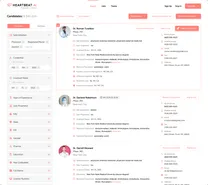
Email bounce triage workflow
Ben Argeband, Founder & CEO of Heartbeat.ai — Safety-first, no growth hacks.
What’s on this page:
Who this is for
If you’re a recruiter or recruiting ops lead dealing with bounce spikes, this is a practical SOP to keep outreach moving without burning your sending domain. It’s built for teams that need a repeatable bounce triage workflow: classify, suppress, verify, refresh, and monitor.
Quick Answer
- Core Answer
- Classify bounces (hard/soft/policy/unknown), suppress immediately, verify before any resend, refresh stale records, and monitor provider signals to protect deliverability.
- Key Insight
- Bounces are signal: repeated sends to bad addresses waste recruiter time and can degrade mailbox-provider trust in your domain.
- Best For
- Recruiters/ops dealing with bounce spikes
Compliance & Safety
This method is for legitimate recruiting outreach only. Always respect candidate privacy, opt-out requests, and local data laws. Heartbeat does not provide medical advice or legal counsel.
First hour containment checklist: pause the affected segment (not all outreach), export the bounce log, suppress clear hard bounces, and quarantine the source list/import until it proves clean.
Framework: “Don’t torch the domain” recruiter reality
When bounces spike, teams either keep sending and hope it clears, or freeze outreach and miss submittals. The workable middle is a containment-and-correction loop that protects the asset you can’t replace mid-search: your sending reputation.
- Contain: stop repeat attempts to known-bad addresses (fast suppression).
- Classify: hard vs soft vs policy vs unknown so you don’t treat everything the same.
- Correct: verify and refresh records before reattempting.
- Prevent: fix upstream sources (forms, imports, enrichment rules, ATS fields).
- Monitor: watch mailbox-provider signals (including Google Postmaster Tools) so ops sees issues before recruiters feel them.
Decision tree (use this when you’re under pressure):
- If hard bounce → suppress permanently + create refresh task (no resend).
- If soft bounce → retry on a schedule up to your cap; then suppress + refresh.
- If policy/content reject → pause the campaign and fix sending/auth/content before resuming.
- If unknown → temporary suppression + verification + switch channel; if repeated, suppress + refresh.
Scope note: this page covers bounce handling. For opt-outs and global suppression governance across tools, use suppression lists and opt-out management.
The trade-off is… you’ll send fewer total emails in the short term, but you’ll protect delivered volume and reduce wasted touches per placement.
Diagnostic Table:
Use this table to triage a bounce spike quickly. Map each bounce reason to an action, an ATS update, and a next trigger. Copy into your ops wiki and standardize the fields.
| Bounce signal (what you see) | Bucket | Immediate action | ATS/CRM fields to update | Next trigger |
|---|---|---|---|---|
| “User unknown”, “No such user”, “Mailbox does not exist” | Hard bounce | Suppress address immediately; do not resend | Email status = Hard bounce; Suppressed = Yes; Source = campaign/import | Create refresh task (new email + alternate channel) before any future outreach |
| “Domain not found”, “NXDOMAIN”, “Host not found” | Hard bounce | Suppress; check for domain typo | Email status = Hard bounce; Notes = suspected typo | If typo suspected, verify corrected address before sending |
| “Mailbox full”, “Over quota” | Soft bounce | Pause sends to that address; retry later with a defined cap | Email status = Soft bounce; Soft bounce count; Last attempt timestamp | After your retry limit, suppress and refresh |
| “Temporary failure”, “Try again later”, “4xx” | Soft bounce | Retry on a schedule; do not rapid-fire | Email status = Soft bounce; Soft bounce count; Last attempt timestamp | If it persists beyond your window, suppress and refresh |
| “Message rejected”, “Policy”, “Blocked”, “Spam-like content” | Policy/content | Pause the campaign; review copy + sending patterns; confirm authentication basics | Campaign status = Paused; Reason = Policy reject; Provider = Gmail/Outlook/etc. | Resume only after fix; monitor provider signals for recurrence |
| “Rate limited”, “Too many messages” | Throttle | Reduce concurrency; stagger sends | Sending profile = throttled; Provider = Gmail/Outlook/etc. | Adjust daily caps; re-check provider signals weekly |
| Ambiguous SMTP text, inconsistent codes, or “access denied” without clarity | Unknown | Temporary suppression; route to verification + alternate channel | Email status = Unknown bounce; Suppressed = Temporary; Notes = paste SMTP message | If it repeats, treat as suppress + refresh; do not keep “testing” the address |
Stop-rules callout note: If a record hard-bounces once, it is suppressed immediately. If a record soft-bounces repeatedly, it is suppressed after your defined retry limit and routed to refresh. No exceptions for “hot” candidates—switch channels while you refresh.
Step-by-step method
Step 0: First-hour containment (ops + recruiter coordination)
- Ops: pause the affected segment/campaign and export the bounce log with recipient, timestamp, SMTP message, sending mailbox, and source list/import.
- Ops: suppress clear hard bounces immediately in the sending tool and mirror the status in the ATS/CRM.
- Ops: quarantine the source list/import that’s driving the spike until it’s verified/cleaned.
- Recruiters: keep working the req by switching to phone/text (where permitted) and to already-verified addresses.
- Recruiters: log the alternate-channel attempt in the ATS/CRM so the team doesn’t duplicate outreach.
- Recruiters: tag the record as “email bounced/blocked” (or equivalent) so it stays out of sequences until verified or refreshed.
Step 1: Classify bounces into action buckets
Don’t let “bounce” be a single status. You need at least four buckets:
- Hard bounce (permanent failure): suppress + refresh required.
- Soft bounce (temporary failure): retry with limits; then suppress + refresh.
- Policy/content reject: pause and fix sending/auth/content before resuming.
- Unknown: suppress temporarily until verified; route to alternate channel.
Step 2: Enforce suppression so it can’t be bypassed
Suppression must be enforced in the sending tool and reflected in the system of record. Minimum rules:
- Hard bounce → permanent suppression for that email address.
- Soft bounce → retry cap, then suppression + refresh task.
- Unknown bounce → temporary suppression until verified.
Also consider temporary domain-level suppression if you see a pattern until you know whether it’s policy, throttling, or a bad segment.
Step 3: Gate resends with verification or refresh
Resending to an address that just bounced is how teams degrade deliverability. Your resend gate should be: “verified since last bounce” or “refreshed to a new address.” This requires manual verification.
Practical verification steps recruiters can execute without guesswork:
- Confirm the domain is real and active (typos are common).
- Check the organization’s public directory or staff page for email format patterns (if available).
- If you can’t verify, don’t resend—route to refresh and use another channel.
Step 4: Refresh stale records (don’t patch them)
Refreshing means replacing stale contact points with current ones, not just trying a second guessed email. Tie refresh to triggers:
- Hard bounce on a previously “good” address
- Soft bounce beyond your retry window
- Wrong-person reply (see the SOP below)
- Role change signals (new employer, new practice site)
For phone outreach while email is being cleaned, Heartbeat supports teams with ranked mobile numbers by answer probability so recruiters spend dials where answers are more likely.
Step 5: Monitor mailbox-provider signals (basic Postmaster hygiene)
You don’t need a deliverability engineer to catch obvious problems early. Minimum monitoring:
- Set up Google Postmaster Tools for your sending domain(s) and review trends weekly.
- Track bounce categories by sending mailbox and by list source/import.
- Confirm SPF/DKIM/DMARC records are present and aligned with your sending domain (coordinate with IT/security).
Weekly Postmaster review checklist (no guesswork):
- Look for sudden changes week-over-week (not day-to-day noise).
- Compare trends across domains/mailboxes to isolate whether the issue is one sender or the whole domain.
- If you paused a segment, confirm signals stabilize before resuming that segment.
- Document what changed (source quarantined, copy updated, throttling adjusted) so you can attribute improvements.
Weighted Checklist:
Use this to decide what to fix first. Score each item 0–2 (0 = not true, 1 = somewhat, 2 = clearly true). Fix the highest-impact gaps first.
| Area | Check | Why it matters | Score (0–2) | Owner |
|---|---|---|---|---|
| List/source | Bounces are concentrated in one import, one vendor file, or one segment | Bad sources keep re-infecting your system | Ops | |
| Suppression | Hard bounces are automatically suppressed in the sending tool and mirrored in ATS/CRM | Prevents repeat damage and recruiter re-sends | Ops | |
| Verification gate | Any resend requires “verified since last bounce” or “refreshed” status | Stops the most common failure loop | Ops | |
| Quarantine lane | New/untrusted sources are isolated from core sequences until they prove clean | Protects your best-performing mailboxes | Ops | |
| Policy/content | Policy rejects are separated from hard bounces and trigger copy/auth review | Different root cause, different fix | Ops + Recruiter lead | |
| Monitoring | Google Postmaster Tools is set up and checked weekly | Early warning before recruiters notice | Ops | |
| Wrong-person protection | Wrong-person replies trigger immediate suppression + refresh + prevention steps | Brand protection and fewer complaints | Recruiters + Ops |
ATS field schema (copy/paste into your admin notes):
- Email status: Valid, Soft bounce, Hard bounce, Policy reject, Unknown bounce
- Suppressed: Yes/No
- Suppression reason: Hard bounce, Soft bounce cap, Policy reject, Wrong person, Opt-out, Unknown
- Source: Import name / vendor / campaign
- Last verified date: date field (used for resend gating)
- Refresh required: Yes/No (or task automation trigger)
Outreach Templates:
These templates are designed to reduce complaints and protect your domain while you clean data. Keep them short, factual, and easy to comply with.
Template 1: Soft-bounce follow-up (only after verification)
Subject: Quick check
Hi {{FirstName}} — I tried reaching you at this address and it didn’t go through. If this is still the best email, I can resend details. If not, what’s the right email for recruiting outreach?
— {{YourName}}
Template 2: Policy/block message (switch channel without pushing)
Subject: Best way to reach you
Hi {{FirstName}} — it looks like your organization’s email system didn’t accept my message. What’s the best way to reach you for a quick recruiting question (email or phone)?
— {{YourName}}
Template 3 (Uniqueness Hook): Brand-protective wrong-person SOP
Use when someone replies “wrong person” or “stop emailing me.” Do not argue.
Subject: Apologies — removing you
Thanks for letting me know, and sorry about that. I’ve removed your email from our recruiting outreach and added it to our suppression list so you won’t be contacted again.
If you’re willing, was this address ever associated with {{CandidateNameOrRole}}? (Optional.)
— {{YourName}}
- Immediate suppression action: suppress the email address in the sending tool and mark “Do not contact” (or equivalent) in the ATS/CRM.
- Refresh trigger: create a refresh task for the intended candidate record (new email + alternate channel).
- Prevention checklist: identify the source field that populated the bad email, stop re-importing it, and tag the source as “wrong person risk” for audit.
Note: This SOP is designed to reduce complaints and protect your brand. It does not promise “zero wrong-person” outcomes.
Common pitfalls
- Continuing to send to bounced addresses. Suppress first. Re-sending to known-bad addresses wastes time and increases risk.
- One status called “bounced.” If ops can’t separate hard vs soft vs policy vs unknown, you can’t fix root cause.
- Letting recruiters override suppression for “hot” candidates. Switch channels while you refresh; don’t re-send to a known-bad address.
- Not tying bounces back to list source. If you can’t answer “where did these emails come from,” you’ll keep importing the same problem.
- Confusing policy rejects with data quality. A policy block can be copy, authentication alignment, or sending pattern—not necessarily a bad address.
- Handling wrong-person replies like objections. Apologize, suppress, refresh, and prevent recurrence.
How to improve results
Improvement here means: fewer bounces, higher delivered volume, and less recruiter time wasted per response. You need consistent measurement and a closed-loop workflow.
Define the metrics (use consistent denominators)
- Deliverability Rate = delivered emails / sent emails (per 100 sent emails).
- Bounce Rate = bounced emails / sent emails (per 100 sent emails).
- Reply Rate = replies / delivered emails (per 100 delivered emails).
- Connect Rate = connected calls / total dials (per 100 dials).
- Answer Rate = human answers / connected calls (per 100 connected calls).
Measurement instructions (what to track weekly)
Measure this by… running a weekly ops report that breaks results down by (1) sending mailbox, (2) campaign/sequence, and (3) source list/import. You’re looking for concentration and drift.
- Bounce Rate by source: if one source is worse than your historical baseline, quarantine it and require verification before it re-enters core sequences.
- Hard vs soft mix: hard-heavy usually indicates stale/bad data; soft-heavy can indicate throttling or temporary failures.
- Reply Rate on delivered: if deliverability improves but replies drop, your copy/targeting is the issue—not bounces.
- Wrong-person rate proxy: track “wrong person” tags / delivered emails (per 100 delivered emails). This is a brand-risk indicator and a data-source quality signal.
Ownership and cadence (so it actually sticks)
- Daily (Ops): sync suppression between sending tool and ATS/CRM; review any new hard-bounce clusters by source.
- Weekly (Ops): review Google Postmaster Tools trends and bounce categories by mailbox; document any changes made.
- Weekly (Recruiter lead): spot-check templates and targeting for segments with low Reply Rate on delivered emails.
- Monthly (Ops + leadership): audit top sources/imports for bounce and wrong-person signals; retire sources that repeatedly fail.
Operational upgrades that move the needle
- Quarantine lane for new data sources: new imports go to a limited send segment until they prove clean.
- Resend gate: no resend unless “verified since last bounce” or “refreshed.”
- Auto-create refresh tasks: hard bounce automatically creates a refresh task with owner + due date in your ATS/CRM.
- Channel switching: when email is blocked or bouncing, route to phone/SMS (where permitted) using your best available numbers and scripts.
For deeper implementation details, use the linked playbooks rather than reinventing the wheel: email verification for healthcare recruiting and suppression lists and opt-out management. For tying outcomes to responses, see reply rate tracking for physician outreach. For setting refresh triggers, see provider data refresh cadence.
Legal and ethical use
This playbook is about responsible recruiting outreach and data hygiene. You should:
- Honor opt-outs immediately and maintain suppression lists across tools.
- Stop contacting people who indicate you have the wrong person; do not argue or pressure.
- Use phone/text outreach only where you have a lawful basis and follow applicable rules (including consent requirements where relevant).
Reference: FCC overview of the Telephone Consumer Protection Act (TCPA) and FCC consumer guidance on unwanted calls/texts. This is not legal advice.
Evidence and trust notes
We treat bounce handling as an ops system: classification, suppression, verification, refresh, and monitoring. Definitions and measurement consistency matter; otherwise teams compare apples to oranges and “fix” the wrong lever.
- Our metric definitions and how we evaluate data quality: Accuracy and metrics definitions.
- Compliance references (phone/text): TCPA (FCC) and Unwanted calls/texts (FCC).
FAQs
What’s the difference between a hard bounce and a soft bounce in recruiting outreach?
A hard bounce is a permanent failure (address doesn’t exist, domain invalid) and should be suppressed immediately. A soft bounce is temporary (mailbox full, temporary error) and can be retried with a strict cap before suppression and refresh.
Should recruiters ever resend to an address that bounced?
Only after the address is verified since the last bounce or the record is refreshed to a new address. Otherwise you’re repeating the same failure and increasing risk to deliverability.
How do I handle “unknown” or ambiguous bounce messages?
Treat them as higher-risk than a soft bounce: temporarily suppress, route to verification, and switch channels. If the same address produces repeated unknown bounces, suppress and refresh instead of repeatedly testing it.
What should I do when someone replies that I have the wrong person?
Apologize, confirm removal, and suppress immediately. Then refresh the intended candidate record and tag the source that produced the bad address for audit. Do not argue.
What’s the minimum monitoring I should have in place?
Set up Google Postmaster Tools for your sending domain(s), review trends weekly, and track Bounce Rate and Deliverability Rate by mailbox, campaign, and source. That’s enough to catch most operational issues early.
Next steps
- Implement the suppression and resend gates in your sending tool and mirror statuses in your ATS/CRM.
- Adopt the wrong-person SOP as a standard operating procedure for every recruiter.
- If you want a workflow that prioritizes reachable contact points and keeps your data fresh, create a Heartbeat account.
About the Author
Ben Argeband is the Founder and CEO of Swordfish.ai and Heartbeat.ai. With deep expertise in data and SaaS, he has built two successful platforms trusted by over 50,000 sales and recruitment professionals. Ben’s mission is to help teams find direct contact information for hard-to-reach professionals and decision-makers, providing the shortest route to their next win. Connect with Ben on LinkedIn.