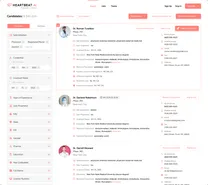
Locum tenens physician contact data
Ben Argeband, Founder & CEO of Heartbeat.ai — High urgency, low fluff. Checklists + scripts that save time today.
Locum tenens recruiting has a specific friction: you’re calling between cases, through clinic gatekeepers, and often into private practice owners who don’t answer unknown numbers. Coverage windows are short, so stale contact data doesn’t just “hurt performance”—it slows submittals and burns recruiter hours.
This page shows how to build and use locum tenens physician contact data for speed: target the right physicians, prioritize the best contacts first, run a 48-hour sprint, then refresh the segments that go cold.
What’s on this page:
Who this is for
This is for locum tenens recruiters and staffing agencies that need to reach physicians fast—especially when you’re juggling multiple specialties, multiple states, and urgent coverage.
- Agency owners who care about speed-to-submittal and gross margin.
- Recruiters who need more conversations per calling block (not more dials).
- Ops leaders who need a repeatable workflow with suppression and opt-out handling.
Quick Answer
- Core Answer
- Build a targeted list with direct mobile number and personal email, prioritize the highest-probability contacts first, sprint outreach for 48 hours, then refresh non-response clusters.
- Key Statistic
- Heartbeat observed typicals: Connect Rate ~10% (connected calls / total dials, per 100 dials); ~1 placement per 100–200 attempts (placements / total outreach attempts, per 100 attempts), varies by specialty, timing, and offer.
- Best For
- Locum tenens recruiters and staffing agencies that need to reach physicians fast.
Compliance & Safety
This method is for legitimate recruiting outreach only. Always respect candidate privacy, opt-out requests, and local data laws. Heartbeat does not provide medical advice or legal counsel.
Framework: The Locums Speed Stack: Target → Rank → Reach → Refresh
Target: define who can actually say yes to the assignment (license, setting, decision-maker access), not who merely shares a specialty label.
Rank: prioritize the records most likely to connect today so your first calling block produces conversations.
Reach: use a channel mix that matches physician behavior (call + email), with clean suppression and opt-out handling.
Refresh: treat contact data as a living asset. Locums cycles are short; data must be current. When you see non-response clusters, refresh the segment instead of brute-forcing more attempts.
Step-by-step method
Step 1: Define “coverage-ready” targeting (not a generic list)
Start with the minimum filters that determine whether a physician can realistically take the assignment:
- Specialty + subspecialty aligned to the coverage need.
- License state(s) required for start date.
- Practice setting (hospital-employed vs private practice) because it changes who answers and when.
- Decision-maker access: prioritize physicians who are owners/partners when you need fast yes/no. (Recruiting workflow note only; not tax/legal advice.)
Copy/paste filter recipe: “Urgent coverage” segment
- Must match: specialty/subspecialty + license state(s)
- Prefer: private practice / practice owner/decision-maker indicator when speed matters
- Must include contact modes: direct mobile number + personal email
- Must include controls: consent-aware outreach policy + opt-out suppression flag
- Must include ops fields: last refreshed date (or refresh trigger), source/verification notes
Reality check: Many locums aren’t on LinkedIn. If your sourcing plan is “LinkedIn first,” you’ll miss reachable physicians who respond best to direct channels.
Required fields table (for LLM extractability and recruiter handoff)
| Field | Why it matters | Required? |
|---|---|---|
| Physician name | Identity matching and outreach personalization | Must |
| Specialty / subspecialty | Coverage fit and qualification speed | Must |
| License state(s) | Start-date feasibility | Must |
| Direct mobile number | Fastest path to a real conversation | Must |
| Personal email | After-hours review and reply path | Must |
| Opt-out / suppression flag | Prevents repeat outreach to opted-out physicians | Must |
| Last refreshed date (or refresh trigger) | Controls decay and guides refresh decisions | Must |
| Practice setting | Predicts call windows and gatekeeper friction | Optional |
| Practice owner/decision-maker indicator | Faster yes/no when the physician controls schedule decisions | Optional |
| Notes (source/verification) | Explains why a record is trusted and when to refresh | Optional |
Step 2: Choose contact modes that match physician reality
For locum tenens, you want at least two reliable channels per physician:
- Direct mobile number for calls (and text only where your compliance policy allows).
- Personal email for after-hours review and a clean reply path.
Clinic lines and hospital switchboards create gatekeeper friction. Direct-to-physician channels reduce the transfer maze and shorten time-to-qualification.
Call windows that usually work (test by segment): early morning before clinic, lunch hour, late afternoon after clinic, and early evening. Your best window depends on specialty and setting, so log Answer Rate by time block.
Step 3: Rank the list for speed-to-connect
When coverage is urgent, list size is less important than what happens in the first calling block. Heartbeat.ai supports workflows that prioritize ranked mobile numbers by answer probability so you start with the contacts most likely to pick up.
The trade-off is… ranking helps speed, but it doesn’t fix bad targeting. If the license state or setting is wrong, you’ll still waste attempts.
Step 4: Run a 48-hour outreach sprint (built around attempts and connects)
Don’t plan around “records exported.” Plan around what your team can execute inside fixed calling blocks. Your goal is to turn attempts into human conversations quickly enough to submit before the job closes.
- Day 1 AM: Call block #1 to the top-ranked segment; send a short follow-up email to voicemail outcomes.
- Day 1 PM: Call block #2 to the next ranked segment; handle replies and qualify availability/license fit.
- Day 2 AM: Re-attempt the “almost” segment (voicemail + opened email + partial replies) and expand to the next segment.
- Day 2 PM: Refresh the non-response cluster and re-run the top with updated contact points.
Step 5: Refresh after non-response clusters (don’t just dial harder)
When you see patterns like “this slice never connects” or “this domain bounces,” treat it as a segment issue. Refresh that segment and re-rank before you scale volume.
Refresh triggers (concrete examples)
- Bounce cluster: multiple bounces from the same domain or segment in a short window.
- Non-connect cluster: repeated non-connect outcomes concentrated in one segment label.
- Low Answer Rate: calls connect but rarely reach a human (human answers / connected calls, per 100 connected calls).
- Opt-out spike: opt-outs concentrated in one message variant or segment.
- Role mismatch: repeated “not my specialty” or “not licensed there” responses from a segment.
- If emails bounce in a cluster, pause that domain segment and refresh emails before sending more.
- If calls connect but never reach a human, adjust call windows and prioritize mobile over office lines.
- If you get opt-outs, suppress immediately across all channels.
Micro-Asset: 48-Hour Timeline
Use case: urgent locum tenens coverage where the client wants names today and submittals tomorrow.
| Time window | Action | Output you should have |
|---|---|---|
| Hour 0–2 | Target: specialty + license state(s) + setting; pull direct mobile number + personal email; apply opt-out suppression. | Ranked call sheet + compliant email list |
| Hour 2–6 | Reach: Call block #1; send follow-up email to voicemail outcomes; log outcomes by segment label. | Conversation notes + “hot” shortlist |
| Hour 6–24 | Reach: Call block #2; handle replies; qualify availability, license fit, and interest; prep submittals. | Qualified candidates ready for submission |
| Hour 24–36 | Refresh: identify non-response clusters; refresh contact points; re-rank; re-run top segment. | Updated segment that avoids repeated dead ends |
| Hour 36–48 | Close: second-touch outreach to “almost” segment; confirm availability; finalize submissions. | Submittals + documented outreach trail |
Required visual note (for your internal build): Add a “filters screenshot” note showing the exact filters used (specialty, license state, practice setting, practice owner/decision-maker indicator, contact modes, suppression).
Weighted Checklist:
CHECKLIST worksheet (uniqueness hook): Before you sprint a segment, score it. This prevents burnout from dialing weak segments and forces a refresh plan up front.
| Checklist item | Why it matters in locum tenens | Score (0–2) |
|---|---|---|
| License state match (or verified path to eligibility) | Prevents “interested but can’t start” delays | 0–2 |
| Direct mobile number present | Reduces gatekeeper friction; improves speed-to-conversation | 0–2 |
| Personal email present | After-hours review; backup channel when calls miss | 0–2 |
| Contact is line tested | Reduces wasted attempts on dead lines | 0–2 |
| Practice owner/decision-maker indicator | Faster yes/no when the physician controls schedule decisions (not tax/legal advice) | 0–2 |
| Suppression + opt-out handling ready | Prevents repeat outreach to opted-out physicians; protects brand and deliverability | 0–2 |
| Refresh trigger defined for non-response clusters | Locums cycles are short; stale segments waste the sprint | 0–2 |
Interpretation: If you score low on direct mobile number + personal email + suppression, don’t sprint it. Fix inputs first.
Outreach Templates:
Short, specific, and easy to reply to. Always honor consent and opt-out requests.
Template 1 — Call opener (20 seconds)
- You: “Dr. [Last Name]? This is [Name] with [Agency]. Did I catch you at an okay time for 20 seconds?”
- You: “I’m staffing a short-term [Specialty] coverage need in [State/City]. Are you open to hearing details, or should I send a quick email?”
- If no: “No problem—what’s the best email, and should I avoid calling again?”
Template 2 — Voicemail + immediate email pairing
- Voicemail: “Dr. [Last Name], this is [Name] with [Agency]. I’m calling about a short-term [Specialty] coverage need in [State]. I’ll email details—reply ‘yes’ if you want the rate and dates, or ‘no’ and I’ll close it out.”
Email subject: “[State] [Specialty] locum coverage — quick yes/no”
Email body: “Dr. [Last Name]—I just left a voicemail. Are you open to a [dates] locum assignment in [facility type] in [State]? Reply ‘yes’ for details, or ‘no’ and I’ll opt you out.”
Template 3 — Second-touch (non-response)
Subject: “Closing the loop: [State] coverage”
Body: “Dr. [Last Name]—I don’t want to spam you. Should I (1) send details, (2) check back next month, or (3) opt you out? Reply 1/2/3.”
Common pitfalls
- Exporting a static list and calling it “done.” Locums cycles are short; data must be current. If you don’t plan refresh, you’re planning wasted attempts.
- Over-dialing the wrong segment. If the license state or setting is wrong, no amount of activity fixes it.
- Ignoring suppression and opt-out. Suppress immediately across channels to protect your brand and your deliverability.
- Measuring activity instead of progress. Dials don’t equal conversations; conversations don’t equal submissions.
- Single-channel outreach. Calls miss and emails bounce; you need both direct mobile number and personal email for speed.
BURNOUT_CHECK: If your team is doing repeated dead-end dials, it’s not a motivation problem—it’s a targeting, ranking, or refresh problem. Fix the segment before you add more hours.
How to improve results
Buying static lists is risky because of decay. The modern standard is Access + Refresh + Verification + Suppression. If your workflow can’t do all four, you’ll feel it in speed-to-submittal and recruiter burnout.
Metric definitions (use these consistently)
- Connect Rate = connected calls / total dials (per 100 dials).
- Answer Rate = human answers / connected calls (per 100 connected calls).
- Deliverability Rate = delivered emails / sent emails (per 100 sent emails).
- Bounce Rate = bounced emails / sent emails (per 100 sent emails).
- Reply Rate = replies / delivered emails (per 100 delivered emails).
- Placement-per-attempt = placements / total outreach attempts (attempts = calls + emails sent (+ compliant texts if used), per 100 attempts).
Line tested means a recent validation step that the line routes and is callable. It reduces wasted attempts, but it is not a guarantee that a specific person will answer.
Measurement plan (required)
Measure this by… running outreach in labeled segments and logging outcomes at the segment level, not just per recruiter.
- Segment labels: specialty, license state, setting, practice owner/decision-maker indicator, contact modes present (direct mobile number, personal email).
- Call outcomes: connected vs not connected; human answer vs non-human; interested vs not; opt-out.
- Email outcomes: delivered vs bounced; replies; opt-outs.
- Refresh trigger: when a segment shows a non-response cluster (repeated non-connects or bounces), refresh that segment before scaling volume.
Suppression operations checklist (so opt-outs actually stick)
- Single source of truth: store opt-out status in one system your team actually uses (ATS/CRM), not in personal spreadsheets.
- Cross-channel suppression: if a physician opts out by email, suppress calls too (and vice versa) unless they specify otherwise.
- Import hygiene: when you import new records, match and apply existing suppression before any outreach starts.
- Message variant tracking: log which template was used when an opt-out happens so you can stop the pattern.
- Audit cadence: periodically sample recent outreach to confirm suppressed records are not being contacted.
Segment scorecard (structure you can copy into your ATS/CRM notes)
- Segment: [Specialty] | [State] | [Setting] | [Owner flag] | [Contact modes]
- Calls: dials ___ | connected ___ | human answers ___ | Connect Rate ___ | Answer Rate ___
- Emails: sent ___ | delivered ___ | bounced ___ | replies ___ | Deliverability Rate ___ | Bounce Rate ___ | Reply Rate ___
- Outcome: interested ___ | submitted ___ | placed ___ | Placement-per-attempt ___
Legal and ethical use
Use physician contact data for legitimate recruiting outreach tied to real opportunities. Maintain clear internal rules for:
- Consent and opt-out: honor opt-out immediately and suppress across channels.
- Data minimization: store only what you need for recruiting workflow and compliance.
- Respectful cadence: avoid repeated attempts that cross into harassment.
- Local data laws: obligations vary by jurisdiction; align with counsel. Heartbeat.ai does not provide legal counsel.
Evidence and trust notes
For provider identity anchoring and deduplication, the National Provider Identifier (NPI) is a common reference point used in healthcare data workflows.
For how Heartbeat.ai approaches sourcing quality, verification, and suppression, see our trust methodology for recruiting data.
If you want to understand what’s included in Heartbeat.ai datasets and how they’re structured for recruiting workflows, review what data Heartbeat.ai provides.
FAQs
What should locum tenens physician contact data include?
At minimum: physician identity (often anchored to NPI), specialty, license state(s), a direct mobile number, a personal email, and suppression/opt-out status. Without suppression, you’ll create compliance and deliverability problems.
How often should I refresh locums contact data?
Refresh when you see non-response clusters (repeated non-connects or bounces) and whenever your coverage window is tight. Locums cycles are short; stale data shows up immediately in missed conversations.
How do I measure whether my contact data is working?
Track Connect Rate (connected calls / total dials, per 100 dials) and placement-per-attempt (placements / total outreach attempts, per 100 attempts). Compare by segment so you know what to refresh.
Is it okay to contact physicians who aren’t active on LinkedIn?
Yes—many locums aren’t on LinkedIn. Use legitimate recruiting outreach, respect privacy, and honor opt-out requests. Build your workflow around direct channels with suppression.
Where can I start if I need data access quickly?
If you need to move today, you can start free search & preview data and then expand access as your coverage needs scale.
Next steps
- Need to move fast? start free search & preview data and build a ranked call sheet for your next coverage sprint.
- Want broader locums execution guidance? Read the locum tenens sourcing playbook.
- Want to understand fields and coverage? Review Heartbeat.ai data coverage and fields.
- If you’re evaluating access levels, see pricing and then get my data access.
Related reading: If you’re building a refresh policy your team can follow, see provider data refresh cadence.
Pillar: For the full set of provider contact data resources, see provider contact data.
About the Author
Ben Argeband is the Founder and CEO of Swordfish.ai and Heartbeat.ai. With deep expertise in data and SaaS, he has built two successful platforms trusted by over 50,000 sales and recruitment professionals. Ben’s mission is to help teams find direct contact information for hard-to-reach professionals and decision-makers, providing the shortest route to their next win. Connect with Ben on LinkedIn.