How to get a physician direct mobile number
By Ben Argeband, Founder & CEO of Heartbeat.ai — Practical scripts and “when to call vs text.”
What’s on this page:
Who this is for
You’re a recruiter getting ghosted. You’ve got a real req, a real timeline, and you need a physician direct mobile number that reaches the physician—not a switchboard, not a scheduling desk, and not a routed line that looks “direct” in your CRM.
This guide is for recruiters who care about speed-to-submittal, connectability, and not creating compliance or reputation problems while trying to move fast.
Quick Answer
- Core Answer
- Get a physician direct mobile number by confirming line type, validating reassignment risk, ranking candidate numbers, then using a short call-first sequence with opt-out.
- Key Statistic
- Heartbeat observed typicals: mobile accuracy 82% first mobile; connect rate ~10% typical (about 10 connected calls per 100 dials). Results vary by specialty, market, and how recently numbers were refreshed and validated.
- Best For
- Recruiters getting ghosted who need better physician mobile numbers.
Compliance & Safety
This method is for legitimate recruiting outreach only. Always respect candidate privacy, opt-out requests, and local data laws. Heartbeat does not provide medical advice or legal counsel.
Framework: The “First Dial” Checklist: Type → Validate → Rank → Message
When you miss a physician on the first attempt, it’s usually not because your pitch is bad. It’s because you dialed the wrong kind of line (office/IVR/VoIP routing), or you hit a reassigned number and created friction you can’t undo.
- Type: identify whether the line behaves like mobile, office, or VoIP.
- Validate: reduce reassignment and dead-line risk before you dial or text.
- Rank: when multiple numbers exist, pick the best first attempt.
- Message: use a short sequence that fits physician schedules and includes opt-out.
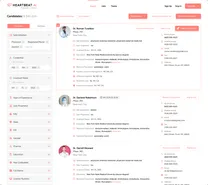
Heartbeat.ai supports this workflow, including ranked mobile numbers by answer probability so your first attempt is more likely to reach a human.
Step-by-step method
Step 1: Define “direct mobile” vs office vs VoIP (so you don’t run the wrong play)
Recruiting outcomes change based on what the number actually is:
- Direct mobile number: typically rings through to the physician or their personal voicemail.
- Office line: clinic/hospital main line, switchboard, scheduling, call center.
- VoIP: can be legitimate (private practice), but often routes like an office line even when it looks “personal.”
If you want a practical way to spot routing behavior, use: mobile vs VoIP: how to tell (for recruiter outreach).
Step 2: Use access that refreshes (not a static export)
Buying static lists is risky because of decay. The modern standard is Access + Refresh + Verification + Suppression.
In recruiter terms: you want a workflow where you can start free search & preview data, see candidate numbers, and then validate before you dial—especially when you’re working a time-sensitive req.
Step 3: Where to source candidate numbers (fast, recruiter-safe)
If you don’t have a usable mobile yet, don’t guess. Use sources that can be refreshed and verified:
- Practice and health system sites: often list office lines; still useful for confirming affiliation and getting routed correctly.
- Conference speaker/author pages: good for confirming specialty focus and location; contact info is often indirect, so treat it as a lead, not a dial.
- Referrals and internal networks: fastest path to a warm intro; log the source so you can repeat what works.
- Verified contact data platforms: prioritize those that refresh, validate, and support suppression so your team doesn’t keep hitting stale numbers.
If you have zero usable numbers
- Confirm the right physician: verify affiliation and role so you don’t burn outreach on the wrong person.
- Use the office line to get the preferred method: ask for the best way to route a message or the best time window for a quick call.
- Then refresh + validate: once you obtain candidate numbers, run Type → Validate → Rank before you try again.
Step 4: Type-check the line (don’t assume formatting means mobile)
Area code and formatting don’t tell you line type. You need a line-type signal and a quick behavioral check:
- Mobile behavior: direct ring, personal voicemail patterns, occasional short answers.
- Office behavior: IVR menus, “press 1 for scheduling,” front desk greeting.
- VoIP behavior: can look like mobile but routes to office staff or generic voicemail; treat it based on what happens when you dial.
Step 5: Validate before dialing (number reassignment is real)
Physician mobiles change. Numbers get reassigned. If you’re calling or texting, being wrong costs more than a wasted attempt: it creates complaints, opt-outs, and internal escalations.
The trade-off is… validation adds a step, but it prevents the worst outcomes: wrong-person contact, repeated attempts to dead lines, and noisy CRM data that hides what’s actually working.
Validation should answer three operational questions:
- Is the number reachable right now (not disconnected)?
- Is there a reassignment risk signal you should treat as a stop sign?
- Does the line type match the channel you plan to use (call vs text)?
For a dedicated recruiter workflow, see: phone validation for provider direct dials.
Step 6: Rank when multiple numbers exist (don’t coin-flip your first attempt)
When you have more than one candidate number, you’re choosing your first impression and your time-to-contact. Rank using what you can observe and what you can validate:
- Prefer numbers that behave like true mobiles (direct ring, personal voicemail).
- Deprioritize numbers that route to IVR, switchboards, or generic voicemail.
- Suppress numbers confirmed as wrong-person or opted out, across every tool your team uses.
Step 7: Use a physician-friendly contact sequence (call windows + short messages)
Physicians are hard to catch live. Clinic hours, procedures, and call schedules mean you need a sequence that respects time and still gets a response.
- Attempt 1 (call): short call; if no answer, leave a voicemail that states who you are and the low-friction next step.
- Attempt 2 (text only when appropriate): short text referencing the call, role-relevant, and with opt-out.
- Attempt 3 (call): one more call at a different time window; if no signal, stop hammering the line and switch channels.
Do not mass text physicians. Keep outreach targeted, role-relevant, and respectful, and honor opt-out immediately.
Diagnostic Table:
| What you’re seeing | Likely issue | What to do next | What to log (structured) |
|---|---|---|---|
| Rings then clinic IVR / “press 1 for scheduling” | Office routing (not direct) | Reclassify as office; call during business hours; stop texting this line | Observed line behavior = IVR; channel allowed = call only |
| Front desk answers | Office line | Ask best way to route a message; request preferred contact method | Gatekeeper reached; best routing notes |
| “Number disconnected / not in service” | Dead line / stale record | Suppress; refresh source; try alternate number | Bad number; date observed; source |
| Wrong person answers | Number reassignment or mismatch | Apologize; confirm you’ll remove; suppress immediately | Wrong-person confirmed; suppress reason = reassigned |
| Personal voicemail greeting with name | High likelihood direct mobile | Leave short voicemail; follow with compliant text if appropriate | VM type = personal; next step = call+text sequence |
| Generic voicemail (“You’ve reached the office…”) | Not personal mobile voicemail | Deprioritize for direct outreach; treat as office/VoIP | VM type = generic; reclassify line type |
Metric definitions (use consistently):
- Connect Rate = connected calls / total dials (e.g., per 100 dials).
- Answer Rate = human answers / connected calls (e.g., per 100 connected calls).
- Mobile accuracy (operational definition) = % of “mobile-labeled” numbers that reach the intended physician (or their personal voicemail) when dialed, measured on a defined sample and time window.
Weighted Checklist:
Use this to decide whether a number is worth your next attempt. Score each item 0–2 and total it.
- Line type confidence (0–2): 0 = office/unknown, 1 = VoIP/unclear, 2 = mobile behavior observed.
- Validation recency (0–2): 0 = unvalidated/old, 1 = unknown, 2 = validated recently with no flags.
- Behavioral signal (0–2): 0 = IVR/gatekeeper, 1 = generic voicemail, 2 = personal voicemail or direct answer.
- Suppression status (0–2): 0 = opt-out/wrong person, 1 = unknown, 2 = clean.
- Role relevance (0–2): 0 = weak match, 1 = partial, 2 = strong match (so you don’t burn good numbers on bad fits).
Decision rule: 8–10 = proceed with call-first sequence; 5–7 = validate/refresh before next attempt; 0–4 = suppress and switch channels.
Outreach Templates:
These templates are designed for legitimate recruiting outreach to a physician. Keep them short, relevant, and stop immediately on opt-out.
Voicemail (first attempt)
Script: “Hi Dr. [Last Name]—this is [Your Name] with [Company]. I’m calling about a [specialty] role in [market] that matches your background. If you’re open to a quick 3-minute screen, call or text me at [your number]. If I’ve got the wrong number, please tell me and I’ll remove it.”
SMS (after a call; only when appropriate)
Text: “Dr. [Last Name], [Your Name] at [Company]. Just left a voicemail re: a [role] in [market]. Worth a 3-min call this week? Reply YES and I’ll send times. Reply STOP to opt out.”
Wrong-person apology + suppression (reassignment-safe)
Text: “Sorry—this is [Your Name]. I was trying to reach Dr. [Last Name] about a recruiting role. I’ll remove this number now.”
Office gatekeeper call opener (when it’s not mobile)
Call opener: “Hi—can you help me reach Dr. [Last Name]? I’m calling with a time-sensitive recruiting opportunity. What’s the best way to route a message, or their preferred contact method?”
Office-line conversion (when you can’t get a mobile)
Message to relay: “Please let Dr. [Last Name] know [Your Name] from [Company] called about a [role] in [market]. What’s the best way to reach them directly, or the best time window for a quick call?”
Uniqueness hook (OUTREACH_TEMPLATES): Use a “reassignment-safe” line in every first text: “If I’ve got the wrong number, tell me and I’ll remove it.” Then treat any wrong-person confirmation as an immediate suppression event across all tools.
Common pitfalls
- Calling the first number you see: if it routes to IVR or a front desk, you lose time and create noise. Type-check and observe behavior.
- Skipping validation: reassignment and dead lines create wrong-person contacts and repeated attempts that go nowhere.
- No suppression discipline: if someone opts out or confirms wrong person, suppress immediately across your CRM, dialer, and any enrichment tools.
- Texting by default: keep texting targeted and policy-driven; include opt-out; stop on STOP.
- No attempt cap: set a team policy (for example, a small number of attempts per week per line) and switch channels instead of hammering one number.
- Measuring only activity: dials are not pipeline. Track connects, answers, replies, and screens tied to line type and validation status.
How to improve results
1) Instrument your funnel with consistent definitions
Use consistent metrics so you can compare sources and workflows:
- Connect Rate = connected calls / total dials (per 100 dials).
- Answer Rate = human answers / connected calls (per 100 connected calls).
- Deliverability Rate = delivered emails / sent emails (per 100 sent emails).
- Bounce Rate = bounced emails / sent emails (per 100 sent emails).
- Reply Rate = replies / delivered emails (per 100 delivered emails).
2) Run a weekly cohort review (so you stop guessing)
Measure this by… running a weekly cohort report grouped by (a) observed line type, (b) validation status, and (c) first-attempt channel (call vs text). Compare Connect Rate and screens per 100 dials across cohorts.
- Keep the cohort consistent (same role type and similar markets) so you’re not comparing different difficulty levels.
- Log observed outcomes as structured fields: IVR, front desk, personal voicemail, wrong person, opt-out.
- Use suppression outcomes as a quality signal: high wrong-person rates indicate reassignment/decay problems.
3) Standardize your CRM logging (so your team can improve)
| Field | Example values | Why it matters |
|---|---|---|
| Line type (observed) | mobile, office, voip, unknown | Prevents running a mobile play on an office line |
| Validation status | validated_recently, unvalidated, flagged | Separates decay/reassignment issues from messaging issues |
| Observed outcome | personal_vm, generic_vm, ivr, front_desk, wrong_person, connected_no_human_answer | Lets you rank and suppress based on reality |
| Suppression reason | opt_out, wrong_person, disconnected | Stops repeat mistakes and reduces complaints |
| Preferred window (if known) | early_am, lunch, evening, unknown | Improves Connect Rate without increasing volume |
4) Tighten your first-attempt timing and stop over-dialing
Pick two call windows, rotate them, and track which window produces higher Connect Rate for your specialty mix. If a number shows repeated IVR/gatekeeper behavior, stop treating it as direct and switch to an office strategy.
Legal and ethical use
- Consent and opt-out: include a clear opt-out path in texts and honor it immediately. Maintain suppression across systems.
- No guarantees: do not imply “TCPA guaranteed” compliance. Compliance depends on your facts, process, and jurisdiction.
- No harassment: avoid repeated attempts that could be perceived as harassment; switch channels or stop.
- Document your process: line type checks, validation steps, and suppression actions should be auditable.
For TCPA baseline context, review the FCC’s overview: Telephone Consumer Protection Act (TCPA) – FCC. For recruiter-specific operational guidance, see: TCPA for recruiters calling/texting physicians.
Evidence and trust notes
Data quality claims should be tied to definitions, sampling, and refresh behavior—not vibes.
- Definitions: we define Connect Rate and mobile accuracy operationally in this article so teams can measure consistently.
- Decay and reassignment: numbers change; responsible outreach uses validation plus suppression to reduce wrong-person contact.
- Methodology: see how Heartbeat evaluates and presents data quality signals: Heartbeat trust methodology.
Citations used: FCC TCPA overview.
Product context: how Heartbeat.ai data is built and refreshed.
FAQs
What counts as a physician direct mobile number?
A number that typically rings through to the physician (or their personal voicemail) without a switchboard, clinic IVR, or call center. Confirm it by line type and observed call behavior.
Why do physician mobile numbers stop working?
Decay and number reassignment. Physicians change roles and carriers; numbers get recycled. That’s why validation and suppression need to be part of your workflow.
Should I call or text first?
Call-first is usually safer operationally. Text only when appropriate, keep it short, and always include opt-out. If you don’t have a clear policy and logging, don’t default to texting.
How do I handle wrong-person answers?
Apologize, state you’ll remove the number, and suppress it immediately across your tools. Log it as wrong-person confirmed (likely reassignment) so it doesn’t happen again.
How do I tell if a number is mobile or VoIP?
Use a line-type signal and confirm with behavior (direct ring, personal voicemail vs IVR/generic office greeting). See: mobile vs VoIP: how to tell.
Next steps
- See the workflow in action: start free search & preview data.
- Implement validation before dialing: phone validation for provider direct dials.
- Align your team on compliant calling/texting: TCPA for recruiters calling/texting physicians.
If you want fewer wasted dials, standardize Type → Validate → Rank → Message and review Connect Rate (connected calls / total dials) weekly by line type and validation status.
About the Author
Ben Argeband is the Founder and CEO of Swordfish.ai and Heartbeat.ai. With deep expertise in data and SaaS, he has built two successful platforms trusted by over 50,000 sales and recruitment professionals. Ben’s mission is to help teams find direct contact information for hard-to-reach professionals and decision-makers, providing the shortest route to their next win. Connect with Ben on LinkedIn.