Are you looking for a direct path to connecting with experts in pediatric hematology? In that case, an authentic pediatric hematologists email list is all you need. In this discussion, we will discuss the practical importance of these lists, illustrating how they streamline communication and provide direct access to the relevant audience.
We’ll look at how accurate data is crucial for improving your outreach, and see how Heartbeat can help you get precise and up-to-date information customized for the pediatric hematology field.
Let’s take a closer look!
What’s on this page:
About Heartbeat Pediatric Hematologists Email List: What You Will Get
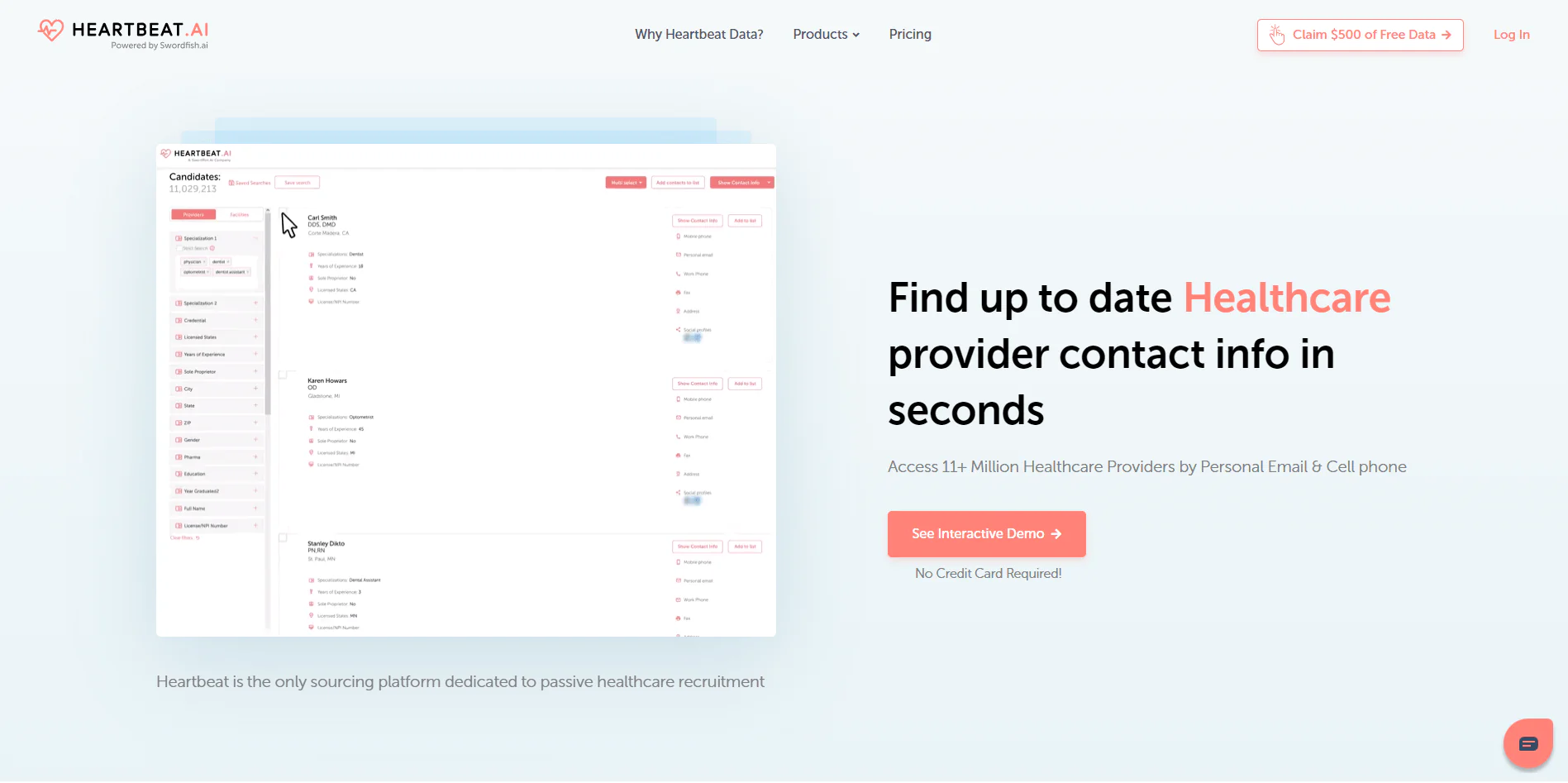
HeartBeat AI has created a specialized database for effective marketing and communication in the pediatric hematology of healthcare. Our primary focus is to provide the authentic contact information of licensed pediatric hematologists around the US.
Here’s what you’ll find in this database.
- Comprehensive Contact Details: HeartBeat ensures inclusive contact information for pediatric hematologists. Our directory contains email addresses, phone numbers, and mailing addresses.
- Segmentation Capabilities: You can categorize our pediatric hematologists email directory based on geographical location. Also, you can search for the experts by specialization, years of expertise, and affiliations with medical institutions.
- Precision and Trustworthiness: We regularly update the pediatric hematologist mailing list, guaranteeing precision and reliability. This minimizes the risk of bounced emails and elevates the effectiveness of communication.
- Extensive Network Coverage: Our email spans a broad network of pediatric hematologists. We provide details of professionals from different regions and medical institutions, ensuring vast outreach possibilities.
Types of Data Included in Pediatric Hematologists Email List
- Names of Pediatric Hematologists
- Location
- Contact Number (Work, Cell, Mobile)
- Email Address
- Specialization
- Years of Experience
- Affiliation Status
- Licensed States
- License Number
- Fax
- Address

Accuracy & coverage of personal contact info were unrivaled by other platforms… this gives any healthcare recruiter a competitive advantage when engaging hard-to-reach healthcare providers.
Senior Growth Strategist



Claim $500 of Free Data
Trusted by



By submitting this form, you are agreeing to Heartbeat’s
Benefits of Using a Valid Pediatric Hematologist Mailing List
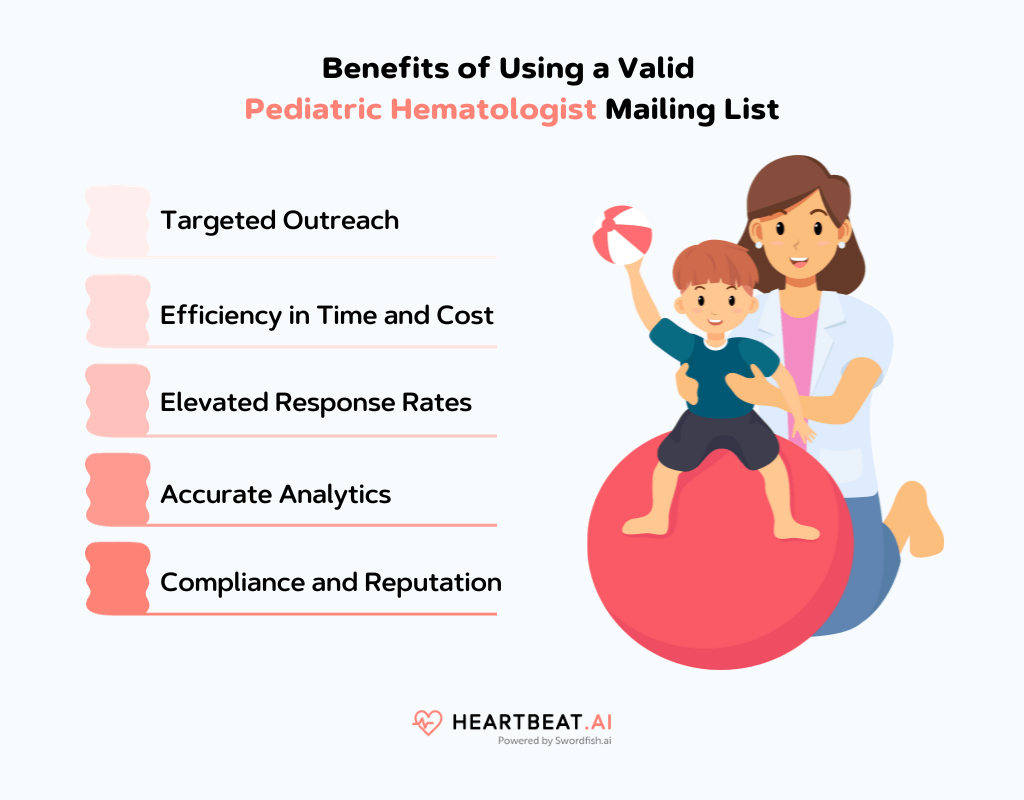
Choosing a verified list of pediatric hematologists with email addresses sets you up for success in many ways. Let’s take a look at the advantages in detail.
Targeted Outreach
Your messages reach the individuals most likely to be interested in your content. Each email is directed to a pediatric hematologist who may genuinely benefit from what you have to offer.
Efficiency in Time and Cost
By specifically targeting pediatric hematologists, you save both time and resources. No more shooting in the dark—your efforts are concentrated on engaging with professionals relevant to your business.
Elevated Response Rates
A targeted pediatric hematologists email list database increases the likelihood of higher response rates. Pediatric hematologists interested in your content are more inclined to engage by reading your emails, clicking on links, or responding directly.
Accurate Analytics
Using an authentic mailing list of pediatric hematologists enhances the accuracy of your analytics. You can track the performance of your campaigns within a specific demographic, leading to informed decision-making for future endeavors.
Compliance and Reputation
Employing a valid and up-to-date list ensures compliance with legal requirements, such as anti-spam laws. This safeguards your mailing list of pediatric hematologists and upholds your reputation by avoiding the distribution of unsolicited emails.
Who Are You Likely to See in Our Pediatric Hematologists Email Database by Category?
In our detailed pediatric hematologist email directory, you’ll see diverse categories of specialists, each contributing to unique fields.
| Pediatric Hematologist Categories |
| General Pediatric Hematologist |
| Pediatric Hematologist specializing in Hematology-Oncology |
| Pediatric Hematologist focusing on Blood Disorders |
| Pediatric Hematologist with expertise in Stem Cell Transplants |
|
Pediatric Hematologist specializing in Thrombosis and Hemostasis
|
| Pediatric Hematologist dealing with Bleeding Disorders |
| Pediatric Hematologist focusing on Pediatric Leukemia |
| Pediatric Hematologist specializing in Sickle Cell Disease |
Available Pediatric Hematologists in Our Email List by States
The HeartBeat AI directory includes pediatric hematologist specialists from every U.S. state. Let’s take a look at the list.
How Do We Compile Our Data to Create a Mailing List of Pediatric Hematologists?
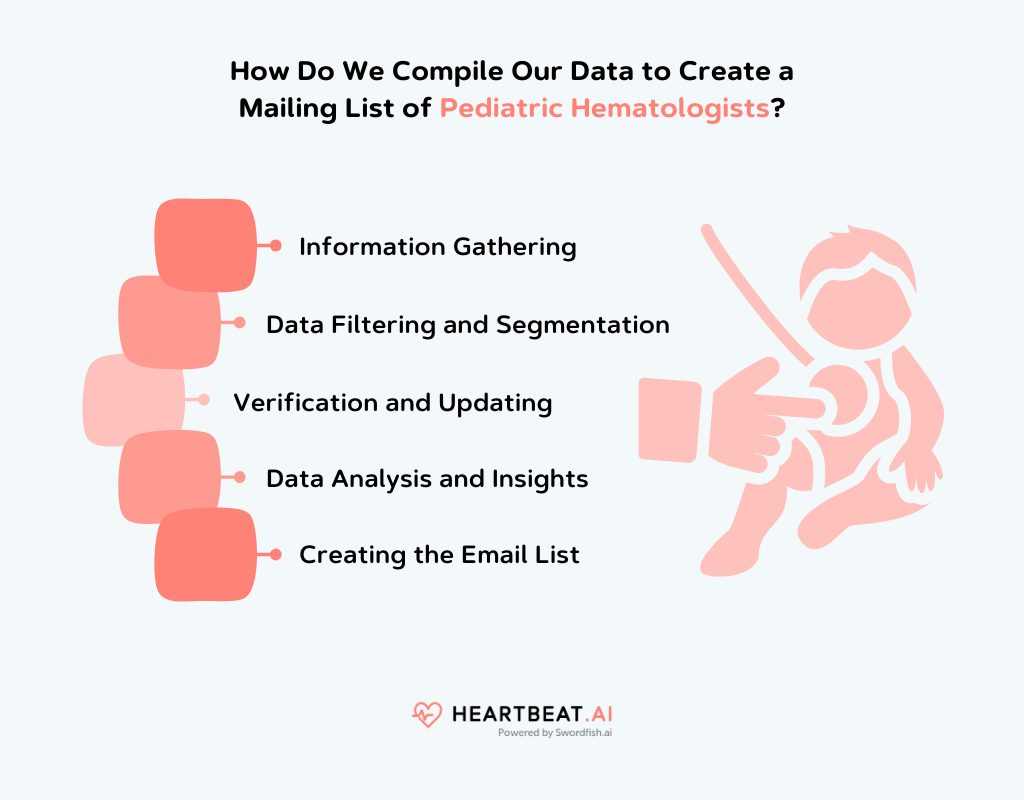
Here are the essential steps we follow at HeartBeat to compile data and create a mailing list of pediatric hematologists:
Information Gathering
At HeartBeat, our process begins by collecting data from 200 official data partners. This process also involves extracting information from different sources, including medical directories, hospital websites, and professional networking platforms.
We focus on gathering details specific to pediatric hematologists, such as their names, contact information, and practice places. This way, you can start a targeted communication without any trouble.
Data Filtering and Segmentation
After gathering a comprehensive dataset, we filter it to include only pediatric hematologists. This step ensures that our list suits your needs, excluding irrelevant medical professionals.
Verification and Updating
We prioritize the accuracy of information by conducting thorough verification. This crucial step involves using automated tools to check email validity and making phone calls for confirmation, ensuring the details are current and correct.
Data Analysis and Insights
With a verified list in hand, we analyze it to provide additional insights. This may involve understanding the geographical distribution of pediatric hematologists, their subspecialties, or affiliations with different medical institutions.
Creating the Email List
Finally, we compile all the gathered information into a user-friendly mailing list format, typically a digital spreadsheet. This format allows easy integration into your email systems for targeted outreach or informational campaigns.
Why Choose Heartbeat AI’s Pediatric Hematologists Mailing List?
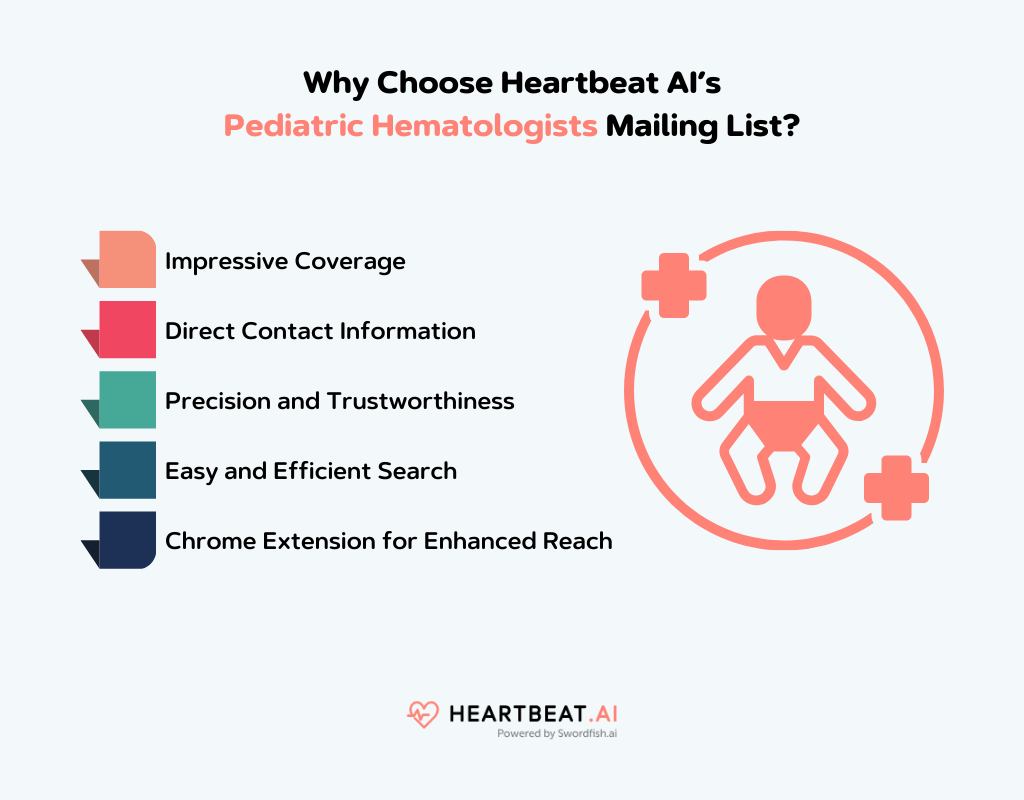
Here are compelling reasons to choose HeartBeat AI’s pediatric hematologist mailing list.
Impressive Coverage
Heartbeat’s Prospector provides access to a database comprising 11 million healthcare professionals in the United States. Our database includes pediatric hematologists from all over the USA. This way, you can expand your network beyond the borders pretty smoothly.
Direct Contact Information
HeartBeat AI understands your healthcare outreach obstacles. For this reason, we provide direct contact info, cell numbers, and emails of pediatric hematologists. Thanks to our comprehensive database, you can enjoy improved effectiveness in your communication efforts.
Precision and Trustworthiness
HeartBeat AI takes pride in data accuracy. Utilizing predictive modeling, we offer an impressive 84% accuracy rate for cell phone numbers and 92% for personal emails, ensuring reliability for your critical communications.
Easy and Efficient Search
Our platform is designed in a user-friendly manner. You can easily search by specialty and subspecialty, saving time and effort by finding the right contacts efficiently.
Chrome Extension for Enhanced Reach
HeartBeat AI offers a Chrome Extension, expanding your contact-finding capabilities on platforms like LinkedIn and Facebook. This tool facilitates quick access to contact information during your online browsing, making your outreach process more seamless.
What to Consider When Getting an Email List of Pediatric Hematologists?
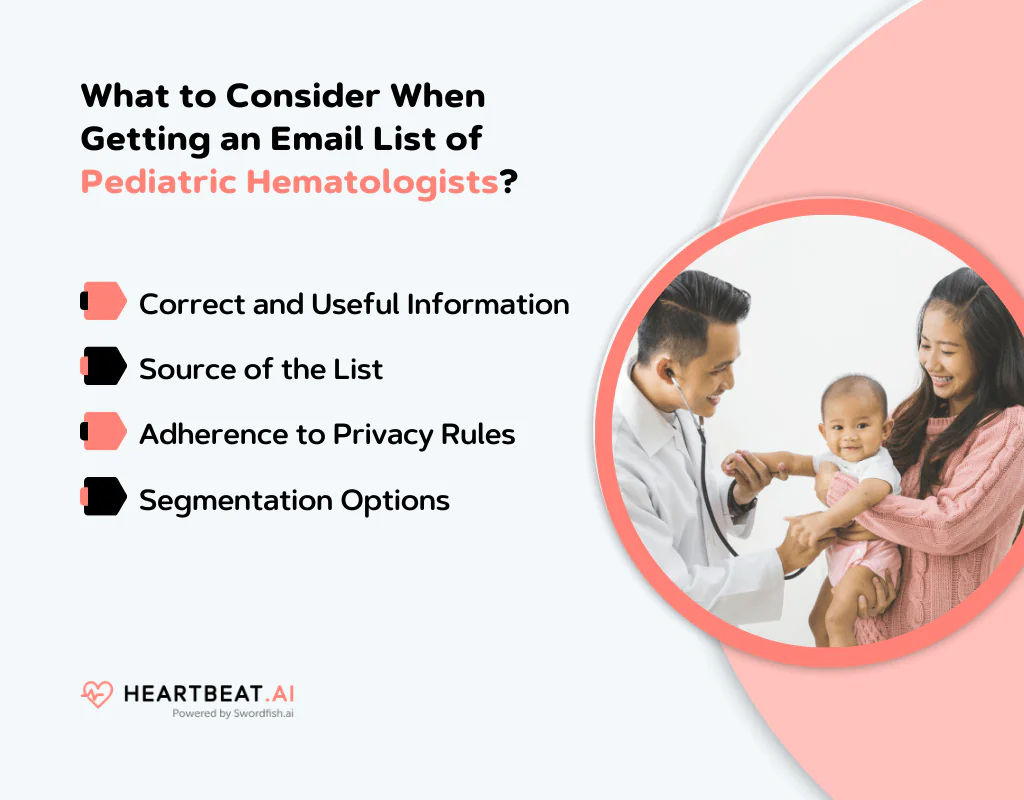
Here are the factors you need to consider while choosing a pediatric hematologists email database.
Correct and Useful Information
The most important thing is having accurate and relevant info. Make sure the pediatric hematologist’s email directory stays up-to-date with precise details. Old or irrelevant contacts can slow down your outreach.
Source of the List
Understanding the origin of the list is vital. Always check whether the email list is collected from verified sources or not. Or else, you won’t be able to reach the right pediatric hematologists in any manner.
Adherence to Privacy Rules
Always verify that the list complies with privacy laws such as GDPR or HIPAA, depending on your region. Or else, you may have to face legal issues while using the list for personal or business purposes.
Segmentation Options
Look for a list that allows segmentation for targeted outreach. An email list with sorting options allows you to plan your emails to specific groups within the pediatric hematologist community. You can divide the list based on geographic location or specialized areas for better outreach.
Now, Who Can Use the Pediatric Hematologists Database?
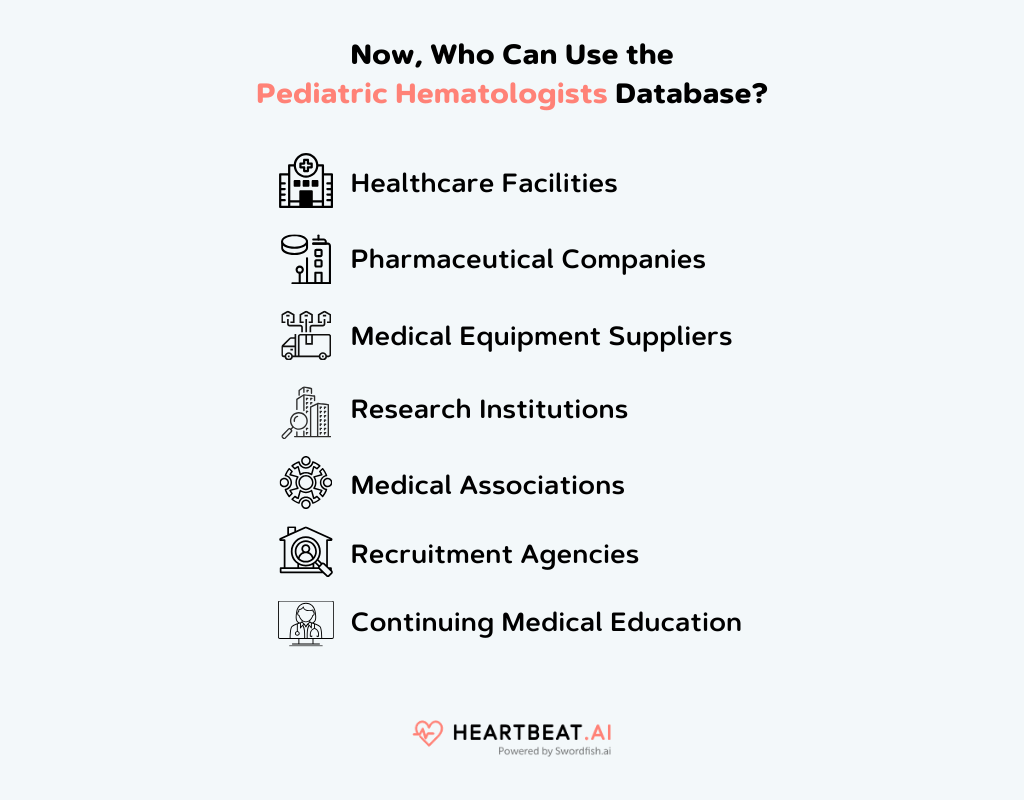
The pediatric hematologists database is a valuable asset primarily designed for healthcare professionals, medical organizations, and businesses within the healthcare industry.
Here’s a breakdown of those who can use such a database.
Healthcare Facilities
Hospitals, clinics, and healthcare centers can use this list to establish connections with pediatric hematologists. They can find experts from the list for recruitment collaboration or update them on new medical equipment and services.
Pharmaceutical Companies
Pharmaceutical companies can target pediatric hematologists to market their products. These and conducting clinical trials related to pediatric hematology.
Medical Equipment Suppliers
Businesses supplying medical equipment and devices used in pediatric hematology can utilize the email list to reach potential customers.
Research Institutions
Universities and research institutions can collaborate with pediatric hematologists on research projects or invite them to conferences and seminars using the email list.
Medical Associations
Medical associations and organizations focused on pediatric hematology can communicate with their members, organize events, and share important updates through the email list.
Recruitment Agencies
Companies specializing in healthcare recruitment can access the list to find qualified pediatric hematologists for job placements.
Continuing Medical Education (CME) Providers
Providers of CME courses and training programs can use the list to promote their educational offerings to pediatric hematologists seeking professional development.
How to Utilize the Directory of Pediatric Hematologists with Email Addresses Effectively
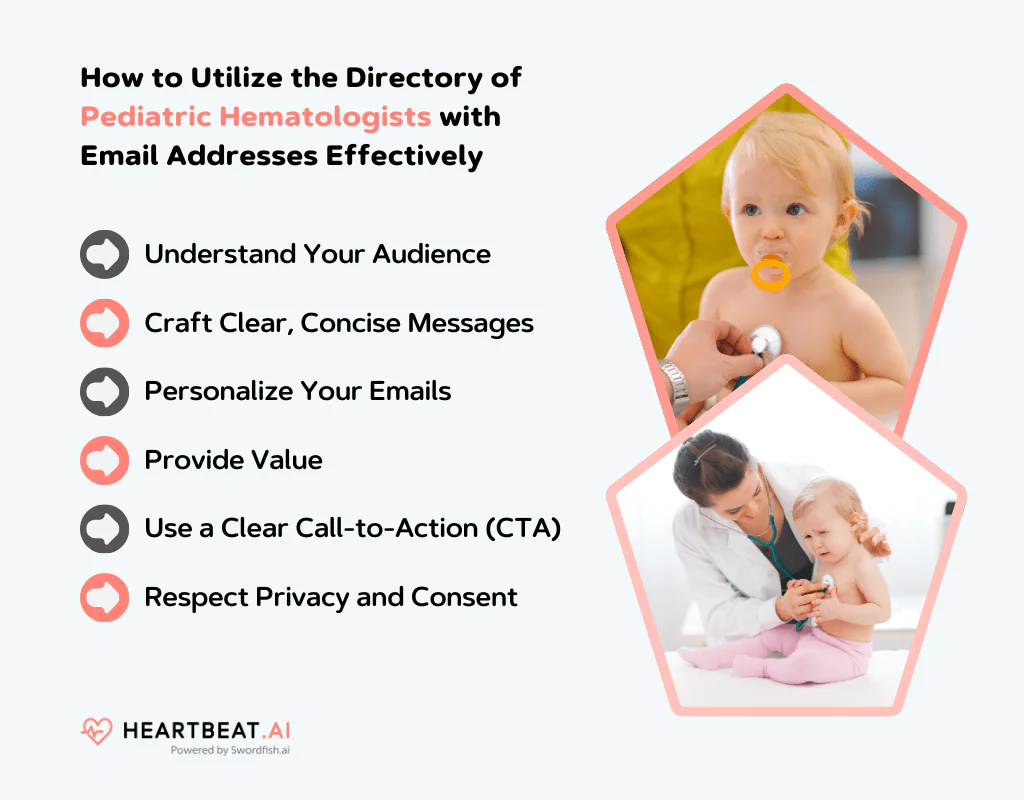
Utilizing a pediatric hematologist mail list effectively involves a few straightforward yet strategic steps. Here’s a simple guide to help you make the most of this valuable resource:
Understand Your Audience
Recognize that pediatric hematologists are busy professionals with specific interests and needs. Customizing your message to align with their professional life is crucial.
Craft Clear, Concise Messages
Ensure your emails are direct and to the point. Avoid lengthy introductions and describe how your product, service, or information can benefit them in pediatric hematology.
Personalize Your Emails
Whenever possible, personalize your emails. Use their name or reference something relevant to their specific practice or recent advancements in pediatric hematology. This demonstrates that your communication is tailored and not generic.
Provide Value
Each email you send should offer something valuable. This could be insights into new treatment approaches, innovative medical equipment, or details about relevant conferences and seminars. Only send emails with a clear value proposition.
Use a Clear Call-to-Action (CTA)
Clearly outline what you want pediatric hematologists to do after reading your email. Whether visiting your website, registering for an event, or trying a new product, make the CTA prominent and straightforward.
Respect Privacy and Consent
Ensure that your pediatric hematologist mailing list is obtained legally and ethically, respecting privacy laws. Provide an easy way for recipients to opt out of future emails.
Conclusion
To summarize, you can use the pediatric hematologists email list to connect with professionals effortlessly. This email database is an excellent resource for those who want to reach pediatric hematology experts for business collaborations or medical consultations.
And if you want to get your hands on an authentic email database of pediatric hematologists, HeartBeat AI is your solution. We provide easy access to accurate contact information for pediatric hematologists.
So, choose Heartbeat AI for seamless connections with pediatric hematologists today!
Frequently Asked Questions
Is the pediatric hematologist email list compliant with privacy laws like GDPR or HIPAA?
Ensuring legal compliance is essential. That’s why reputable providers like HeartBeat AI adhere to privacy laws like GDPR or HIPAA, safeguarding the pediatric hematologist mailing list to prevent any legal complications related to data privacy.
Can I use this email list for marketing purposes?
Yes, pediatric hematologist’s email database can be used for various purposes, including marketing campaigns, research initiatives, networking, and more. However, ensuring that your list use complies with relevant regulations and guidelines is essential.
How can this email list benefit pediatric hematologists themselves?
Pediatric hematologists can use the list for networking, staying updated on industry trends, accessing new research, and discovering professional development opportunities.