What’s on this page:
Key takeaways
- A cardiac care nurse contact list can help focus outreach on a specific nursing specialty, but it does not guarantee responses.
- Before buying a list, ask how records are sourced, verified, refreshed, and corrected.
- Check the list’s specialty and geographic coverage against your outreach needs.
- Confirm that your planned use of contact information complies with applicable privacy and marketing requirements.
- Personalize outreach, honor opt-out requests, and monitor results to guide future sends.
Last updated: August 28, 2026

Cardiac or cardiovascular care is one of the larger clinical specialties in nursing. A 2024 federal workforce report on registered nurses found that cardiac or cardiovascular care accounted for a meaningful share of the RN workforce, with roughly 177,000 nurses working in that specialty as of 2021. That is a large pool of professionals, but it is also a specialized one, and generic outreach lists rarely reach them with accurate, current contact details.
Building a reliable list of cardiac care nurses on your own takes time: verifying license status, confirming current employers, and finding working emails or direct phone numbers instead of generic hospital switchboard addresses. Heartbeat AI says it compiles contact data for healthcare outreach, recruiting, and research teams seeking cardiac care nurse contacts. Verify the provider’s data coverage, accuracy, and permitted uses before relying on it.
What’s Included in HeartBeat’s Cardiac Care Nurses Email Database

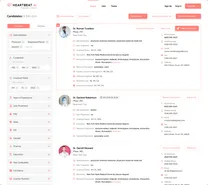
Heartbeat AI describes its platform as providing contact records for healthcare professionals, including cardiac and cardiovascular care nurses, with records checked on an ongoing basis. Ask the provider how it verifies records and how often it refreshes them.
When you search cardiac care nurse contacts on the platform, you can generally expect:
- Multiple contact points: Work and personal email addresses, plus phone numbers where available.
- Filterable criteria: Narrow results by location, years of experience, or facility type.
- Ongoing data refreshes: Records are updated on a regular cycle rather than pulled once and forgotten.
- Direct outreach tools: Contacts formatted for recruiting, marketing, or research use.
- Research-friendly exports: Useful for surveys, studies, or educational campaigns aimed at cardiac care staff.
- Better targeting: Campaigns reach people who actually work in the specialty instead of a broad nursing list.
Data Fields Typically Included
- Name
- Location
- Contact numbers (work, cell, mobile)
- Email address
- Specialization
- Years of experience
- Sole proprietor status
- Licensed states
- License number
- Fax
- Address
 Accuracy & coverage of personal contact info were unrivaled by other platforms… this gives any healthcare recruiter a competitive advantage when engaging hard-to-reach healthcare providers.
Senior Growth Strategist





Why an Accurate Cardiac Care Nurses Email List Matters

Direct access to specialists
A focused list can help you reach people identified as working in cardiac care instead of relying only on general nursing directories or hospital switchboard numbers. Verify individual records before outreach.
Time saved on sourcing
Manually finding and checking contacts for a specialized nursing audience can take time. A ready-to-use list may reduce sourcing work, leaving more time for outreach.
Sharper communication
Messages tailored to people who work in the specialty may be more relevant than broadcast emails sent to a general nursing list.
Networking reach
A focused list opens doors to build relationships across the cardiac care field, whether for recruiting, partnerships, or peer collaboration. It pairs well with a broader Comprehensive Nurses Email List if you need to expand beyond cardiology.
Education and awareness campaigns
Cardiac care nurses are a practical audience for sharing clinical updates, continuing education content, or product information relevant to their day-to-day work.
Direct feedback loops
These nurses can offer practical, front-line feedback on products or services aimed at cardiac care settings.
Better response rates
A specialty-focused audience may make outreach more relevant, but it does not guarantee higher open or reply rates. Results depend on factors such as list accuracy, message relevance, and recipient preferences.
You can also explore related specialty lists, including the Pain Management Nurses Email List and a Critical Care Nurses Email List, if your outreach spans multiple nursing specialties.
Cardiac Care Nurse Categories in the Directory
Cardiac care nursing covers several distinct roles, each with its own clinical focus. Knowing which subtype you need helps narrow a list before you start outreach.
| Cardiac Care Nurse Categories |
| Acute Care Cardiac Nurses |
| Cardiac Catheterization Lab Nurses (Cath Lab Nurses) |
| Electrophysiology Nurses |
| Cardiovascular Operating Room Nurses (CVOR Nurses) |
| Cardiac Clinical Research Nurses |
| Cardiac Care Nurse Practitioners |
| Cardiac Home Care Nurses |
Cardiac Care Nurses by State
Coverage extends across all 50 states. Use the table below to jump to a state-specific page if your outreach is geographically focused.
How the Data Is Compiled

Building a usable mailing database of cardiac care nurses takes several distinct steps:
Sourcing
The article describes possible sources such as medical databases, hospital directories, and nursing associations. Ask a provider to explain its actual sources and how it obtains and maintains contact information.
Collection
Before collecting or using names, emails, or other identifying details, confirm that the methods and intended use comply with applicable privacy and marketing requirements.
Verification
Contact details may be checked against available records and, in some cases, confirmed with a workplace. Ask the provider which verification methods it uses and how it handles inaccurate or outdated entries.
Ongoing maintenance
Healthcare staffing changes, so contact records can become outdated. Ask how often the provider refreshes its list and what it does with records that can no longer be confirmed.
Segmentation
Contacts are organized by location, experience level, and role so you can filter down to exactly the subset you need instead of buying an undifferentiated list.
Compliance checks
Ask the provider what privacy requirements apply to its data handling and what checks it performs before making records available. Do not assume a general compliance statement establishes that a particular use is lawful.
Quality review
A final quality check may help catch errors before outreach, but it does not guarantee every record is accurate. Ask what the check covers and how errors are handled.
Evaluating Heartbeat’s Cardiac Care Nurses Mailing List

Specialty coverage inside a larger database
Cardiac care nurses are one segment inside Heartbeat’s broader healthcare provider database, which the company states covers more than 11 million U.S. healthcare workers, including nurses across many specialties.
Contact quality
Heartbeat states that its records include verified cell phone numbers and personal email addresses. Ask how these details are sourced and verified, what ‘verified’ means, and whether your intended use is permitted. Contact information may still be inaccurate or outdated.
Time saved on sourcing
Searching for healthcare professionals one by one can take time. A searchable, filterable platform may reduce sourcing work for recruiting or outreach, depending on the coverage and quality of its records.
Plans scaled to different needs
Heartbeat’s pricing plans range from basic database access up through bulk file enrichment and team management features, depending on the scale of your outreach.
Integration options
Data can be exported in common formats or pulled directly into other systems. A Chrome Extension is also available for pulling contact data while browsing sites like LinkedIn.
What to Check Before Buying a Cardiac Care Nurse Email List

- Recency: Nurses change jobs and licenses lapse. An outdated list produces bounced emails and wasted outreach.
- Compliance: Confirm the provider’s data collection practices align with applicable privacy laws, including HIPAA where relevant.
- Specialty fit: A general nursing list won’t have the depth of cardiac-specific filters you need for targeted campaigns.
- Source transparency: Ask where the data comes from. Vague answers are a red flag.
- Cost versus response rate: A cheaper list with poor deliverability often costs more in wasted time than a pricier, well-maintained one.
- Update cadence: Ask how often the provider refreshes records, not just how the list was built initially.
Who Typically Uses a Cardiac Care Nurse Email List

Medical equipment suppliers
Medical equipment suppliers may use targeted outreach to contact cardiac care nurses about equipment relevant to their work. Confirm that the contacts and outreach method are appropriate for the intended use.
Healthcare facilities
Hospitals and clinics may use targeted outreach to recruit cardiac nurses or connect with peers to share practice standards.
Continuing education providers
Continuing education providers may use targeted outreach to inform relevant audiences about cardiac care training or certification programs.
Conference and event organizers
Conference and event organizers may use targeted outreach to invite cardiac care professionals to relevant workshops or seminars.
Medical researchers
Researchers studying heart health may use targeted outreach to invite practitioners to participate in studies or share findings. Research recruitment should follow applicable ethics and privacy requirements.
Healthcare technology companies
Healthcare technology companies may use targeted outreach to seek feedback from cardiac care professionals or share information about relevant tools.
Using a Cardiac Care Nurse Email List Without Wasting It

- Define your objective first. Recruiting, marketing, education, and research each call for a different message and tone.
- Personalize the message. Use names and reference specifics relevant to cardiac care rather than sending a generic template.
- Lead with something useful. Clinical updates, product information, or professional development opportunities perform better than a pure sales pitch.
- Respect opt-outs. Make unsubscribing easy and honor requests promptly; this isn’t optional under most email compliance rules.
- Track what happens after you send. Open and reply rates tell you what’s landing and what to drop.
- Keep it short. Nurses are busy; get to the point in the first two sentences.
- Prune your list regularly. Remove people who’ve gone unresponsive or whose details have changed, so future sends stay effective.
The Bottom Line
A cardiac care nurse list may reduce manual sourcing and help focus outreach compared with a broad nursing database. Quality varies by provider, so evaluate record recency, source transparency, and applicable compliance requirements rather than relying on headline database size.
If you are considering a maintained, filterable list of cardiac care nurse contacts, compare Heartbeat AI with other options based on your outreach needs, budget, data quality, and permitted uses.
Frequently Asked Questions
How often is a cardiac care nurses email list updated?
Update frequency varies by provider. Lists maintained by professional organizations, healthcare networks, or dedicated data platforms each run on their own refresh schedule, so it’s worth asking directly before buying.
Are there ethical considerations in using a cardiac care nurses mail list?
Yes. Ethical use means respecting recipient privacy, avoiding spam tactics, honoring opt-out requests, and keeping communication relevant and professional.
How can a cardiac care nurses email list improve healthcare outreach?
It narrows communication to people who actually work in the specialty, which tends to improve response rates and reduces wasted outreach compared to broad, unfiltered nursing contact lists.